Showing posts with label future. Show all posts
Showing posts with label future. Show all posts
Saturday, December 21, 2013
If all the ice melted
National Geographic's recent infographic If All the Ice Melted visualizes a 216-foot sea level rise. It's like catnip for our geology series.


Saturday, April 9, 2011
Muddy water taking back the land
 Continental drift (1, 2, 3, 4, 5) isn't the only way the shape of landforms will change. Coastlines vary a great deal with sea level, as well. Climate change predicts at least a certain amount of change in sea levels. The IPCC's Fourth Assessment Report, Climate Change 2007, Working Group II, predicts less than a meter of sea level rise over the next century or so.
The most extreme speculations about rising sea levels have to do with the melting of all the ice trapped in Greenland and Antarctica, which could cause sea levels to rise 60 or 70 meters. Of course, that's nothing more than informed speculation: people just don't know enough about the the Antarctic ice sheet to predict how it will behave in the future. The current arrangement of the continents means that ocean currents are very different from the ancient worlds that had well-mixed oceans and ice-free poles, and as long as Antarctica is located over the South Pole, keeping the ice from floating off, a great deal of ice may be parked there.
But, speculation is fun! According to the USGS, even a 10-m rise would displace 25% of the US population. Sea Level Explorer shows height above sea level using Google Maps. Flood Maps uses Google Maps to show sea level rise from 7 meters to over 60 meters. At 13 meters, Shanghai and Tianjin in China are completely flooded, and much of Bangladesh and Calcutta in India are flooded. Not to mention Miami and New Orleans. At 60 meters, huge population centers in Bangladesh, China, coastal Europe, and the southern U.S. are under water. Johnston's Archive has some neat pictures of a 66-meter rise in sea level.
The 100-meter maps are the most fun. Maps for "An End to Global Warming" has maps of North America with a 100-meter rise (also here), released by Dave Pape under a CC-Attribution license.
New England is an island, stretching from the Hudson Straits to New Brunswick.
 Below its cataracts, the Ohio River flows through the tidewater directly into the huge Mississippi Sea.
 In the Greater Antilles, Cuba is a much-reduced archipelago, while Jamaica and Hispaniola mostly retain their shapes.

With Dubia, Chris Wayan speculates on an Earth after a thousand years of unrestrained carbon pollution and global warming:
That world heats up. Climate zones move north until the poles thaw. Greenland and Antarctica melt. Coastal nations are drowned. In the end, the sea rises some 110 meters. Global hothouse! It's happened before, of course, on this scale, but not in the last 50 million years or so.His Planetocopia has all sorts of images of speculative versions of Earth and other planets. There's also some interesting discussion at the Randi forums....we shouldn't be surprised to find that Florida now has no governor—or voters. It's a scuba paradise rivaling Australia's Barrier Reef, but there's no dry land at all. Louisiana was doomed too, of course, but I was startled to find that the sea swallows half Alabama too—south of Tuscaloosa, only Red and Grove Islands and the small Troy Peninsula are left. Mississippi is even worse off—the Gulf chews inland to Tupelo and Mantee, leaving only the Jackson Peninsula and Brookhaven Island, and a jungly strip up at the Tennessee border. Mississippi Bay nibbles all the way up into Illinois, though it's broken up on the west side by long Crowley Island and the Spring and Pleasant Isles. Further south, in Texas, fishermen avoid the rotting, polluted Houston Reefs. But Austin survives—with a steamy coastal climate, flora, and culture resembling lost New Orleans.
Unfortunately, Dallas survives too.
...For, by definition, most readers will be from our world's high-population zones. Random changes will, on average, degrade them. And the lands that improve, that become the heartlands of Randomia's civilizations, are likely to be barren obscure lands in our world, mere names (if that) to non-Randomian readers. The great European cities are all flooded on Dubia (millions of European readers groan), while the green Sahara nurtures great civilizations (a handful of Saharan readers cheer). If you love civilization, Randomia will probably kill or cripple the ones you love, and plant its greatest civilizations in places you associate with backwardness.
So the grass always looks browner in a parallel world--because what you value most, what you KNOW to value, is generally lost. This principle makes it hard to see alternate worlds fairly.
Thursday, November 11, 2010
Even more continental drift
Somehow my earlier posts about speculative future continental drift neglected the great Oct. 20, 2007, article at NewScientist.com, "Pangea, the comeback".

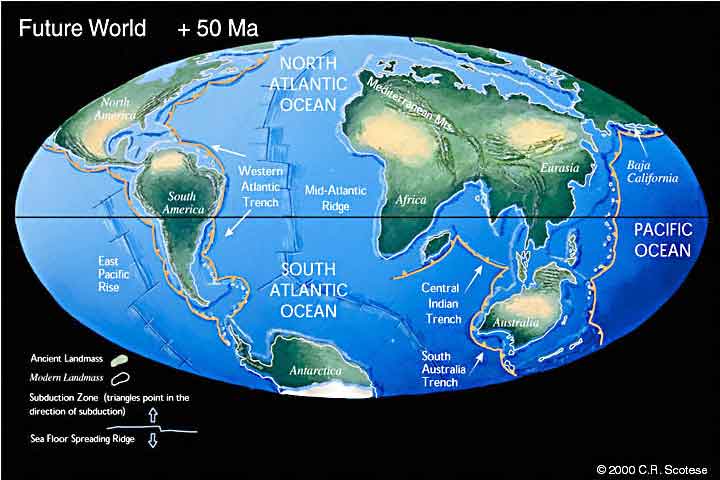
Most of these projections assume that, over 300 million years or so, Australia (and possibly Antarctica) will fly across the Pacific Ocean and collide with western North America. Then, the Americas will mash together and collide with the eastern edge of Afro-Eurasia. The exception is Christopher Scotese's Pangaea Proxima, which has the Atlantic Ocean stop widening and begin to shrink away.
These are all just speculation, of course, and apt fodder for fantasy. Grognard James Maliszewski, considering setting his old-school RPG in a hypothetical future Pangea, pointed out that the map of the Mystara campaign setting was based on the continents of the Jurassic. Commenter Malcadon points out the similarity between Robert E. Howard's Hyborian age and the Afro-Eurasia of 50 million years from now.
Dougal Dixon, an author of "The Future is Wild", has another similar work: After Man: A Zoology of the Future.
EDIT
Offensive redirected link removed for the Hyborian Age. Try Wikipedia here or here.
Tuesday, September 7, 2010
Letters to a future age
...on the Georgia Guidestones, an American Stonehenge: Monumental Instructions for the Post-Apocalypse (Wired).
It's kind of amazing how relatively easy it is to send Rosetta Stones forward into the future, although I wonder how this monument would hold up over 10,000 years. That is a truly mind-boggling distance of time, and yet but a pittance if our species is to continue to survive in geological time.
EDIT
The third directive is "unite humanity with a living new language".
Wednesday, February 3, 2010
3D POD
Sean K. Reynolds points us to Shapeways, which appears to offer 3D printing on demand. Very cool stuff. Ceramicwombat offers stainless steel dice; Bathsheba offers mathematical sculptures like hypercubes; and there is stuff like gyroscopes, astrolabes, orreries, and rings. The company also has a StampMaker and RingPoem maker. They also have a cool blog.
Tuesday, January 5, 2010
Solar eclipses in the Ohio River Valley
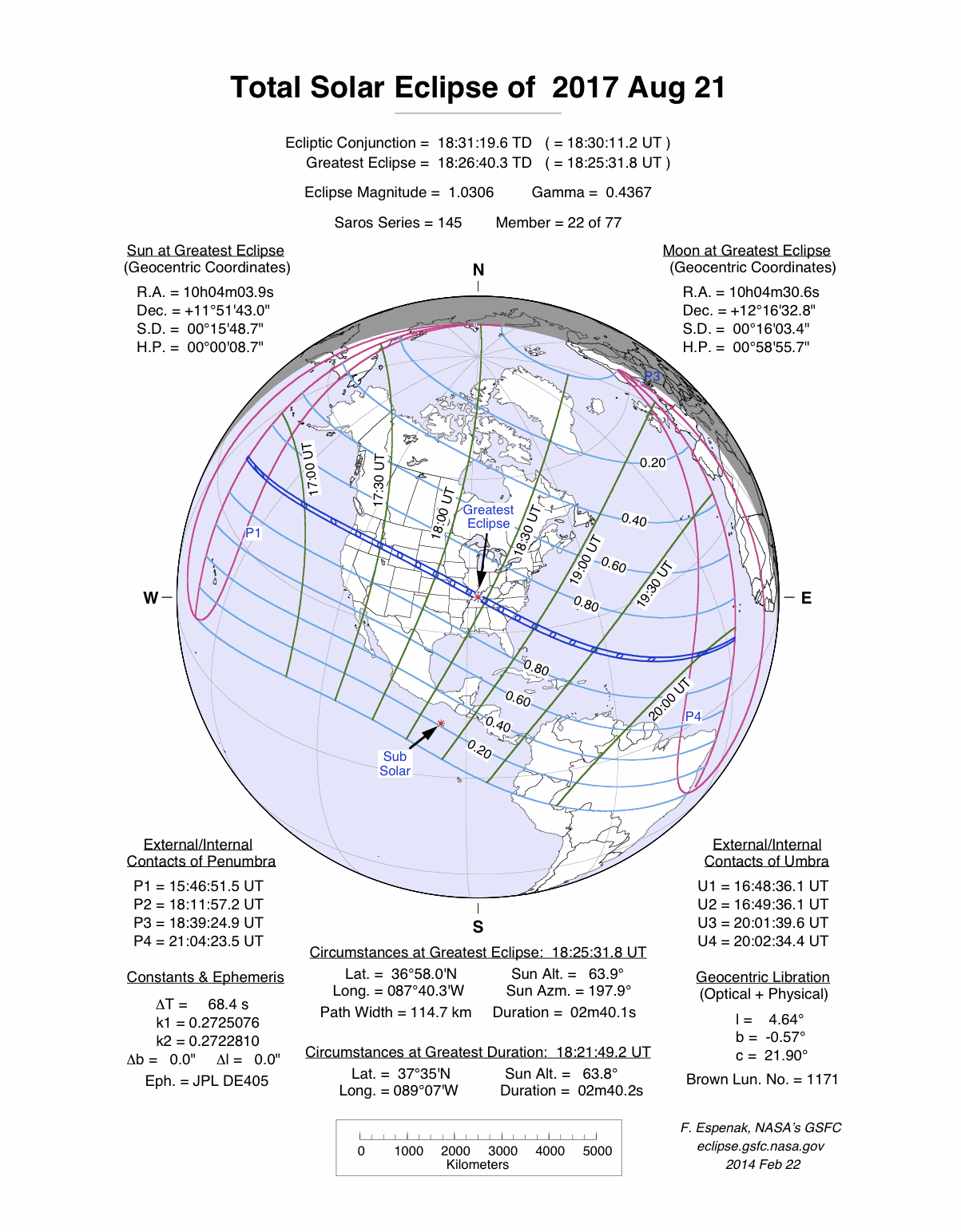
A mendicantbug post about searching WolframAlpha for eclipses alerts us to the upcoming major total solar eclipses in August 2017 (NASA) and April 2024. That'll be the last eclipse with a nearby totality until 2045.
The next lunar eclipse on the winter solstice this year and the 2012 partial solar eclipse may be visible just before sunset.
Perhaps WolframAlpha is more useful than I had thought.
The next lunar eclipse on the winter solstice this year and the 2012 partial solar eclipse may be visible just before sunset.
Perhaps WolframAlpha is more useful than I had thought.
Sunday, November 29, 2009
Communicating with folk 500 generations hence
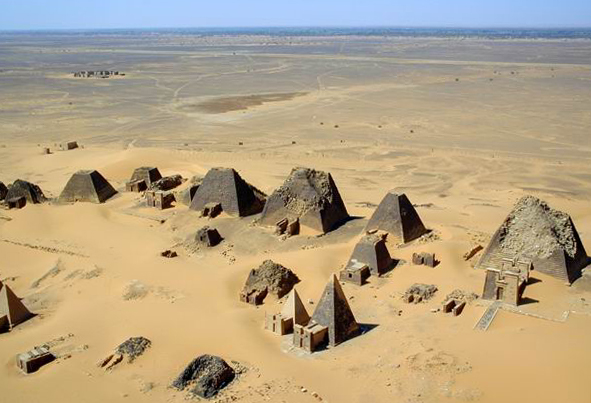 Via Matthew Yglesias, I found this Salon article about communicating with people 10,000 years in the future about the dangers of nuclear waste via Atomic Priesthoods, Thorn Landscapes, and Munchian Pictograms.
The main basis of the article is the government report Sandia Report SAND92-1382: Expert Judgement on Markers to Deter Inadvertent Human Intrusion into the Waste Isolation Pilot Plant, from November 1993, concerning the WIPP, near Carlsbad, New Mexico. It really is quite an interesting report.
I've been thinking about these issues mostly in terms of computer obsolescence and digital decay. In the very long run, it seems that the best way to preserve data for a long time or communicate with the people of the future would be through aluminum (or rather, minimally reactive durable) punch cards, or well-labelled ceramic or stone tiles that contain images, text, and clearly visualized pictographic instruction on binary or base-16 mathematics, to provide multiple points of reference for future archaeologists to decrypt the text. It's easier with the assumption that you're communicating with the kinds of people who deciphered Maya hieroglyphs, the Rosetta stone, and Sumerian cuneiform.
Charles Piller's 2006 LA Times story doesn't appear to have a durable URL, but it was carried in the Cincinnati Post and the Edmonton Journal. Here's from the Cincinnati Post, May 10, 2006:
As chief scientist of the Waste Isolation Pilot Plant, [Roger] Nelson oversees a cavernous salt mine that is the first geological lockbox for what he calls the "fiendishly toxic" detritus of nuclear weapons production: chemical sludge, lab gear and filters laced with tons of radioactive plutonium.
Nearly half a mile underground, workers push waste drums into crystalline labyrinths that seem as remote as the moon. A faint salty haze glows in powdery beams from miners' headlamps and settles on the lips like a desert kiss. Computer projections predict that within 1,000 years the ceilings and walls will collapse in a crushing embrace that seals the plutonium in place.
But plutonium remains deadly for 250 times that long -- an unsettling reminder that some of today's hazards will outlast the civilizations that created them. The so-called "forever problem," unique to the modern technological age, has made crafting the user manual for this toxic tomb the final daunting task in an already monumental project. The result is a gargantuan system that borrows elements equally from Stonehenge and "Star Trek."
Communicating danger might seem relatively straightforward, but countless human efforts to bridge the ages have failed as societies fall, languages die and words once poetic or portentous become the indecipherable marks of a long-forgotten scribbler.
... The U.S. Energy Department predicted such a problem when it began planning for the $9-billion waste dump, dubbed WIPP, in 1974 and for a similar repository in Nevada at Yucca Mountain, near Las Vegas. That site is not yet open. Eventually it will store highly radioactive spent fuel from nuclear power plants as well as high- level waste from the weapons program.
Trying to communicate across 500 generations posed an unprecedented challenge of linguistics, semiotics and materials science, so the government first asked scientists, futurists and historians to envision what the far-distant future might be like.
Their report combines dry analysis and projections worthy of sci- fi disaster films, including massive climate change and feminist corporations that disbelieve WIPP warnings because they were written by men. Civilization is so interdependent and fragile, one panelist grimly noted, "that any massive global catastrophe might lead to reversion to at least a pre-industrial era." Greed or desperation could give rise to legends that WIPP holds buried treasure -- apparently confirmed by surface warnings to keep out.
...If Egyptian pyramids have lasted more than 5,000 years, today's monuments should fare better. ...To grasp the scale of the warnings, start with the Great Pyramid in Egypt, built from more than 6.5 million tons of stone covering 13 acres. Multiply that mass by five, and you have the first warning layer of this contemporary construction: a 98-foot-wide, 33-foot- tall, 2-mile-long berm surrounding the site. That's just to get the attention of anyone who happens by.
Ten thousand years, of course, twice as long as it took for Proto-Indo-European to change and diversify into Latin and Sanskrit, and then to Hindi, Farsi, Italian, Russian, Icelandic, and contemporary English.
Such warnings could indeed become the Rosetta stones of the future, with warnings on carved stone slabs in the contemporary UN languages English, Spanish, Russian, French, Chinese, Arabic, local languages such as Navajo, and space for the languages of the future when contemporary languages become obsolete and unintelligible. The report also includes a number of proposed warnings.
The monuments themselves, proposed in the report, are indeed interesting. I was most intrigued by Forbidding Blocks (for all the wrong reasons, of course). Despite a massive effort to deny use, it seems like the most likely for future civilizations to take an interest in. Such a site seems less likely to be investigated by future scholars and archaeologists than bored adolescents, clever seekers of shelter, and get-rich-quick looters.


Subscribe to:
Posts (Atom)

 Posts