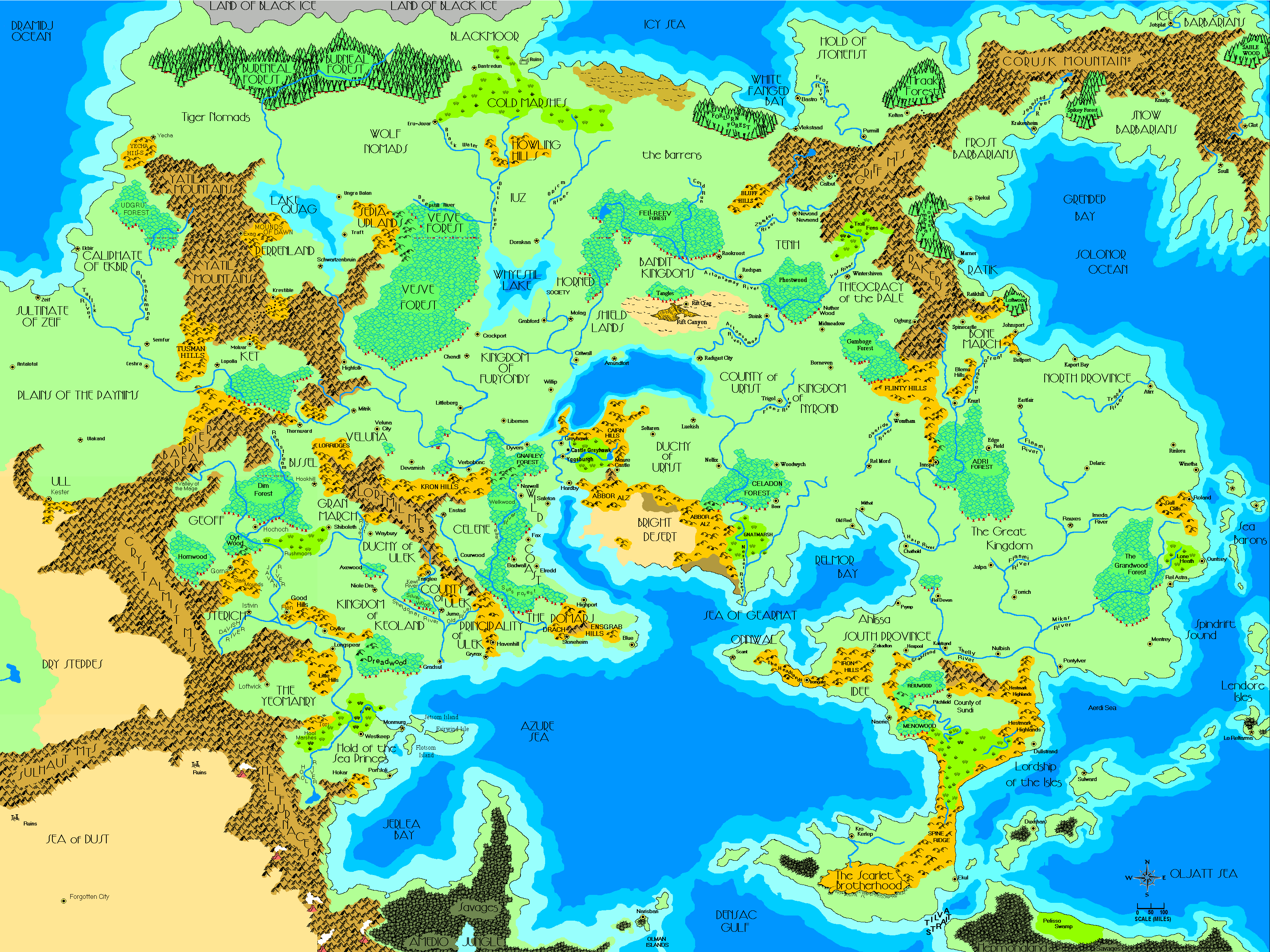
I earlier noted that many of the classic D&D modules were located in and around the Sheldomar Valley. The Temple of Elemental Evil, for one, is located just over the Lortmil Mountains near Verbobonc. Others could be relocated nearby with some slight modifications: for example, a large swamp in the western Seahold could contain modules S1 and S2, while the Lendore Isles (and UK1, L1, and L2) could be moved offshore of the Seahold. So I've been putting together this pocket guide to the Sheldomar Valley based of various wikis and the Living Greyhawk Gazetteer; there is plenty of official information about the Greyhawk campaign setting, but it can be easy to get lost in it all. Here's a map. I'm more interested in the situation circa 579 CY, when adventurers begin arriving at Hommlet.
The Flanaess is inhabited by three main types of humans: the pale, blond Suloise, the olive-skinned Oerdians, and the aboriginal bronze-skinned Flan, for whom the region is named. Their ancient languages (Ancient Suloise, Old Oerdian, and Flan, respectively) are the ancestors of most contemporary human tongues. Across the mountains to the west live the Baklunish, and the Olman inhabit the jungle islands of the Densac Gulf, but relatively few of these peoples dwell in the Sheldomar Valley.
The Common Tongue is descended from a dialect of Old Oerdian developed by Baklunish scribes, with some Suloise influence, that developed into a language of trade and administration. Modern spoken descendents of Old Oerdian include Keoish and Velondi. Keoish is the dominant human language of the Sheldomar Valley, while Velondi is spoken by the peasants of Furyondy and Veluna. Suloise is essentially dead, but of interest to sages and scholars. It has a few modern descendants: Amedi is spoken by the barbarians of the Amedio Jungles, Lendorian is spoken in the Lendore Isles, and languages of the tundra barbarians of the north are descended from Suloise.
The Kingdom of Keoland is one of the oldest states in the Flanaess. It is a feudal monarchy, governed largely by Suel aristocracy; the king is chosen by the Noble Council of Nicole Dra, the capital. Although founded centuries ago, it reached its peak during "imperial" expansion in the 350s; several of its daughter states govern northern parts of the Sheldomar Valley. Most people are of mixed Suel and Oerdian descent and speak Keoish and Common, and few Flan remain.
Gran March is a heavily militarized state north of Keoland; the elected Commandant governs from Hookhill. Although Gran March owes fealty to Keoland, it is self-governing and dominated by the Knights of the Watch; all adult males are required to provide military service. Most people speak Keoish and Common.
The Grand Duchy of Geoff is a feudal monarchy owing fealty to Keoland; the Grand Duke governs from Gorna. It is further divided into six cantrevs, each ruled by a Llwyr (a baron). Flan culture and people are more prominent in Geoff than the rest of the Sheldomar Valley; most people speak Flan and Common, as well as Keoish to a lesser extent.
Sterich is a feudal monarchy that is formally a vassal to Keoland, but self-governing in practice; the earl governs from Istivin. Sterich was established by settlers from Geoff, and has long been a mining colony where peasants do well since labor is in short supply.
The Seahold, formerly a province of Keoland, is a sovereign state ruled by Prince Jeon II, who has taken up a campaigns against slavery and slave-raiding from the Amedio Jungle and Olman Islands. Most people speak Keoish and Common, a few speak Amedi, Olman, or other languages. (There are dark whispers that the Scarlet Brotherhood has some future designs upon the Hold of the Sea Princes ca. 589).
The Yeomanry League is a democratic republic to the southwest of Keoland; the Spokesman governs from Loftwick. It was allied with Keoland until the 360s, when it objected to Keoland's conquests. Most people in the Yeomanry are freeholders of mixed Suel and Flan descent who speak mostly Keoish and Common.
Bissel is a border state at the northern end of the region, at the crossroads of the Sheldomar Valley, the Baklunish states, and the rest of the Flanaess. Bissel was conquered by Keoland in the 350s, governed as the Littlemark, then later conquered by the kingdom of Furyondy. Furyondy's influence gradually waned, until the Margrave established Bissel's independence in a battle in 477 CY. Most people are of mixed Baklunish, Suel, and Oerdian descent, and speak Common or Baklunish dialects.
The Ulek States are a trio of three sovereign kingdoms east of Keoland. The northernmost is an elven kingdom, the southernmost is a dwarven kingdom, and a druidic human kingdom lies between.
The Valley of the Mage is an isolated and xenophobic elven kingdom hidden in the Barrier Peaks. It is ruled by a powerful arcane spellcaster known as the Black One. The valley elves are scorned by all other elves (possibly due to an ancient bargain for extraplanar lore) and reject the elven pantheon, preferring Ehlonna and the druidic Old Faith. A plurality of the Valley's residents are various humans under the rule of a human earl, a vassal of the elven king, and many gnomes live there as well, but the valley is thinly populated and has very little traffic with the outside world, even preferring raiding to trade.
The most popular and widespread gods in the Sheldomar Valley include such important deities like Heironeous, Fharlanghn, Ehlonna, and St. Cuthbert, as well as Phaulkon, Zilchus, and Norebo. Sea gods like Osprem and Procan are popular along the coast, while Flan gods like Pelor, Allitur, and Obad-Hai are popular in the western half of the region. Istus and Rao are worshipped in Bissel, while Kelanen has a headquarters in Istivin and adherents in the Seahold.
Showing posts with label mythology. Show all posts
Showing posts with label mythology. Show all posts
Saturday, June 9, 2012

Tuesday, April 26, 2011
Book Snippets: "The Sumerians"—Enki, Nin-ti, and Eve
Samuel Noah Kramer, in "The Sumerians: Their History, Culture and Character" (U of Chicago P, 1964), makes occasional connections between Sumerian and Biblical mythology, citing for example a connection between Dumuzi and the Tammuz mentioned in Ezekiel 8:14-15. Another is an interesting similarity between the Sumerian and Biblical creation myth:
One of the more detailed and revealing of the Sumerian myths concerns the organization of the universe by Enki, the Sumerian water-god and god of wisdom... Another Enki myth tells an intricate and as yet somewhat obscure tale involving the paradise-land Dilmun, perhaps to be identified with ancient India. Very briefly sketched, the plot of this Sumerian "paradise" myth, which treats of gods, not humans, runs as follows:
Dilmun is a land that is "pure," clean," and bright," a "land of the living" which knows neither sickness nor death. What is lacking, however, is the fresh water so essential to animal and plant life. The great Sumerian water-god, Enki, therefore orders Utu, the sun-god, to fill it with fresh water brought up from the earth. Dilmun is thus turned into a divine garden, green with fruit-laden fields and meadows.
In this paradise of the gods eight plants are made to sprout by Ninhursag, the great mother-goddess of the Sumerians, perhaps originally Mother Earth. She succeeds in bringing these plants into being only after an intricate process involving three generations of goddesses, all conceived by the water-god and born—so our poem repeatedly underlines—without the slightest pain or travail. But probably because Enki wanted to taste them, his messenger, the two-faced god Isimud, plucks these precious plants one by one and gives them to his master, who proceeds to eat them each in turn. Whereupon the angered Ninhursag pronounces the curse of death upon him. Then, evidently to make sure she will not change her mind and relent, she disappears from among the gods.
Enki's health begins to fail; eight of his organs become sick. As Enki sinks fast, the great gods sit in the dust. Enlil, the air-god, the king of the Sumerian gods, seems unable to cope with the situation when a fox speaks up. If properly rewarded, the fox will bring Ninhursag back. As good as his word, the fox succeeds in some way—the relevant passage is unfortunately destroyed—in having the mother-goddess return to the gods and heal the dying water-god. She seats him by her vulva, and after inquiring which eight organs of his body ache, she brings into existence eight corresponding healing deities, and Enki is brought back to life and health.
Although our myth deals with a divine, rather than a human, paradise, it has numerous parallels with the Biblical paradise story. In fact, there is some reason to believe that the very idea of a paradise, a garden of the gods, originated with the Sumerians. ...perhaps the most interesting result of our comparative analysis of the Sumerian poem is the explanation which it provides for one of the most puzzling motifs in the Biblical paradise story, the famous passage describing the fashioning of Eve, "the mother of all living," from the rib of Adam—for why a rib? Why did the Hebrew storyteller find it more fitting to choose a rib rather than any other organ of the body for the fashioning of the woman whose name, Eve, according to the Biblical notion, means approximately "she who makes live." The reason becomes quite clear if we assume a Sumerian literary background, such as that represented by our Dilmun poem, to underly the Biblical paradise tale; for in our Sumerian poem, one of Enki's sick organs is the rib. Now the Sumerian word for rib is ti (pronounced tee); the goddess created for the healing of Enki's rib was therefore called in Sumerian Nin-ti, "the Lady of the rib." But the Sumerian word ti also means "to make live." The name Nin-ti may thus mean "the Lady who makes live" as well as "the Lady of the rib." In Sumerian literature, therefore, "the Lady of the rib" came to be identified with "the Lady who makes live" through what may be termed a play on words. It was this, one of the most ancient of literary puns, which was carried over and perpetuated in the Biblical paradise story, although there, of course, the pun loses its validity, since the Hebrew words for "rib" and "who makes live" have nothing in common. (147-149)
Subscribe to:
Posts (Atom)

 Posts
Posts