Some well-developed campaign worlds have a calendar. Tolkien also developed alternate calendars for Earth. These are intended to be more evocative than practical, I suspect.
The problem with timekeeping and calendar reform for Earth is that nothing matches up perfectly or in an evenly divisble way. A year is slightly less than 365.25 days, a sidereal day is about four minutes shorter than a solar day, there are 86,400 seconds in a day only on average, and we can't have a simple perpetual calendar because the Abrahamic religions have religious objections to intercalary days.
For more abstract timekeeping purposes in a game, a 364-day Generic Game Year is very similar to an Earth year, and more easily divided. The Generic Game Year has a perpetual calendar in both lunar and solar months.
The Lunar Generic Game Year is divided into 13 lunar months, each with 28 days. Each month is further subdivided into four weeks, each with seven days: Moonday, Fireday, Waterday, Treeday, Goldday, Earthday, and Sunday (as in the Japanese calendar). Moonday is the first night of the full moon, which occurs on the first Moonday, Fireday, and Waterday of the month (consequently, it's easy to tell when the lycanthropes will attack). The lunar date is given by the number of the moon. For example: "the third day of the eight moon of last year". The year begins on a Moonday, the first night of the full moon following the winter solstice.
The Solar Generic Game Year is divided into four seasons (Winter, Spring, Summer, and Fall), each of which is divided into three months: Forewinter, Highwinter, Wintersaft, Forespring, Highspring, Springsaft, Foresummer, Highsummer, Summersaft, Forefall, Highfall, and Fallsaft. Each month has 30 days, except the last month in a season, which has 31 days. This extra day is of special solar significance: Wintersaft 31 is the vernal equinox; Springaft 31 is the summer solstice; Summersaft 31 is the autumnal equinox; and Fallsaft 31 (a Sunday) is the winter solstice and the end of the year. Alternatively, you could view the solar calendar as having twelve 30-day months and four intercalary days, one between each season.
This system, of course, is agnostic about the epoch for counting years, leap days, and eclipses and other astronomical events. It doesn't account for a more unusual planetary system with a double sun, extra moons, &c, but rather represents a regular Earthlike system in a simplified, abstract way.
EDIT
Note also Paizo's Time on Golarion. Who wouldn't like a 360-day calendar, at least if you could pronounce the names of the months? ;)
Saturday, July 4, 2009

Timekeeping in d20
The d20 game has for a long time had a unique system of timekeeping, based on the need to count relatively short but human-scale units of time. This system meshes interestingly with the traditional Chinese system of twelve two-hour watches.
The smallest unit of time is a second. There are 6 seconds in a round, 10 rounds in a minute, 10 minutes in a turn, 12 turns in a watch, and 12 watches in a day. The terminology may vary according to the edition of the game.
In southern temperate latitudes (say, between Boston and Miami), sunrise and sunset varies over the course of the year, by about an hour and a half in the south and about three hours farther north. In Atlanta, Georgia, it's very close to two hours. For gameplay purposes, it'd be a simple abstraction to rule that the sun rises in the fourth watch and sets on the tenth watch. This would be very nearly true in Atlanta if the first watch started at 11:30pm rather than midnight. The timezones make some things simpler, but not necessarily the accurate assessment of true solar noon and solar midnight.
A pendulum with a period of two rounds (which would count one round per swing) would be about 36 meters long; a pendulum with a period of one round (which would count a half-round every swing) would be about 9 meters long.
The smallest unit of time is a second. There are 6 seconds in a round, 10 rounds in a minute, 10 minutes in a turn, 12 turns in a watch, and 12 watches in a day. The terminology may vary according to the edition of the game.
In southern temperate latitudes (say, between Boston and Miami), sunrise and sunset varies over the course of the year, by about an hour and a half in the south and about three hours farther north. In Atlanta, Georgia, it's very close to two hours. For gameplay purposes, it'd be a simple abstraction to rule that the sun rises in the fourth watch and sets on the tenth watch. This would be very nearly true in Atlanta if the first watch started at 11:30pm rather than midnight. The timezones make some things simpler, but not necessarily the accurate assessment of true solar noon and solar midnight.
A pendulum with a period of two rounds (which would count one round per swing) would be about 36 meters long; a pendulum with a period of one round (which would count a half-round every swing) would be about 9 meters long.
Tuesday, June 23, 2009
The Cubit
The Egyptian ordinary cubit was divided into 24 fingers, and the Egyptian foot was 16 fingers, or 2/3 of a cubit. The cubit was the length from the tip of the finger to the elbow; thus it was essentially half a yard. Many ancient terms for this unit mean "elbow".
Surviving Egyptian rulers use the royal cubit which was an ordinary cubit plus four fingers, and this royal cubit was the basis of ancient Egyptian architecture and other measurements. A natural cubit is 6/7 of the royal cubit. The Greeks and Romans took up the natural cubit, while other ancient and Mesopotamian cultures continued the use of the royal cubit for sacred architecture.
Given the imprecision of ancient meauring tools, it's possible to only imprecisely compare ancient Egyptian measures to contemporary ones. The surviving royal cubit rulers are 526 mm, plus or minus 3 mm, so an ordinary cubit would be 450.8 mm. The customary American foot is 457 mm. If metric inch (25 mm) was used instead of the international inch (25.4 mm), the ancient Egyptian ordinary cubit would be exactly 18 metric inches.
This is a coincidence. The ancient Egyptian system of measurement was the basis of the Greek system of measurement, which was the basis of the Roman system of measurement, which was the basis for contemporary customary measurement. But the system shifted over time. The Romans emphasized the inch ("uncia") as a unit of measure, and the Roman inch and the Roman cubit were a few miliimeters shorter than the contemporary American standard. The word "cubit" itself comes from the Roman word for the unit, "cubitus."
Effectively, a cubit is a measure of 18 inches, a foot and a half, or half a yard, which in ancient times was closer to 450 mm.
Surviving Egyptian rulers use the royal cubit which was an ordinary cubit plus four fingers, and this royal cubit was the basis of ancient Egyptian architecture and other measurements. A natural cubit is 6/7 of the royal cubit. The Greeks and Romans took up the natural cubit, while other ancient and Mesopotamian cultures continued the use of the royal cubit for sacred architecture.
Given the imprecision of ancient meauring tools, it's possible to only imprecisely compare ancient Egyptian measures to contemporary ones. The surviving royal cubit rulers are 526 mm, plus or minus 3 mm, so an ordinary cubit would be 450.8 mm. The customary American foot is 457 mm. If metric inch (25 mm) was used instead of the international inch (25.4 mm), the ancient Egyptian ordinary cubit would be exactly 18 metric inches.
This is a coincidence. The ancient Egyptian system of measurement was the basis of the Greek system of measurement, which was the basis of the Roman system of measurement, which was the basis for contemporary customary measurement. But the system shifted over time. The Romans emphasized the inch ("uncia") as a unit of measure, and the Roman inch and the Roman cubit were a few miliimeters shorter than the contemporary American standard. The word "cubit" itself comes from the Roman word for the unit, "cubitus."
Effectively, a cubit is a measure of 18 inches, a foot and a half, or half a yard, which in ancient times was closer to 450 mm.
Sunday, June 21, 2009
The Mesoamerican Calendar & Vigesimal
Many people know that the Maya calendar "predicted" a "catastrophe" in 2012. But the Maya calendar was strange and interesting. Rather than solar years, the Maya Long Count calendar counted the number of days from the beginning of their mythological epoch thousands of years earlier.
Counting the number of days in 4,000 years is somewhat unwieldy in our numeral system—it nearly a million and a half days. Rather than our decimal (base-10) system, the Mayans used a vigesimal (base-20) system of numbers. In vigesimal, each position in the numeral is worth more: rather than 1s, 10s, 100s, and 1000s, each position denotes 1s, 20s, 400s, and 8000s. Rather than count a million and a half days in the seven digits it would take in decimal numbers, they counted it in just five digits. The Long Count calendar was not a pure vigesimal count; the Mayans modified it so the first two digits would count a period of 360 days rather than 400 days, which was close enough to a solar year to be convenient for their purposes.
Imagine we used a system of counting days, and we only used five digits to do so. The day 13,765 would be the 250th day of the 37th Julian year. The day 99,999 would be the 285th day of the 273rd year. On the next day, the count would reset to zero, because we aren't using a sixth digit for the hundred thousandth day. In a decimal count, this would happen about every 273 years. In the Maya's modified vigesimal count, it would have happened every 2,880,039 days, or roughly every 7,885 years.
If, using our decimal system, we began counting the number of days since April 27, 1821, then December 20, 2012, would be the 69,999th day. The next day (December 21) would be the 70,000th day. Something analogous happens on that day in the Mayan calendar. Obviously, it's a great chance for someone to get rich selling stuff to New Agers.
A couple of months ago, I was working on a fictional puzzle that would use a vigesimal day-count calendar, which is an unfamiliar and confusing concept for most people, and was monkeying around with base-20 math and how to represent it graphically. One of the problems with thinking about numbers in other bases is that they're very difficult to conceptualize for a number of reasons. One is that we don't have many words to describe these numbers. Another is that we don't have adequate glyphs to represent them: there are only ten Arabic numerals.
Most of us have been trained for years in base-10 math, and find it very intuitive, easy to talk about, and easy to think in. The English language has remnants of alternative systems: base-12 or dozenal (dozens, grosses, and great grosses), and base-20 or vigesimal ("Four score and seven years ago..."). These systems are pretty common in the world's cutures, because they are easier to divide. While ten is evenly divisible only by two and five, twenty is divisible by 2, 4, 5, and 10, and twelve is divisible by 2, 3, 4, and 6. The base-60 or sexagesimal system of the Sumerians and Babylonians consisted of six base-10 units, and survives in measurements of time and geometry.
Computer scientists have been using octal and hexadecimal, base-8 and base-16, for decades because they are convenient ways to handle binary, base-2, numbers. But computer scientists don't have numerals to represent them, instead borrowing the letters of the alphabet to stand in for the missing digits. It can be a somewhat confusing system.
In 1968, Bruce A. Martin proposed a new series of numerals that drew out the 15 numerals according to their bit position. I tried some similar ideas, drawing out the numbers in a way somewhat similar to the Maya numerals. There is a design problem with this, though: the numerals are difficult to distinguish and sometimes rely on counting out every digit. In Martin's system, for example, the glyph for three is hard to quickly and clearly distinguish from the glyph for five. Good font design, or using an angle bracket instead of a straight line for the back, could help, but it's an inherent problem.
 Working with invented alphabets and scripts, it's clear that a quick and easy way to generate glyphs for sounds is to flip or rotate existing characters. In the Latin alphabet, M, W, q, p, b, and d, are all flipped or rotated. So, I tried something similar for the Arabic numerals, and borrowed the character for 10 from kanji. It's certainly not a perfect system: 1 and 8 rotated look like other symbols, and need to be somewhat modified. Ten looks very like a plus symbol, and they would need to be clearly distinguished in a font. OTOH, for those of us accustomed to the decimal system, it's easy to remember which glyph represents seventeen.
Another reason that it's easy to think in decimals and hard in other bases is that the decimal positions all have names. Ten tens is a hundred, ten hundreds is a thousand, a thousand thousands is a million, a thousand million is a billion, a million million is a trillion. English has some words in dozenal: a dozen dozen is a gross, a dozen gross is a great gross. But what is a score score? I borrowed and twisted around some old Scottish and English words to have some vocabulary to play with.
A score scores is a dubbock; a score dubbocks is a skelling, and a score skellings is a skell. In decimal, a score is 20, a dubbock is 400, a skelling is 8,000, and a skell is 160,000. Thus, two skelling, twelve dubbock, nine score and sixteen is equivalent to (in decimal) twenty thousand, nine hundred, and ninety-six. Somewhere after a skell is a villion, the vigesimal million.
Counting the number of days in 4,000 years is somewhat unwieldy in our numeral system—it nearly a million and a half days. Rather than our decimal (base-10) system, the Mayans used a vigesimal (base-20) system of numbers. In vigesimal, each position in the numeral is worth more: rather than 1s, 10s, 100s, and 1000s, each position denotes 1s, 20s, 400s, and 8000s. Rather than count a million and a half days in the seven digits it would take in decimal numbers, they counted it in just five digits. The Long Count calendar was not a pure vigesimal count; the Mayans modified it so the first two digits would count a period of 360 days rather than 400 days, which was close enough to a solar year to be convenient for their purposes.
Imagine we used a system of counting days, and we only used five digits to do so. The day 13,765 would be the 250th day of the 37th Julian year. The day 99,999 would be the 285th day of the 273rd year. On the next day, the count would reset to zero, because we aren't using a sixth digit for the hundred thousandth day. In a decimal count, this would happen about every 273 years. In the Maya's modified vigesimal count, it would have happened every 2,880,039 days, or roughly every 7,885 years.
If, using our decimal system, we began counting the number of days since April 27, 1821, then December 20, 2012, would be the 69,999th day. The next day (December 21) would be the 70,000th day. Something analogous happens on that day in the Mayan calendar. Obviously, it's a great chance for someone to get rich selling stuff to New Agers.
A couple of months ago, I was working on a fictional puzzle that would use a vigesimal day-count calendar, which is an unfamiliar and confusing concept for most people, and was monkeying around with base-20 math and how to represent it graphically. One of the problems with thinking about numbers in other bases is that they're very difficult to conceptualize for a number of reasons. One is that we don't have many words to describe these numbers. Another is that we don't have adequate glyphs to represent them: there are only ten Arabic numerals.
Most of us have been trained for years in base-10 math, and find it very intuitive, easy to talk about, and easy to think in. The English language has remnants of alternative systems: base-12 or dozenal (dozens, grosses, and great grosses), and base-20 or vigesimal ("Four score and seven years ago..."). These systems are pretty common in the world's cutures, because they are easier to divide. While ten is evenly divisible only by two and five, twenty is divisible by 2, 4, 5, and 10, and twelve is divisible by 2, 3, 4, and 6. The base-60 or sexagesimal system of the Sumerians and Babylonians consisted of six base-10 units, and survives in measurements of time and geometry.
Computer scientists have been using octal and hexadecimal, base-8 and base-16, for decades because they are convenient ways to handle binary, base-2, numbers. But computer scientists don't have numerals to represent them, instead borrowing the letters of the alphabet to stand in for the missing digits. It can be a somewhat confusing system.
In 1968, Bruce A. Martin proposed a new series of numerals that drew out the 15 numerals according to their bit position. I tried some similar ideas, drawing out the numbers in a way somewhat similar to the Maya numerals. There is a design problem with this, though: the numerals are difficult to distinguish and sometimes rely on counting out every digit. In Martin's system, for example, the glyph for three is hard to quickly and clearly distinguish from the glyph for five. Good font design, or using an angle bracket instead of a straight line for the back, could help, but it's an inherent problem.
 Working with invented alphabets and scripts, it's clear that a quick and easy way to generate glyphs for sounds is to flip or rotate existing characters. In the Latin alphabet, M, W, q, p, b, and d, are all flipped or rotated. So, I tried something similar for the Arabic numerals, and borrowed the character for 10 from kanji. It's certainly not a perfect system: 1 and 8 rotated look like other symbols, and need to be somewhat modified. Ten looks very like a plus symbol, and they would need to be clearly distinguished in a font. OTOH, for those of us accustomed to the decimal system, it's easy to remember which glyph represents seventeen.
 Another reason that it's easy to think in decimals and hard in other bases is that the decimal positions all have names. Ten tens is a hundred, ten hundreds is a thousand, a thousand thousands is a million, a thousand million is a billion, a million million is a trillion. English has some words in dozenal: a dozen dozen is a gross, a dozen gross is a great gross. But what is a score score? I borrowed and twisted around some old Scottish and English words to have some vocabulary to play with.
A score scores is a dubbock; a score dubbocks is a skelling, and a score skellings is a skell. In decimal, a score is 20, a dubbock is 400, a skelling is 8,000, and a skell is 160,000. Thus, two skelling, twelve dubbock, nine score and sixteen is equivalent to (in decimal) twenty thousand, nine hundred, and ninety-six. Somewhere after a skell is a villion, the vigesimal million.
Saturday, June 20, 2009
The Tengwar in English and Japanese (日本語のテングゥアのモード)
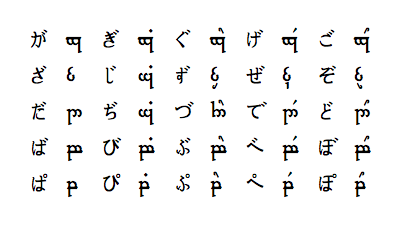
J.R.R. ト−ルキンの文字は美しいけど、英語はその字がちょっと複雑です。テングゥア(トールキンの字)で、英語より日本語は書きやすいよ。そして、これは”日本語のテングゥアのモード”です。上の図はいろは歌 です。中の図は用例です。下の図は五十音です。
このウェブサイトに、テングゥアについて英語で読める。
 J.R.R. Tolkien's tengwar, used for writing his Elvish languages as well as English and other European languages, is truly a beautiful script: it is steeped in the calligraphic traditions of medieval European writing, elegantly and systematically represents most consonant sounds, has strong lines and a hypnotic, engaging repetition of basic shapes.
But, as a script, the tengwar causes me great frustration. Tolkien devised an extraordinarily elegant way of representing consonants, but he never really settled on a way of consistent or systematic way of representing vowels. There are full modes and tehta modes, all varying. Even the full modes barely have enough vowels for English, and the tehta modes are wholly inadequate. Furthermore, many fans of the scripts find phonemic English writing confusing, and so most people write in the so-called "orthographic" modes, which often write consonants phonemically and vowels according to their representation in the Latin alphabet.
Using the five vowels of the Latin alphabet to write the dozen-plus vowels of English is an ugly hack. Using the Latin vowels as written in English in an otherwise phonemic script is an ugly hack of an ugly hack.
Many people are intrigued by the idea of writing English in an abugida, and the tehta modes are probably as close as it's practical to come. But I find it pretty awkward. There are a two main problems with writing English this way: English has numerous consonant clusters, and English has too many vowels to use diacritics easily.
But it'd be great for Japanese! Japanese has a simple syllable structure, a simple vowel inventory, and is already written with a syllabary. So here is a Japanese mode for the tengwar.
 For more information about the tengwar, consult the guides at Amanye Tenceli or Tolkien script publishing. These samples were created using the Code2000 font, which encodes the tengwar as in the ConScript Unicode Registry. The iroha is above, a a few sample sentences follow, and the tables of tengwar and kana are at the bottom.
These tengwar here generally follow rōmaji. The usage of súle for つ and anto for づ are unsystematic, but seemed like the best borrowing. The long vowel carrier is used in an unusual way; it is merely placed after a letter to show that the vowel is long. Note also the bottom bar used for palatized consonants, and I've offered no way to represent the sokuon っ.
このモードはロマ字みたい。本当は日本語を日本語の字で書くことがいいけど、テングゥアが面白い。


EDIT (July 26, 2009)
 Significantly revised, so one can write with a sokuon. Use the doubler bar (underbar) to mark a consonant that would be proceeded by a sokuon.
今このモードで促音を書ける。
このウェブサイトに、テングゥアについて英語で読める。
 J.R.R. Tolkien's tengwar, used for writing his Elvish languages as well as English and other European languages, is truly a beautiful script: it is steeped in the calligraphic traditions of medieval European writing, elegantly and systematically represents most consonant sounds, has strong lines and a hypnotic, engaging repetition of basic shapes.
 But, as a script, the tengwar causes me great frustration. Tolkien devised an extraordinarily elegant way of representing consonants, but he never really settled on a way of consistent or systematic way of representing vowels. There are full modes and tehta modes, all varying. Even the full modes barely have enough vowels for English, and the tehta modes are wholly inadequate. Furthermore, many fans of the scripts find phonemic English writing confusing, and so most people write in the so-called "orthographic" modes, which often write consonants phonemically and vowels according to their representation in the Latin alphabet.
Using the five vowels of the Latin alphabet to write the dozen-plus vowels of English is an ugly hack. Using the Latin vowels as written in English in an otherwise phonemic script is an ugly hack of an ugly hack.
Many people are intrigued by the idea of writing English in an abugida, and the tehta modes are probably as close as it's practical to come. But I find it pretty awkward. There are a two main problems with writing English this way: English has numerous consonant clusters, and English has too many vowels to use diacritics easily.
But it'd be great for Japanese! Japanese has a simple syllable structure, a simple vowel inventory, and is already written with a syllabary. So here is a Japanese mode for the tengwar.
 For more information about the tengwar, consult the guides at Amanye Tenceli or Tolkien script publishing. These samples were created using the Code2000 font, which encodes the tengwar as in the ConScript Unicode Registry. The iroha is above, a a few sample sentences follow, and the tables of tengwar and kana are at the bottom.
 These tengwar here generally follow rōmaji. The usage of súle for つ and anto for づ are unsystematic, but seemed like the best borrowing. The long vowel carrier is used in an unusual way; it is merely placed after a letter to show that the vowel is long. Note also the bottom bar used for palatized consonants, and I've offered no way to represent the sokuon っ.
このモードはロマ字みたい。本当は日本語を日本語の字で書くことがいいけど、テングゥアが面白い。


EDIT (July 26, 2009)
 Significantly revised, so one can write with a sokuon. Use the doubler bar (underbar) to mark a consonant that would be proceeded by a sokuon.
今このモードで促音を書ける。
Thursday, June 18, 2009
Kiloseconds & Brevels
The second is the unit of time we all know and love. It is the duration of 9,192,631,770 periods of the radiation corresponding to the transition between the two hyperfine levels of the ground state of the cesium 133 atom at rest at absolute zero, corrected for gravitational time dilation.
A hectosecond is about a minute and a half.
A kilosecond is between 16 and 17 minutes. There are 3.6 kiloseconds in an hour.
A megasecond is about 11 and a half days.
A gigasecond is 31.7 years.
A terasecond is more than 31,000 years.
SI uses the second-minute-hour system because these standard prefixes are completely impractical. It's probably possible for people to think in a system that has 86.4 kiloseconds per day, and an 11-day week. But the system of metric prefixes doesn't allow for a unit of time between 11.5 days and 31.7 years. Some of the obsolete or nonstandard metric units might be helpful. A myriameter would be about 2.7 hours. A hectokilosecond would be 1.2 days.
Adapting an ordinary dial clock to indicate the time in kiloseconds would be a hassle, since the kilosecond doesn't divide easily into minutes or hours. But that doesn't mean we must ignore the humorous or unusual units of measurement. They can live on, as the moment does.
Impractical as it may be, I'm not ready to give up on the kilosecond. Fifteen minutes is a useful, common block of time, and a kilosecond is very similar. One one-hundreth of a day is 14.4 minutes, also very close. This is a unit of time that only needs a name: I dub it the brevel.
The brevel is a vague and indeterminate amount of time: not quite 15 minutes, but close; not quite a thousand seconds, but close; and there are nearly, but not quite, a hundred brevels in a day.
EDIT
Effectively, this is similar to the ancient Chinese ke (刻).
A hectosecond is about a minute and a half.
A kilosecond is between 16 and 17 minutes. There are 3.6 kiloseconds in an hour.
A megasecond is about 11 and a half days.
A gigasecond is 31.7 years.
A terasecond is more than 31,000 years.
SI uses the second-minute-hour system because these standard prefixes are completely impractical. It's probably possible for people to think in a system that has 86.4 kiloseconds per day, and an 11-day week. But the system of metric prefixes doesn't allow for a unit of time between 11.5 days and 31.7 years. Some of the obsolete or nonstandard metric units might be helpful. A myriameter would be about 2.7 hours. A hectokilosecond would be 1.2 days.
Adapting an ordinary dial clock to indicate the time in kiloseconds would be a hassle, since the kilosecond doesn't divide easily into minutes or hours. But that doesn't mean we must ignore the humorous or unusual units of measurement. They can live on, as the moment does.
Impractical as it may be, I'm not ready to give up on the kilosecond. Fifteen minutes is a useful, common block of time, and a kilosecond is very similar. One one-hundreth of a day is 14.4 minutes, also very close. This is a unit of time that only needs a name: I dub it the brevel.
The brevel is a vague and indeterminate amount of time: not quite 15 minutes, but close; not quite a thousand seconds, but close; and there are nearly, but not quite, a hundred brevels in a day.
EDIT
Effectively, this is similar to the ancient Chinese ke (刻).
Tuesday, June 16, 2009
Things to Do in Ohio, So They Said
Cincinnati lies along the north bank of the Ohio River, between where the Great Miami and Little Miami Rivers flow into the Ohio. Dayton is about 55 miles north of Cincinnati on the Great Miami River, and Columbus is 110 miles northeast of Cincinnati, where the Olentangy flows into the Scioto River, a relict of the Teays. The Miami Rivers are so named because prior to American colonization, the rivers were the eastern boundary of the lands of the Miami (1). To the east and south (in Kentucky) were the traditional lands of the Shawnee around Chillicothe and the lower Scioto.
The Carew Tower (441 Vine St) is Cincinnati's tallest building, and apparently it's panoramic observation deck is open daily.
Southeastern Ohio includes some of the most significant ancient archaeological sites of the midwest and Ohio River Valley, Serpent Mound, the largest effigy earthwork in the world, and Fort Ancient, a key site of the upper Ohio Valley moundbuilders. Near Serpent Mound is the Davis Memorial Nature Preserve. In central Ohio, there are several Hopewell moundbuilders sites (Great Circle, Octagon, Wright, and Seip Mound), as well as Flint Ridge and some Adena sites (1, 2). The Hopewell Culture National Historical Park is near Chillicothe.
The Ohio River Trail is a bike path running trhough Cincinnati that will connect to the Little Miami Scenic River Trail and eventually to the planned Ohio to Erie Trail, on which one could cycle on 453 miles all the way from downtown Cincinnati to Lake Erie at Cleveland. ORW also hosts the Ohio River Swim and Paddlefest.
The Bicycle Museum of America is way out in New Bremen, Ohio. I thought it had something to do with the Wright brothers, but they were from Dayton, where the National Museum of the United States Air Force, the Dayton Aviation Heritage National Resort Park, Paul Laurence Dunbar House, and SunWatch Indian Village are. The area around New Bremen has some remaining sections of the Miami and Erie Canal. Miamisburg Mound, the largest conical burial mound in Ohio, is south of Dayton, as is Fort Hill.
Morgan's Raid is the most significant engagements of the Civil War fought in Indiana and Ohio. The only remaining fortification remaining from the Civil War emergency defense of Cincinnati is Battery Hooper at the James A. Ramage Civil War Museum, which was filled in with dirt, in Fort Wright, Kentucky. The defense of Cincinnati was the occasion of the first bridge across the Ohio River there, a military pontoon bridge.
Cincinnati was one of the most significant links in the Underground Railroad and the western abolitionist movement. The National Underground Railroad Freedom Center was established in 2004. Other Cincinnati museums include the Cincinnati Art Museum, Cincinnati Fire Museum (the nation's first municipal fire department was established in Cincy in 1853), the Cincinnati Museum Center of History and Natural History and Science, the American Sign Museum, and the Harriet Beecher Stowe house. Southeastern Ohio also includes the Ulysses S. Grant birthplace in New Richmond and boyhood home in Georgetown, the National Afro-American Museum in Wilberforce.
Here's the Best of Cincinnati 2009, including Urban Life and the hills.
There are plenty of state parks in Ohio. In the area around Cincinnati, the most significant state parks and natural areas may be Clifton Gorge State Nature Preserve, Caesar Creek Gorge State Nature Preserve, Little Miami State and National Scenic River, Little Miami State Park, Caesar Creek State Park, and John Bryan State Park, as well as Brush Creek State Forest and Stonelick State Park. Ohio's only national park is in the north between Akron and Cleveland.
It'd be something of a drive past Cincinnati, but we could always get some Kentucky flags and drive to Portsmouth, Ohio, to protest the theft of the Indian Head Rock by those buckeyes up there.
The Carew Tower (441 Vine St) is Cincinnati's tallest building, and apparently it's panoramic observation deck is open daily.
Southeastern Ohio includes some of the most significant ancient archaeological sites of the midwest and Ohio River Valley, Serpent Mound, the largest effigy earthwork in the world, and Fort Ancient, a key site of the upper Ohio Valley moundbuilders. Near Serpent Mound is the Davis Memorial Nature Preserve. In central Ohio, there are several Hopewell moundbuilders sites (Great Circle, Octagon, Wright, and Seip Mound), as well as Flint Ridge and some Adena sites (1, 2). The Hopewell Culture National Historical Park is near Chillicothe.
The Ohio River Trail is a bike path running trhough Cincinnati that will connect to the Little Miami Scenic River Trail and eventually to the planned Ohio to Erie Trail, on which one could cycle on 453 miles all the way from downtown Cincinnati to Lake Erie at Cleveland. ORW also hosts the Ohio River Swim and Paddlefest.
The Bicycle Museum of America is way out in New Bremen, Ohio. I thought it had something to do with the Wright brothers, but they were from Dayton, where the National Museum of the United States Air Force, the Dayton Aviation Heritage National Resort Park, Paul Laurence Dunbar House, and SunWatch Indian Village are. The area around New Bremen has some remaining sections of the Miami and Erie Canal. Miamisburg Mound, the largest conical burial mound in Ohio, is south of Dayton, as is Fort Hill.
Morgan's Raid is the most significant engagements of the Civil War fought in Indiana and Ohio. The only remaining fortification remaining from the Civil War emergency defense of Cincinnati is Battery Hooper at the James A. Ramage Civil War Museum, which was filled in with dirt, in Fort Wright, Kentucky. The defense of Cincinnati was the occasion of the first bridge across the Ohio River there, a military pontoon bridge.
Cincinnati was one of the most significant links in the Underground Railroad and the western abolitionist movement. The National Underground Railroad Freedom Center was established in 2004. Other Cincinnati museums include the Cincinnati Art Museum, Cincinnati Fire Museum (the nation's first municipal fire department was established in Cincy in 1853), the Cincinnati Museum Center of History and Natural History and Science, the American Sign Museum, and the Harriet Beecher Stowe house. Southeastern Ohio also includes the Ulysses S. Grant birthplace in New Richmond and boyhood home in Georgetown, the National Afro-American Museum in Wilberforce.
Here's the Best of Cincinnati 2009, including Urban Life and the hills.
There are plenty of state parks in Ohio. In the area around Cincinnati, the most significant state parks and natural areas may be Clifton Gorge State Nature Preserve, Caesar Creek Gorge State Nature Preserve, Little Miami State and National Scenic River, Little Miami State Park, Caesar Creek State Park, and John Bryan State Park, as well as Brush Creek State Forest and Stonelick State Park. Ohio's only national park is in the north between Akron and Cleveland.
It'd be something of a drive past Cincinnati, but we could always get some Kentucky flags and drive to Portsmouth, Ohio, to protest the theft of the Indian Head Rock by those buckeyes up there.
Subscribe to:
Posts (Atom)

 Posts
Posts


