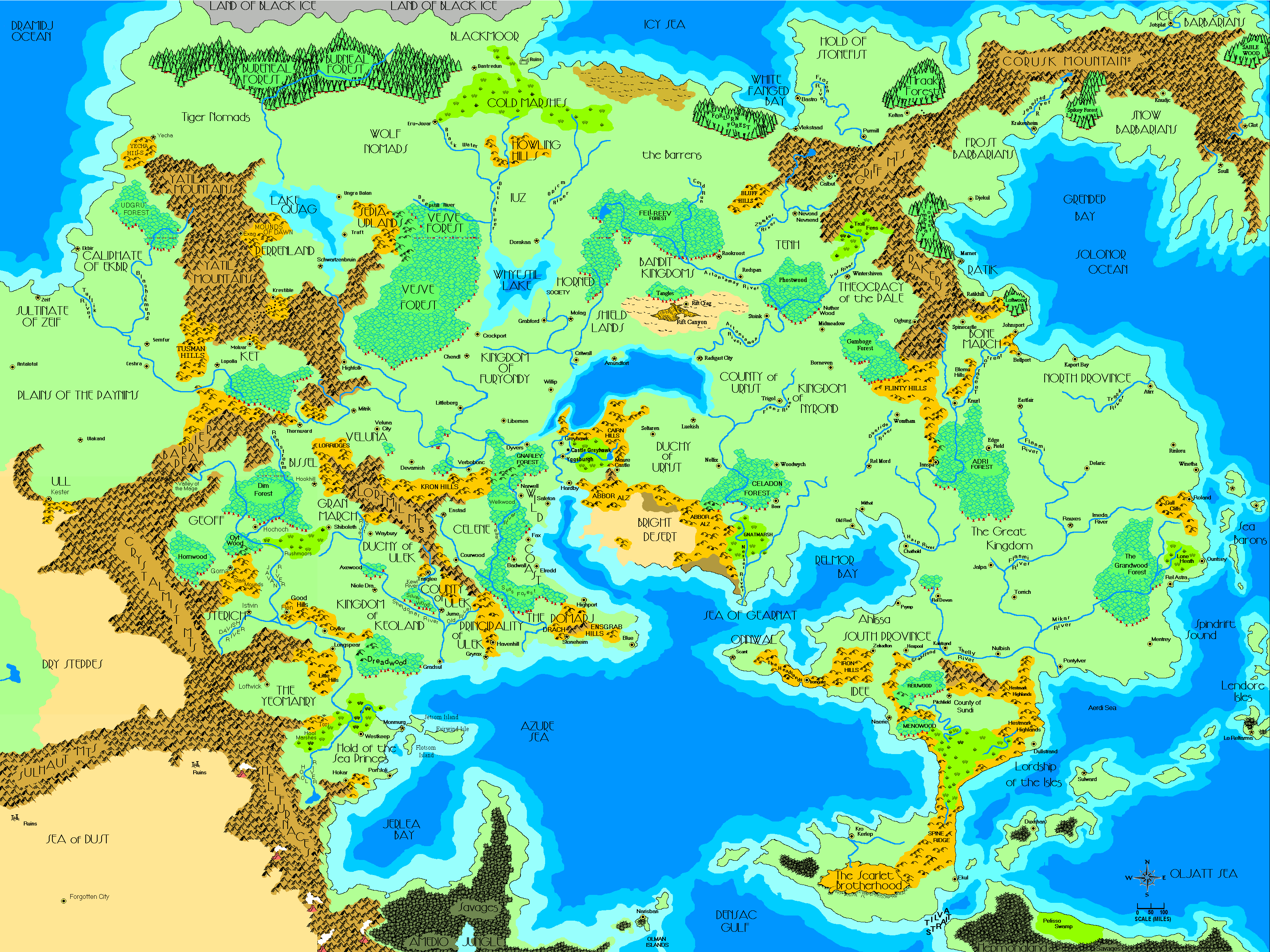
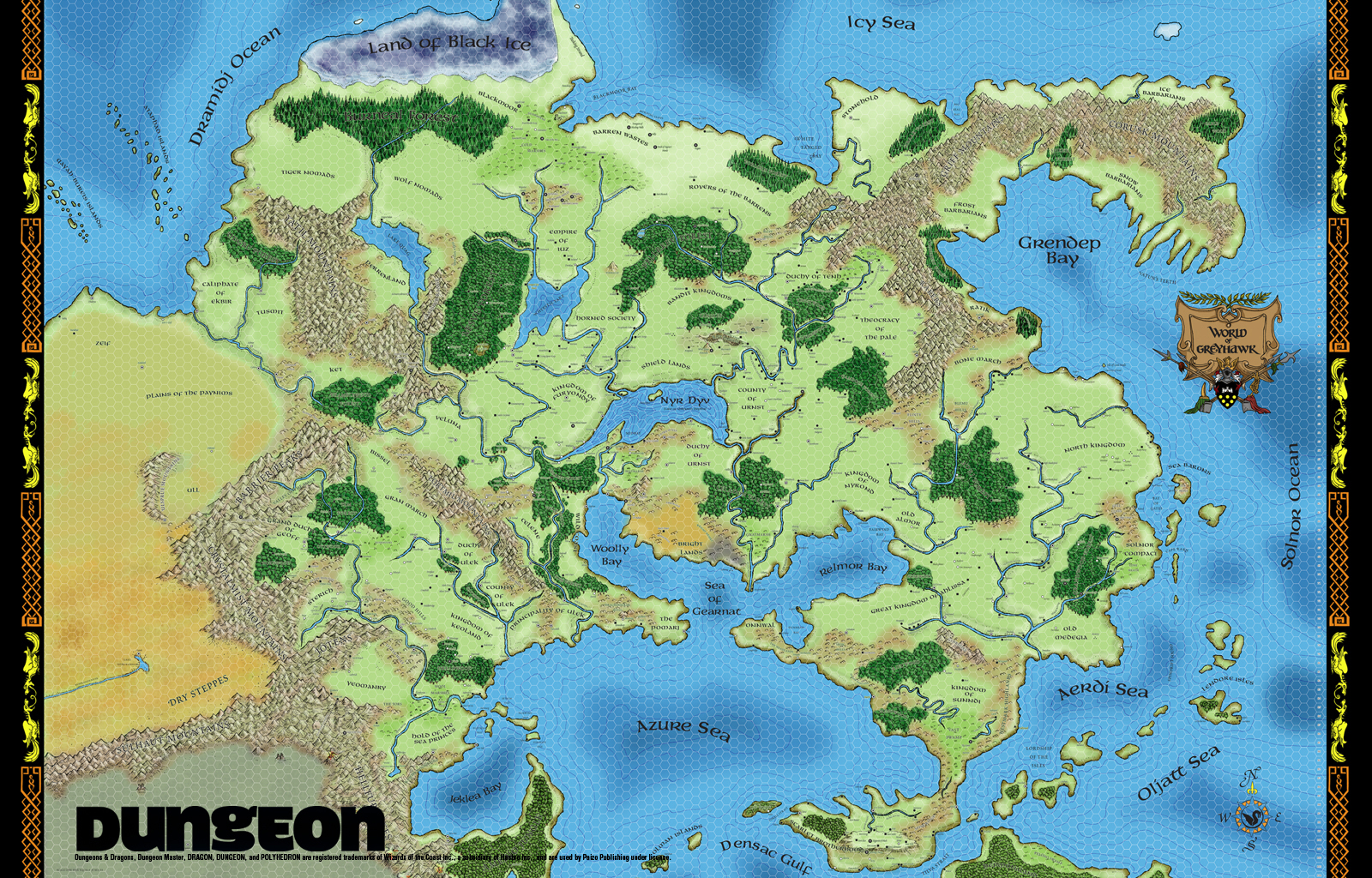
I earlier noted that many of the classic D&D modules were located in and around the Sheldomar Valley. The Temple of Elemental Evil, for one, is located just over the Lortmil Mountains near Verbobonc. Others could be relocated nearby with some slight modifications: for example, a large swamp in the western Seahold could contain modules S1 and S2, while the Lendore Isles (and UK1, L1, and L2) could be moved offshore of the Seahold. So I've been putting together this pocket guide to the Sheldomar Valley based of various wikis and the Living Greyhawk Gazetteer; there is plenty of official information about the Greyhawk campaign setting, but it can be easy to get lost in it all. Here's a map. I'm more interested in the situation circa 579 CY, when adventurers begin arriving at Hommlet.
The Flanaess is inhabited by three main types of humans: the pale, blond Suloise, the olive-skinned Oerdians, and the aboriginal bronze-skinned Flan, for whom the region is named. Their ancient languages (Ancient Suloise, Old Oerdian, and Flan, respectively) are the ancestors of most contemporary human tongues. Across the mountains to the west live the Baklunish, and the Olman inhabit the jungle islands of the Densac Gulf, but relatively few of these peoples dwell in the Sheldomar Valley.
The Common Tongue is descended from a dialect of Old Oerdian developed by Baklunish scribes, with some Suloise influence, that developed into a language of trade and administration. Modern spoken descendents of Old Oerdian include Keoish and Velondi. Keoish is the dominant human language of the Sheldomar Valley, while Velondi is spoken by the peasants of Furyondy and Veluna. Suloise is essentially dead, but of interest to sages and scholars. It has a few modern descendants: Amedi is spoken by the barbarians of the Amedio Jungles, Lendorian is spoken in the Lendore Isles, and languages of the tundra barbarians of the north are descended from Suloise.
The Kingdom of Keoland is one of the oldest states in the Flanaess. It is a feudal monarchy, governed largely by Suel aristocracy; the king is chosen by the Noble Council of Nicole Dra, the capital. Although founded centuries ago, it reached its peak during "imperial" expansion in the 350s; several of its daughter states govern northern parts of the Sheldomar Valley. Most people are of mixed Suel and Oerdian descent and speak Keoish and Common, and few Flan remain.
Gran March is a heavily militarized state north of Keoland; the elected Commandant governs from Hookhill. Although Gran March owes fealty to Keoland, it is self-governing and dominated by the Knights of the Watch; all adult males are required to provide military service. Most people speak Keoish and Common.
The Grand Duchy of Geoff is a feudal monarchy owing fealty to Keoland; the Grand Duke governs from Gorna. It is further divided into six cantrevs, each ruled by a Llwyr (a baron). Flan culture and people are more prominent in Geoff than the rest of the Sheldomar Valley; most people speak Flan and Common, as well as Keoish to a lesser extent.
Sterich is a feudal monarchy that is formally a vassal to Keoland, but self-governing in practice; the earl governs from Istivin. Sterich was established by settlers from Geoff, and has long been a mining colony where peasants do well since labor is in short supply.
The Seahold, formerly a province of Keoland, is a sovereign state ruled by Prince Jeon II, who has taken up a campaigns against slavery and slave-raiding from the Amedio Jungle and Olman Islands. Most people speak Keoish and Common, a few speak Amedi, Olman, or other languages. (There are dark whispers that the Scarlet Brotherhood has some future designs upon the Hold of the Sea Princes ca. 589).
The Yeomanry League is a democratic republic to the southwest of Keoland; the Spokesman governs from Loftwick. It was allied with Keoland until the 360s, when it objected to Keoland's conquests. Most people in the Yeomanry are freeholders of mixed Suel and Flan descent who speak mostly Keoish and Common.
Bissel is a border state at the northern end of the region, at the crossroads of the Sheldomar Valley, the Baklunish states, and the rest of the Flanaess. Bissel was conquered by Keoland in the 350s, governed as the Littlemark, then later conquered by the kingdom of Furyondy. Furyondy's influence gradually waned, until the Margrave established Bissel's independence in a battle in 477 CY. Most people are of mixed Baklunish, Suel, and Oerdian descent, and speak Common or Baklunish dialects.
The Ulek States are a trio of three sovereign kingdoms east of Keoland. The northernmost is an elven kingdom, the southernmost is a dwarven kingdom, and a druidic human kingdom lies between.
The Valley of the Mage is an isolated and xenophobic elven kingdom hidden in the Barrier Peaks. It is ruled by a powerful arcane spellcaster known as the Black One. The valley elves are scorned by all other elves (possibly due to an ancient bargain for extraplanar lore) and reject the elven pantheon, preferring Ehlonna and the druidic Old Faith. A plurality of the Valley's residents are various humans under the rule of a human earl, a vassal of the elven king, and many gnomes live there as well, but the valley is thinly populated and has very little traffic with the outside world, even preferring raiding to trade.
The most popular and widespread gods in the Sheldomar Valley include such important deities like Heironeous, Fharlanghn, Ehlonna, and St. Cuthbert, as well as Phaulkon, Zilchus, and Norebo. Sea gods like Osprem and Procan are popular along the coast, while Flan gods like Pelor, Allitur, and Obad-Hai are popular in the western half of the region. Istus and Rao are worshipped in Bissel, while Kelanen has a headquarters in Istivin and adherents in the Seahold.
Saturday, June 9, 2012

Saturday, June 2, 2012
On Klingon
I'm no Klingonist, but I've been reading more about it the past few days (a used copy of the Klingon Dictionary and an instructional audiobook doesn't break $10). I really like Mark Okrand has a subtle sense of humor. And Klingon has a strangely appealling phonoaesthetic for such a choppy language: it's like a tour of the points of articulation that are difficult for an Anglophone.
Klingon intentionally has a weird phonology. Not in the actual sounds that are used, which are normal human language sounds, but rather the pattern of sounds: it has several prominent holes in its phonology.
For example, Klingon has the velar nasal /ŋ/ and velar fricatives /x/ and /ɣ/ (which sound like sounds from French and German), but it does not have the velar stop /k/. Meanwhile, it has the uvular stop /qʰ/ and uvular affricate /qχ/, but no other uvular sounds. It would be very likely, in a natural language, if this kind of weird gap arose, for either the two series to converge on one point of articulation (for example, shifting /q/ to /k/ and /qχ/ to /kx/), or alternatively for new consonants to spring up to fill out the phonology at each point of articulation (for example adding /k/ and /χ/ as phonemes).
And while Klingon has the affricate /tɬ/ and the affricate /tʃ/, but the only alveolar or postalveolar fricative is the retroflex /ʂ/, which seems like it would merge with either /ɬ/ or /ʃ/.
Similarly, while Klingon contrast the voiceless stop /p/ with the voiced stop /b/, it contrasts the voiceless stop /t/ not with the voiced stop /d/, but rather with the voiced retroflex stop /ɖ/. It's pretty weird, to articulate it as retroflex rather than plain voiced, and it seems likely that Klingon would undergo a sound change: first the retroflex consonant would be in variation with the plain stop /d/, and then it would be dropped in favor of /d/. Of course, any description of a language is just a snapshot of it in time, with changes behind it and changes to come.
Now in practice, these uvular consonants are very difficult consonants for native English speakers to produce, and I think that a great deal of spoken Klingon has speakers using /k/ instead of /q/, or /d/ instead of the retroflex /ɖ/. Marc Okrand seemingly addressed this somewhat in The Klingon Dictionary:
Dialect can explain some of the problems with voice acting in Klingon. But it's just too difficult for Anglophones to pronounce. Christopher Plummer's General Chang in "Star Trek VI" is a great character, quoting Shakespeare even more than Kirk does in some of the earlier movies. Except when he's speaking Klingon: the only time he does it, at Kirk's trial, it is a bunch of disconnected syllables that don't display the interesting morphology of the language.
Mark Okrand talks about the creation of the Klingon language in this series of videos (1, 2, 3, 4, 5). Since the Klingon language was created on the set of "Star Trek III", Okrand was able to incorporate the actors' performance errors into the canonical version of the Klingon language. "My sort of 'role model' of what Klingon sounds like is Christopher Lloyd saying it, because he was my first big speaker," Okrand says.
However, Michael Dorn, who played Worf on "Star Trek: The Next Generation" and "Deep Space Nine", as well as three of the movies, has probably spoken more lines of Klingon than any other actor. He's also done a lot of voice work narrating audiobooks on the languageand videogames (such as Star Trek: Klingon), although in the audiobook of Conversational Klingon, Okrand pronounces all the Klingon words and phrases. Dorn is also kind of awesome.
Klingon intentionally has a weird phonology. Not in the actual sounds that are used, which are normal human language sounds, but rather the pattern of sounds: it has several prominent holes in its phonology.
For example, Klingon has the velar nasal /ŋ/ and velar fricatives /x/ and /ɣ/ (which sound like sounds from French and German), but it does not have the velar stop /k/. Meanwhile, it has the uvular stop /qʰ/ and uvular affricate /qχ/, but no other uvular sounds. It would be very likely, in a natural language, if this kind of weird gap arose, for either the two series to converge on one point of articulation (for example, shifting /q/ to /k/ and /qχ/ to /kx/), or alternatively for new consonants to spring up to fill out the phonology at each point of articulation (for example adding /k/ and /χ/ as phonemes).
And while Klingon has the affricate /tɬ/ and the affricate /tʃ/, but the only alveolar or postalveolar fricative is the retroflex /ʂ/, which seems like it would merge with either /ɬ/ or /ʃ/.
Similarly, while Klingon contrast the voiceless stop /p/ with the voiced stop /b/, it contrasts the voiceless stop /t/ not with the voiced stop /d/, but rather with the voiced retroflex stop /ɖ/. It's pretty weird, to articulate it as retroflex rather than plain voiced, and it seems likely that Klingon would undergo a sound change: first the retroflex consonant would be in variation with the plain stop /d/, and then it would be dropped in favor of /d/. Of course, any description of a language is just a snapshot of it in time, with changes behind it and changes to come.
Now in practice, these uvular consonants are very difficult consonants for native English speakers to produce, and I think that a great deal of spoken Klingon has speakers using /k/ instead of /q/, or /d/ instead of the retroflex /ɖ/. Marc Okrand seemingly addressed this somewhat in The Klingon Dictionary:
There are a number of dialects of Klingon. Only one of the dialects, that of the current Klingon emperor, is represented in this dictionary. When a Klingon emperor is replaced, for whatever reason, it has historically been the case that the next emperor speaks a different dialect. As a result, the new emperor's dialect becomes the official dialect. Those Klingons who do not speak the official dialect are considered either stupid or subversive, and are usually forced to undertake tasks that speakers of the official standard find distasteful. Most Klingons try to be fluent in several dialects.
Some dialects differ only slightly from the dialect of this dictionary. Differences tend to be in vocabulary (the word for forehead, for example, is different in almost every dialect) and in the pronunciation of a few sounds. On the other hand, some dialects differ significantly from the current official dialect, so much so that speakers of these dialects have a great deal of difficulty communicating with current Klingon officialdom. The student of Klingon is warned to check into the political situation in the Klingon Empire before trying to talk.There does seem to be a great deal of continuity in spoken Klingon between different eras (as much as in the English of these periods), although some of this might result from the prominence of Colonel Worf (an official of the Klingon Empire who defended Captain Kirk in court) and Lieutenant Worf (a later officer of the USS Enterprise). Interestingly, according to Okrand, English has a position of high prestige in the Klingon Empire, serving as a signal of elite status and a private means of communication among starship officers. If Klingons use English as a signal of social prestige, it doesn't seem implausible that, in Klingon, they would use a somewhat artificial, archaic, and difficult-to-pronounce sociolect as a prestige dialect as well.
Dialect can explain some of the problems with voice acting in Klingon. But it's just too difficult for Anglophones to pronounce. Christopher Plummer's General Chang in "Star Trek VI" is a great character, quoting Shakespeare even more than Kirk does in some of the earlier movies. Except when he's speaking Klingon: the only time he does it, at Kirk's trial, it is a bunch of disconnected syllables that don't display the interesting morphology of the language.
Mark Okrand talks about the creation of the Klingon language in this series of videos (1, 2, 3, 4, 5). Since the Klingon language was created on the set of "Star Trek III", Okrand was able to incorporate the actors' performance errors into the canonical version of the Klingon language. "My sort of 'role model' of what Klingon sounds like is Christopher Lloyd saying it, because he was my first big speaker," Okrand says.
However, Michael Dorn, who played Worf on "Star Trek: The Next Generation" and "Deep Space Nine", as well as three of the movies, has probably spoken more lines of Klingon than any other actor. He's also done a lot of voice work narrating audiobooks on the languageand videogames (such as Star Trek: Klingon), although in the audiobook of Conversational Klingon, Okrand pronounces all the Klingon words and phrases. Dorn is also kind of awesome.
Thursday, May 31, 2012
The HHH system of measurement
The hathmic system, also known as the hathom-hecand-hemoth
system, is a hexadecimal anthropocentric system of measurement, created
as an exercise in recreational arithmetic, as an intellectual folly,
and possibly for purposes of fiction. The names aren't serious, mostly
just bad puns on various historical units (fathom, plethron, li, league, fist, watch, behemoth, and quadrans).
Anthropocentric units are often more useful to humans than geocentric ones, but they should be based on some consistent scale rather than using different ratios between units. The metric system is inconvenient in anthropocentric terms, but is very convenient in being based consistently on a decimal system. But the decimal system is kind of boring, so this system based upon hexadecimal comes from a made-up culture that reveres squares. Different systems of measurement are good at measuring different things; this system is focused on representing human-scale walking travel times. For example, in one haach (of time), a person can walk about one hleeg (of distance).
The base unit is the hathom, which by astonishing coincidence is precisely 1.8 meters. This is six feet in metric (25-mm) inches, or about 5 feet 10 inches, roughly the average height of a human male. Sixteen hathoms are a lethron, which is 28.8 meters or about 94.5 feet. Sixteen lethrons are a hli, which is 460.8 meters or about 0.29 miles. Sixteen hlis are a hleeg, which is 7.372 kilometers, or about 4.58 miles.
Going smaller, one-sixteenth of a hathom is a lister, which is 112.5 millimeters or about 4.43 inches. A lister is further divided into sixteen units, each of which is each to about 7 millimeters or 0.28 inches.
The most practical unit of time is the day, one-sixteenth of which is a haach. This is an hour and a half long. The base unit of time, however, is the hecand, which is about 1.3 seconds. There are 65,536 hecands in a day.
There has to be a base unit of mass, to fill out the system; I'm just ripping off SI on this. The base unit of mass is the hemoth, equivalent to 5,832 kilograms. More commonly, people would use a huad, which weighs about 89 grams. Sixteen huads weigh about 1.42 kilograms.
Anthropocentric units are often more useful to humans than geocentric ones, but they should be based on some consistent scale rather than using different ratios between units. The metric system is inconvenient in anthropocentric terms, but is very convenient in being based consistently on a decimal system. But the decimal system is kind of boring, so this system based upon hexadecimal comes from a made-up culture that reveres squares. Different systems of measurement are good at measuring different things; this system is focused on representing human-scale walking travel times. For example, in one haach (of time), a person can walk about one hleeg (of distance).
The base unit is the hathom, which by astonishing coincidence is precisely 1.8 meters. This is six feet in metric (25-mm) inches, or about 5 feet 10 inches, roughly the average height of a human male. Sixteen hathoms are a lethron, which is 28.8 meters or about 94.5 feet. Sixteen lethrons are a hli, which is 460.8 meters or about 0.29 miles. Sixteen hlis are a hleeg, which is 7.372 kilometers, or about 4.58 miles.
Going smaller, one-sixteenth of a hathom is a lister, which is 112.5 millimeters or about 4.43 inches. A lister is further divided into sixteen units, each of which is each to about 7 millimeters or 0.28 inches.
The most practical unit of time is the day, one-sixteenth of which is a haach. This is an hour and a half long. The base unit of time, however, is the hecand, which is about 1.3 seconds. There are 65,536 hecands in a day.
There has to be a base unit of mass, to fill out the system; I'm just ripping off SI on this. The base unit of mass is the hemoth, equivalent to 5,832 kilograms. More commonly, people would use a huad, which weighs about 89 grams. Sixteen huads weigh about 1.42 kilograms.
A slight index to some classic D&D modules
Back in 2004 (in issue #116), /Dungeon/ magazine offered a list of the top 30 D&D adventures of all time. They're listed with some comment at RPG Geek and Grognardia. RPG Geek also has a composite ranking of the highest-rated adventures which may be more useful, as well as a list of highly-rated Dungeon adventures. Many such lists have similar items (1, 2, 3, 4, 5, 6, 7). For a long time, I've wondered how these old modules fit into their campaign worlds, where these dungeons are supposed to be, and how they fit together. So I've put together this little index to some classic modules, focusing on canonical geography, and jumping off from the 2004 Dungeon list.
This list is restricted to actual modules from TSR from about 1975-1985. So it doesn't include Judge's Guild modules like Dark Tower (1980), Caverns of Thracia (1980), or Tegel Manor (1977); later Gygaxian material like Necropolis (1992); other TSR modules like The Dancing Hut of Baba Yaga; or Dungeon adventures like "The Mud Sorcerer's Tomb" (#37). Wolfgang Baur's "Kingdom of the Ghouls" (Dungeon #70, September 1998) is set in Greyhawk, starting from the town of Loftwick in the Yeomanry in Sheldomar Valley and traveling under the Crystalmist and Hellfurnace Mountains. Similarly, I'll skip a couple of later adventures from the Dungeon list: The Gates of Firestorm Peak (1996), The Forge of Fury (2000), Dead Gods (1997), Ruins of Undermountain (1991), City of the Spider Queen (2002), Return to the Temple of Elemental Evil by Monte Cook (2001), Return to the Tomb of Horrors by Bruce Cordell (1998), and WGR6: City of Skulls (1993).
Clearly, a campaign focusing on these adventures set in a canonical campaign world should be set in the Sheldomar Valley in Greyhawk: about three-quarters of these adventures have a canonical location in Greyhawk. Of these, about 38% are in or around the Sheldomar Valley, while about 24% are somewhere between the Free City of Greyhawk and the Pomarj. Nearly all of them could be put in and around the Sheldomar Valley with some slight geographical modifications. Paizo published a giant poster map of Greyhawk, although this map is more legible online, and this one has hexes for specific module locations. The Atlas of Greyhawk has some very detailed terrain maps. OTOH, most of the Mystara adventures are set (or retconned) to Karameikos.
Temple of the Frog (1975), by Dave Arneson, was the first module published for D&D, in the Blackmoor supplement. It was revised and expanded as DA2: Temple of the Frog in 1986, for characters of levels 10-14. Located in a deep swamp, it includes some science-fiction crossover elements. Blackmoor was included in northern regions of both Mystara and Greyhawk settings.
B1: In Search of the Unknown (1978), by Mike Carr, is a beginner's scenario intended to show how to create dungeons, for characters of levels 1-3. The Basic series modules were initially setting neutral. (W, Grognardia &c.)
B2: The Keep on the Borderlands (1979), by Gary Gygax, is a dungeon crawl for characters of levels 1-3. Originally setting-neutral, GAZ1: The Grand Duchy of Karameikos located the Keep in Karameikos in Mystara; the 1999 sequel Return to the Keep on the Borderlands placed the Keep in Greyhawk, in the Yeomanry in Sheldomar Valley, although it made reference to non-Greyhawk deities and some Mystara background information. Ranked #7 by Dungeon in 2004. (W, Grognardia)
B3: Palace of the Silver Princess (1981), by Jean Wells, is a low-level dungeon crawl for characters of levels 1-3, intended for a single game session. It features a country frozen in time except for the royal palace, a white dragon, three-headed ubues, and a giant ruby. (W, Grognardia)
B4: The Lost City (1982), by Tom Moldvay, is a beginning adventure for characters of levels 1-3. It is set in the ruined city of Cynidicea, buried in a desert, mostly within a sunken step pyramid infested with cultists of Zargon at war with Cynidiceans who follow the city's ancient gods. The compilation B1-9: In Search of Adventure locates the dungeon in Mystara. Ranked #28 by Dungeon in 2004. (W, Grognardia)
X1: Isle of Dread (1980), by David Cook and Tom Moldvay, is a wilderness exploration adventure for characters of levels 3-7. Adventurers sail to and explore the jungle island, inhabited by dinosaurs, kopru, aranea, rakasta, and phanaton. This module introduced the Known World that would become the Mystara setting. In Dungeon #114, it was relocated to Greyhawk, to the Densac Gulf west of Hepmonaland and east of the Amedio Jungle and the Hellfurnaces. Dungeon's Savage Tide adventure path had PCs sail from Sasserine and visit the Isle of Dread via Tamoachan. Ranked #16 by Dungeon in 2004. (W, Grognardia)
X2: Castle Amber (1981), by Tom Moldvay, is a weird adventure for characters of levels 3-7. The PCs are traveling to the magocracy of Glantri in Mystara, but are drawn into the castle and must travel through a portal to Averoigne to reach an interdimensional tomb. Ranked #15 by Dungeon in 2004. (W, Grognardia)
S1: Tomb of Horrors (1978), by Gary Gygax, is a fiendish dungeon for characters of levels 10-14, the tomb of the demilich Acererak. The dungeon itself is located on some lost and lonely hill in Greyhawk, in the Vast Swamp south of Sunndi. Ranked #3 by Dungeon in 2004. Return to the Tomb of Horrors introduces Skull City built over the tomb. (W, Grognardia, Atlas)
S2: White Plume Mountain (1979), by Lawrence Schick, is a puzzle dungeon crawl for characters of levels 5-10, which revolves around a quest to retrieve an intelligent trident, warhammer, and sword from the eponymous volcano in Greyhawk. White Plume Mountain is located south of the Great Swamp, in the Shield Lands just south of the Rift Canyon and north of the great lake Nyr Dyv. There's a revision for 3.5e for 7th-level characters. Ranked #9 by Dungeon in 2004. (W, Grognardia, Atlas)
S3: Expedition to the Barrier Peaks (1980), by Gary Gygax, is a dungeon crawl for characters of levels 8-12, in which adventurers explore a crashed space ship. It is located in Greyhawk, unsurprisingly in the Barrier Peaks north of Geoff and east of the Crystalmist Mountains. Ranked #5 by Dungeon in 2004. (W, Grognardia)
S4: The Lost Caverns of Tsojcanth (1982), by Gary Gygax, is a monster-filled labyrinth for characters of levels 6-10, in which adventurers delve for the treasure of Iggwilv. Set in Greyhawk, the dungeon is located in the Yatil Mountains south of Perrenland. WG4: The Forgotten Temple of Tharizdun is a loosely connected sequel to this. Ranked #22 by Dungeon in 2004. (W, Grognardia)
WG4: The Forgotten Temple of Tharzidun (1982), by Gary Gygax, is a Lovecraftian wilderness and dungeon adventure for characters of levels 5-10. Set in Greyhawk, it is a loosely connected sequel to S4: The Lost Caverns of Tsojcanth, and has the PCs follow rampaging norkers from the Caverns to the Temple. Ranked #23 by Dungeon in 2004. (W, Grognardia)
WG5: Mordenkainen's Fantastic Adventure (1984), by Rob Kuntz and Gary Gygax, is a dungeon crawl for characters of levels 9-12. Set in Greyhawk, it is located at Maure Castle, just east of Greyhawk city. This adventure was revised and expanded as "Maure Castle" in Dungeon #112, #124, and #139. (W, Grognardia, Atlas)
C1: The Hidden Shrine of Tamoachan (1980), by Harold Johnson and Jeff R. Leason, is a tournament module for characters of levels 5-7. The adventure was set in Greyhawk at a ruined Olman city in the Amedio Jungle. Ranked #18 by Dungeon in 2004. (W, Grognardia)
C2: The Ghost Tower of Inverness (1979), by Allen Hammack, is a competition module for characters of levels 5-7. Set in Greyhawk, the tower is located in the southern Abbor-Alz Hills north of the Bright Desert. Ranked #30 by Dungeon in 2004. (W, Grognardia, Atlas)
N1: Against the Cult of the Reptile God (1982), by Douglas Niles, is a town, wilderness, and dungeon adventure for characters of levels 1-3. Set in Greyhawk, it is located between the Gran March and the Kingdom of Keoland in the Sheldomar Valley. Ranked #19 by Dungeon in 2004. (W)
DL1: Dragons of Despair (1984), by Tracy Hickman, is an introductory adventure for characters of levels 4-6. Set in Krynn, it begins in the elven town of Solace and travels to the jungle-covered ruins of the city of Xak Tsaroth. Ranked #25 by Dungeon in 2004. (W, Grognardia)
U1: The Sinister Secret of Saltmarsh (1981), by Dave J. Browne with Don Turnbull, is for characters of levels 1-3, with a ghostly ship and a spooky mansion in the eponymous town. Located in Greyhawk, Saltmarsh is in the Hold of the Sea Princes in the southern Sheldomar Valley. Ranked #27 by Dungeon in 2004. (W, Grognardia)
UK1: Beyond the Crystal Cave (1983), by Dave Browne, Tom Kirby, and Graeme Morris, is an adventure for characters of levels 4-7, in which the adventurers travel to a enchanted garden of eternal summer in a pocket dimension. Set in Greyhawk, it's on Sybarate Isle in the Hold of the Sea Princes in the southern Sheldomar Valley. (W, Grognardia)
L1: The Secret of Bone Hill (1981), by Len Lakofka, is a mini-setting for characters of levels 2-4. Set in Greyhawk, it is located in a fishing port in the Lendore Isles. (W, Grognardia)
L2: The Assassin’s Knot (1983), by Len Lakofka, is a murder mystery for characters of levels 2-4. A sequel to L1: The Secret of Bone Hill, it is set in the same community. Ranked #29 by Dungeon in 2004. (W)
I1: Dwellers of the Forbidden City (1981), by David Cook, is an adventure for characters of levels 4-7, in which PCs travel to a jungle city overrun by yuan-ti and tasloi. Characters can intrigue with the bugbears, bullywugs, or mongrelmen of the city, and the module also introduced aboleths and yellow musk creepers. Set in Greyhawk, it is located in Hepmonaland. Ranked #13 by Dungeon in 2004. (W, Grognardia)
I3-5: The Desert of Desolation (1983), by Tracy and Laura Hickman, is a compilation of three Egyptian-themed modules, for characters of levels 5-7: I3: Pharaoh, I4: Oasis of the White Palm, and I5: Lost Tomb of Martek. Set in a desert, the compilation was retconned into Raurin in the Forgotten Realms. Ranked #6 by Dungeon in 2004. (W, Grognardia)
I6: Ravenloft (1983), by Tracy and Laura Hickman, is a horror adventure for characters of levels 5-7, in which adventurers oppose the famous vampire. It is set at Castle Ravenloft in Barovia, which later evolved into the Ravenloft setting. Ranked #2 by Dungeon in 2004. (W, Grognardia)
T1-4: The Temple of Elemental Evil (1985), by Gary Gygax and Frank Mentzer, includes T1: The Village of Hommlet within the T1-4 module, for characters of levels 1-8. Set in Greyhawk, the adventure starts at the village of Hommlet near the city-state of Verbobonc, then travels to the nearby village of Nulb and the Temple. Ranked #4 by Dungeon in 2004. (W, Grognardia &c., Atlas)
A1-4: Scourge of the Slave Lords (1986), by David Cook, Allen Hammack, Harold Johnson, Tom Moldvay, Lawrence Schick, and Edward Carmien, is a compilation of modules for characters of levels 7-11, which includes A1: Slave Pits of the Undercity, A2: Secret of the Slavers Stockade, A3: Assault on the Aerie of the Slave Lords, and A4: In the Dungeon of the Slave Lords. Set in Greyhawk, the adventure begins in the city of Highport in the Pomarj, then travels for a hundred miles or more through the Drachensgrab Hills to the hidden city of Suderham, on an island in a volcanic crater. Ranked #20 by Dungeon in 2004. (W, Grognardia, Atlas)
G1-3: Against the Giants (1981), by Gary Gygax, is a compilation of three dungeon crawls, for characters of levels 8-12: G1: Steading of the Hill Giant Chief, G2: Glacial Rift of the Frost Giant Jarl, and G3: Hall of the Fire Giant King. Set in Greyhawk, G1 begins in Istivin in the Sheldomar Valley; the PCs travel overland to the hill giants' steading, from where they are magically transported to the frost giants' glacier in the Crystalmists, from where they are magically transported to the fire giants' hall in the Hellfurnaces. As part of GDQ1-7: Queen of the Spiders (1986), this was ranked #1 by Dungeon in 2004. (W, Grognardia)
D1-3: Descent into the Depths of the Earth (1978), by Gary Gygax, is a compilation of three dungeon crawls, for characters of levels 9-14: D1: Descent into the Depths of the Earth, D2: Shrine of the Kuo-Toa, and D3: Vault of the Drow. Set in Greyhawk, the PCs follow a tunnel down from the fire giants' hall in G3 through the Underdark to the drow city of Erelhei-Cinlu. As part of GDQ1-7: Queen of the Spiders (1986), this was ranked #1 by Dungeon in 2004. (W, Grognardia 1 2 3)
Q1: Queen of the Demonweb Pits (1980), by David Sutherland with Gary Gygax, is an adventure for characters of levels 10-14. Set in Greyhawk, the adventurers travel through a planar gate in the drow city of Erelhei-Cinlu to the 66th layer of the Abyss to confront the demon goddess Lolth. As part of GDQ1-7: Queen of the Spiders (1986), this was ranked #1 by Dungeon in 2004. (W, Grognardia)
Saturday, May 5, 2012
2012 Derby Disclosure
Take Charge Indy, Dullahan, and Bodemeister. Liason is a longshot.
EDIT
It was I'll Have Another, Bodemeister, and Dullahan. A strange run by Bodemeister, outpacing the sprinter Trinniberg (9) early on.
EDIT
It was I'll Have Another, Bodemeister, and Dullahan. A strange run by Bodemeister, outpacing the sprinter Trinniberg (9) early on.
Friday, May 4, 2012
2012 Kentucky Oaks Disclosure
Eden's Moon and Karlovy Vary. Grace Hall and Broadway's Alibi are favorites.
EDIT
Rosie Napravnik on Believe You Can was the first female jockey to win the Oaks!
EDIT
Rosie Napravnik on Believe You Can was the first female jockey to win the Oaks!
Sunday, April 1, 2012
Road to Derby 2012
As pointed out in 2011, the road to the Kentucky Derby follows a couple of high-profile races through the Derby prep season. Some of the major races are:
- The Florida Derby (YT) was on March 31. In an upset, Take Charge Indy with Calvin Borel beat Revelon and the favorite, Union Rags with Julien Leparoux.
- The Louisiana Derby at Fair Grounds is April 1 (YT, HRN). Hero of Order beats Mark Valeski at 109-1 odds.
- The Santa Anita Derby at Santa Anita Park is April 7 (HRN).
- The Illinois Derby at Hawthorne is April 7 (HRN).
- The Wood Memorial States at Aqueduct is on April 7 (HRN)
- The Arkansas Derby at Oaklawn is on April 14.
- The Blue Grass Stakes at Keeneland is April 14.
Subscribe to:
Posts (Atom)

 Posts
Posts