Showing posts with label American Civil War. Show all posts

Friday, March 9, 2012

2011 Book of the Year

In the last few weeks of 2011, I suffered a catastrophic hard drive crash that wiped out several years of my data; it was especially hard because, since I had generally been so diligent about backing up my information and transferring it from one computer to another, I had lots of data to lose. This is part of the reason posting has been light the last few months; the other is that I started grad school in January. So I've been quite busy. Much of my data that I still have is stuff that I've posted or saved online in various formats, though, which should itself be incentive to post more often.

Anyway: back when I lived in Japan and New York, I had gotten in the habit of reading on the train or subway; it's an hour or more with nothing else to do but sit, so it's a great time to knock out some reading. But after returning to Kentucky, I discovered that we have few to no subways here. With my most common venue for recreational reading gone, and the Internet always beckoning, I partially fell out of the habit of reading actual books.

Sometime in late 2010, I hit upon the idea of making a list of each book I read as I read it. And indeed, this led to dramatically increasing the number of books I read over the year. One of the things I lost in the hard drive crash is the detailed list of every book I completed in 2011. However, since I bought most of these books and kept them together, I remember most of the list.

From these, I'm nominating a couple of books to recommend. My "Book of the Year" is a pretty idiosyncratic "award": It's not a book that came out in 2011, just one I happened to read for the first time; it's maybe not the best book I read, just one that some folks might enjoy or draw from insight from. The nominations are pretty heavy on non-fiction, since most of the fiction was stuff I re-read: Kim Stanley Robinson's Mars trilogy, Fritz Leiber's pre-1971 Nehwon books. Here are the runner-ups:
  • Linguist Arika Okrent 's "In the Land of Invented Languages" both overviews a history of constructed languages and recounts her experiences interacting with the communities that have formed around languages such as Esperanto, Lojban, and Klingon. It's an interesting popular history of philosophical and linguistic follies, and pretty funny in places, as when she's interacting with the Klingonists.

  • Piers Vitebsky's "The Reindeer People" probably has a limited appeal, although it's fascinating if you're interested in Siberian anthropology, or the beliefs and cultural history of Tungusic reindeer pastoralists in the Russian Far East, from the Soviet through the post-Soviet era. Read an excerpt at NPR.

  • I don't know how I managed to go so long without reading James McPherson's "Battle Cry of Freedom", a one-volume history of the American Civil War. It's been about a decade and a half since I've read any of his books, and picked this up to review for the sesquicentennial. McPherson's writing is wonderful: even over 900 pages, it's concise, fresh, and insightful.

  • Journalist Joshua Foer's "Moonwalking with Einstein" details his experiences preparing for and competing in the U.S. Memory Championships, using classical palace-of-memory techniques, and discussing the neurological underpinnings of memory, synesthesia, and similar interesting topics: wacky and amazing. Read some excerpts at Time and at the New York Times Magazine.

  • Michael Chabon's novel "The Yiddish Policemen's Union" took me about 100 pages to get into the rhythm of, but it's a fascinating instance of worldbuilding. The novel originates from the 1997 essay "A Yiddish Pale Fire", available at the Internet Archive, discussing a Yiddish phrasebook he found in a chain bookstore.

  • Matthew Kapstein's "The Tibetans" surveys the cultural, social, and political history of Tibet from the early centuries of the Common Era to the beginning of the 20th century. Tibetan history since the 1940s is well known, but it's much more difficult to find an overview of the socioeconomic history of Tibet in the 18th century and earlier. Contemporary rationalization of the Chinese takeover often refers to the tyrannical and exploitative governance in the monastic era. Among the things that Kapstein describes is the interweaving of monastic organizations and aristocratic families in a preindustrial agricultural society. Retiring to a monastery allowed aristocratic leaders to forestall succession crises while maintaining influence, and allied monasteries could provide bureaucratic and manpower support to local authorities; monasteries could also be significant landowners, IIRC. But the Tibetan state was very fragile and weak, and Chinese troops stationed in Tibet at great distance from Beijing had a great deal of autonomy. A thumbnail does Kapstein's arguments little justice; this is a dense work surveying a long period of complex history.
But my 2011 book of the year is Manly Wade Wellman's "Who Fears the Devil? The Complete Silver John", an anthology of fantasies and short stories set in postwar Appalachia. Wellman was one the few pulp writers of the mid-20th century nominated for a Pulitzer, and the Silver John tales are Americana fantasy at its best.

Wednesday, June 8, 2011

Book Snippets: "Battle Cry of Freedom" - Political parties

In a couple of my posts here on electoral reform, I've referred to some contemporary dissatisfactions about political parties. That contemporary parties do not represent a pure (or even coherent) ideological position, but rather a mishmash of ideas that can be manipulated or exploited by elites, corrupt elements, or the powers that be.

James M. McPherson's "Battle Cry of Freedom" (Oxford UP, 1988) has an interesting (if somewhat orthogonal passage) on the role of political parties in the Union and Confederacy:
Formal political parties did not exist in the Confederacy. This state of affairs arose from two main causes: the erosion of the two-party system in the 1850s and the perceived need for a unified front during the emergencies of secession and war. Southerners considered this circumstance a source of strength. ...But in fact, as historians now recognize, the absence of parties was actually a source of weakness. In the North the two-party system disciplined and channeled political activity. The Republican party became the means for mobilizing war resources, raising taces, creating a new financial system, initiating emancipation, and enacting conscription. Democrats opposed most of these measures; the existence of this well-defined opposition caused Republicans to close ranks when the chips were down. Because measures were supported or opposed by parties, voters could identify those responsible for them and register their approval or disapproval at the polls by voting a party ticket. Both parties, of course, used their well-oiled machinery to rally voters to their side. In the Confederacy, by contrast, the Davis administration had no such means to mobilize support. No parties meant no institutionalized discipline over congressmen or governors. Davis could not invoke party loyalty and patronage in behalf of his policies, as Lincoln could. Opposition to the Davis administration became personal or factional and therefore difficult to deal with.

In the North, where nearly all state governors were Republicans, the ties of party bound them to the war effort. In the South the obstructionist activities of several governors hindered the centralized war effort because the centrifugal tendencies of state's rights were not restrained by the centripetal force of party. The Confederate Constitution limited the president to a single six-year term, so Davis had little reason to create a party organization for re-election. Such government policies as conscription, impressment, the tax in kind, and management of finances were the main issues in the congressional elections of 1863. Opposition candidates ran on an individual rather than a party basis, and the government could not muster political artillery to shoot at all these scattered targets. (689-690)
This implies that the main function of the party system is not to represent coherent ideological positions, but rather to focus support for or opposition to the governing party. And indeed, even aside from Duverger's law, it seems to me that the main distinction between the parties is governing vs. opposition. The two contemporary parties have a governing form and an opposition form that contrast with each other, which helps explains Jane's Law: "The devotees of the party in power are smug and arrogant. The devotees of the party out of power are insane."

Following the Civil War, the Republican Party was the leading governing party in the North (while the Democratic Party was the main opposition party there), while the Democratic Party was the leading governing party in the South (while the Republican Party was the main opposition party there. The Democratic Party was a famously Southern agent of Jim Crow and white supremacism until the 1960s. But as for the contemporary parties, it's almost as if the old governing-party form of each withered away and disappeared, leaving the opposition-party form as the new governing party in each section. For whatever sectionalism remains, the Democratic Party has become the leading governing party in the northeastern United States, while the Republican Party has become the leading governing party in the southeastern United States.

Book Snippets: "Battle Cry of Freedom" - Musket to rifle

James M. McPherson explains, in "Battle Cry of Freedom" (Oxford UP, 1988), that the shift from musket to rifle just before the American Civil War caused a shift from offensive infantry charges with bayonet to defensive tactics. "The rifle and trench ruled Civil War battlefields as thoroughly as the machine-gun and trench ruled those of World War I," he says (477). In one battle later in the war, a defensive line of three trenches crawling with riflemen achieved a rate of fire on charging troops nearly equivalent to machine-gun fire, and Lee's army met its eventual defeat in the grueling trench warfare around Petersburg, Virginia. McPherson:
One reason for the high casualties of Civil War battles was the disparity between traditional tactics and modern weapons. The tactical legacy of eighteenth-century and Napoleonic warfare had emphasized close-order formations of soldiers trained to maneuver in concert and fire by volleys. To be sure, some of the citizen-soldiers of the American Revolution fought Indian-style from behind trees or rocks, and the half-trained levée en masse of the French Revolution advanced in loose order like "clouds of skirmishers." But they did so mainly because they lacked training and discipline; the ideal for Washington's Continentals and Napoleon's veterans as well as Frederick's Prussians and Wellington's redcoats remained the compact, cohesive columns and lines of automatons who moved and fired with machine-like efficiency.

These tactics also stressed the offensive. Assault troops advanced with cadenced step, firing volleys on command and then double-timing the last few yards to pierce the enemy line with bayonet charge. Napoleon used his artillery in conjunction with infantry assaults, moving the field guns forward with the foot soldiers to blast holes in enemy ranks and soften them up for the final charge. Americans used these tactics with great success in the Mexican War. West Point teaching stressed the tactical offensive. Most of the top Civil War officers had fought in Mexico and/or had attended West Point; from both experiences they had absorbed the message that the tactical offensive based on close-order infantry assaults supported by artillery won battles.

In Mexico this happened without high casualties because the basic infantry weapons was the single-shot muzzle-loading smoothbore musket. The maximum range of this weapon was about 250 yards; its effective range (the distance at which a good marksman could hit a target with any regularity) was about eighty yards on a still day. The close-order formation was therefore necessary to concentrate the firepower of these inaccurate weapons; artillery could accompany charging infantry because cannoneers were relatively safe from enemy musket fire until they came within a couple of hundred yards or less; bayonet charges could succeed because double-timing infantry could cover the last eighty yards during the twenty-five seconds it took defending infantrymen to reload their muskets after firing a volley.

Rifling a musket increased its range fourfold by imparting a spin to a conical bullet that enabled it literally to bore through the air. This fact had been known for centuries, but before the 1850s only special regiments or one or two companies per regiment were equipped with rifles. These companies were used as skirmishers—that is, they operated in front and on the flanks of the main body, advancing or withdrawing in loose order and shooting at will from long range at enemy targets of opportunity. Given the rifle's greater range and accuracy, why were not all infantrymen equipped with it? Because a bullet large enough to "take" the rifling was difficult to ram down the barrel. Riflemen sometimes had to pound the ramrod down with a mallet. After a rifle had been fired a few times a residue of powder built up in the grooves and had to be cleaned out before it could be fired again. Since rapid and reliable firing was essential in battle, the rifle was not practicable for the mass of infantrymen.

Until the 1850s, that is. Although several people contributed to the development of a practicable military rifle, the main credit belongs to French army Captain Claude E. Minié and to the American James M. Burton, an armorer at the Harper's Ferry Armory. In 1848 Minié perfected a bullet small enoguh to be easily rammed down a rifled barrel, with a wooden plug in the base of the bullet to expand it upon firing to take the rifling. Such bullets were expensive; Burton developed a cheaper and better bullet with a deep cavity in the base that filled with gas and expanded the rim upon firing. This was the famous "minié ball" of Civil War rifles. The superiority of the rifle was demonstrated by British and French soldiers who carried them in the Crimean War. As Secretary of War in 1855, Jefferson Davis converted the United States army to the .58 caliber Springfield rifled musket. Along with the similar British Enfield rifle (caliber .577, which would take the same bullet as the Springfield, the Springfield became the main infantry arm of the Civil War.

...Northern industry geared up to manufacture more than two million rifles during the war; unable to produce more than a fraction of this total, the South relied mainly on imports through the blockade and on capture of Union rifles. In 1861 neither side had many rifles, so most solidiers carried old smoothbores taken from storage in arsenals. During 1862, most Union regiments received new Springfields or Enfields, while many Confederate units still had to rely on smoothbores. ...By 1863 nearly all infantrymen on both sides carried rifles.

The transition from smoothbore to rifle had two main effects: it multiplied casualties; and it strengthened the tactical defensive. Officers trained and experienced in the old tactics were slow to recognize these changes. Time and again generals on both sides ordered close-order assaults in the traditional formation. With an effective range of three or four hundred yards, defenders firing rifles decimated these attacks.Artillery declined in importance as an offensive weapon, because its accuracy and the reliability of shells at long range was poor, and the gund could no longer advance with the infantry toward enemy lines, for marksmen could pick off cannoneers and especially the horses at distances up to half a mile. Sharpshooters also singled out enemy officers, which helps to explain why officers and especially generals had higher casualty rates than privates. ...The old-fashioned cavalry charge against infantry, already obsolescent, became obsolete in the face of rifles that could knock down horses long before their riders got within saber or pistol range. The Civil War hastened the evolution of dismounted cavalry tactics in which the horse was mainly a means of transportation rather than a weapon in its own right. (472-475)

Book Snippets: "Battle Cry of Freedom" - American Industrialization

As noted before, James M. McPherson's "Battle Cry of Freedom" (Oxford UP, 1988) is a fantastic book. And a great deal of its value derives from McPherson's excellent, well-crafted prose. Later in the book, McPherson briefly describes dozens of battles with great clarity and freshness and remarkably little repetition. He's able to succintly and evocatively summarize complex trends in a page or two, or overview a debated topic simply.

For example, McPherson describes the momentous "transportation revolution" of the first half of the 19th century, which began with overland travel limited to muddy wagon tracks and rivers, followed by a massive network of railroads and canals enabling fast shipping from the western frontier to the coast. Communication that had been limited to the postal service and couriers on horseback was revolutionized by a telegraph network that allowed the instantaneous nationwide communication of prices, allowing price disparities in distant parts of the country to by arbitraged away by traders. So...
The transportation revolution refashioned the economy. As late as 1815, Americans produced on their farms or in their homes most of the things they consumed, used, or wore. Most clothing was sewn by mothers and daughters, made from cloth that in many cases they had spun and woven themselves by the light of candles they had dipped or by natural light coming in through windows in houses built of local materials from a nearby sawmill or brickyard by local carpenters or masons or by the male members of the household. Shoes were made by members of the family or by the village cordwainer from leather cured at a local tannery. Blacksmiths forged the tools and farm implements used in the community. Even firearms were built with handicraft skill and pride by a nearby craftsman. In larger towns and cities, master tailors or shoemakers or cabinetmakers or wheelwrights presided over small shops where they worked with a few journeymen and an apprentice or two who turned out fine custom or "bespoke" goods for wealthier purchasers. In an age of slow and expensive overland transport, few of these items were sold more than twenty miles from where they were made.

This pre-industrial world could not survive the transportation revolution, which made possible a division of labor and specialization of production for ever larger and more distant markets. More and more farmers specialized in crops for which their soil and climate were most suitable. With all the cash from sale of these crops they bought food and clothing and hardware previously made locally or by themselves but now grown, processed, or manufactured elsewhere and shipped in by canal or rail. To sow and reap these specialized crops, farmers bought newly invented seed drills, cultivators, mowers, and reapers that burgeoning farm machinery industry turned out in ever-increasing numbers.

In towns and cities, entrepreneurs who became known as "merchant capitalists" or "industrialists" reorganized or standardized the production of a variety of goods for large-volume sale in regional and eventually national markets. Some of these new entrepreneurs came from the ranks of master craftsmen who now planned and directed the work of employees to whom they paid wages by the day or by the piece instead of sharing with the work of fabricating a product and the proceeds of its sale. Other merchant capitalists and industrialists had little or not prior connection with the "trade" (shoemaking, tailoring, etc.). They were businessmen who provided capital and organizing skills to restructure an enterprise in a more efficient manner. This restructuring took various forms, but had one dominant feature in common: The process of making a product (shoes or furniture, for example), which had previously been performed by one or a few skilled craftsmen, was broken down into numerous steps each requiring limited skills and performed by a separate worker. Sometimes the worker did his task with hand tools, but increasingly with the aid of power-driven machinery.

...Whatever the precise mixture of power machinery and hand tools, of central shop and putting out, the main characteristics of production were division and specialization of labor, standardization of product, greater discipline of the labor force, improved efficiency, higher volume, and lower costs. These factors reduced wholesale commodity prices by 45 percent from 1815 to 1860. During the same years consumer prices declined even more, by an estimated 50 percent.

By 1860 the nascent outline of the modern American economy of mass consumption, mass production, and capital-intensive agriculture was visible. Its development had been uneven across different regions and industries. It was far from complete even in the most advanced sections of the country like New England, where many village blacksmiths and old-time shoemakers could still be found. On the frontier west of the Mississippi and on many internal frontiers in the older sections where the transportation revolution had not yet penetrated–the upland and piney woods regions of the South, for example, or the forests of Maine and the Adirondacks–it had scarcely begun. Many Americans still lived in a nearly self-sufficient handicraft, premarket economy not much different from what their grandparents had known. But the advanced sectors of the economy had already given the United States the world's highest standard of living and the second-highest industrial output, closing in fast on their British counsins despite the latter's half-century head start in the industrial revolution. (13-15)
Several explanations have been proposed for the unique, capital-intensive, mechanized pattern of development in the United States, McPherson explains: the scarcity of labor, which made laborers open to invention and mechanization, the sheer wealth of capital available in the form of natural resources, and high levels of education. (17-18)

Later, McPherson notes that the "South's defensive-aggressive temper in the 1850s stemmed in part from a sense of economic subordination to the North", since the North's economy appeared to be developing much faster than the South's (91):
Contemporaries and historians have advanced several explanations for this "failure of industrialization in the slave economy," as the subtitle of a recent study has termed it. ...Other accounts of southern industrialization have focused not on deficiencies of labor or of demand but on a lack of capital. Capital was abundant in the South, to be sure: in 1860, according to the census measure of wealth (real and personal property), the average southern white male was nearly twice as wealthy as the average northern white man. The problem was that most of this wealth was invested in land and slaves. ...A northerner described the investment cycle of the Southern economy: "To sell cotton in order to buy negroes–to make more cotton to buy more negroes, 'ad infinitum,' is the aim and direct tendency of all operations of the thorough going cotton planter." (95-97)

Tuesday, April 26, 2011

Book Snippets: "Battle Cry of Freedom" - Pro-War, Pro-Horsemen

I've been reading James M. McPherson's "Battle Cry of Freedom" (Oxford UP, 1988) as a review to begin my sesquicentennial homework. I'm only a couple of chapters in, and it's great. In the second chapter, he overviews the impact of the Mexican War: in the late 1840s and 1850s, the political parties divided along sectional lines over whether to allow slavery to expand into into the territory acquired in the war. The Whigs had opposed the war, and broke up in the domestic aftermath of the conflict. Here's McPherson citing a Whig congressman ironically expressing his feelings on the Mexican War:
"Mr. Polk's War" evoked opposition from Whigs in Congress, who voted against the resolution affirming a state of war with Mexico in May 1846. After the Democratic majority passed this resolution, however, however, most Whigs supported appropriations for the armies confronting enemy forces. Having witnessed the disappearance of the Federalist party after it opposed the War of 1812, a Whig congressman said sardonically that he now favored "war, pestilence, and famine." (47)
Like any patriotic and loyal American, he favors the war. As he favors the plague, the famine, and the death. Brilliant.

Tuesday, April 12, 2011

Commemorating the Civil War

There are times, when traveling, that we must fly in to a city, spend a few days there, and depart. But when you see a place in this way, the sense you get of that place is disconnected from the space that it inhabits. You don't get a sense of how far the place is from its neighbors, from its rivals, from its mountains or rivers or coasts. I prefer a mode of travel that is itself a journey: fly into a city if necessary, but travel from there to another place, and depart. To travel overland, be it by train, by car, by ferry, on the surface of the Earth gives you a much deeper appreciation for the context of a place, and how it fits into the space of the world, in relationship to other places.

As with space, so with time. This commemoration of the American Civil War should not be a sudden occasional glimpse of some stuff that happened an arbitrary amount of time ago, but a way to understand the context of the unfolding events of the past, and their relationships to each other, by making an analogy to the timestream that we experience every day. It's low-bandwidth approach to appreciating history: rather than observing deeply for a short period of time, observe shallowly for a long period of time.

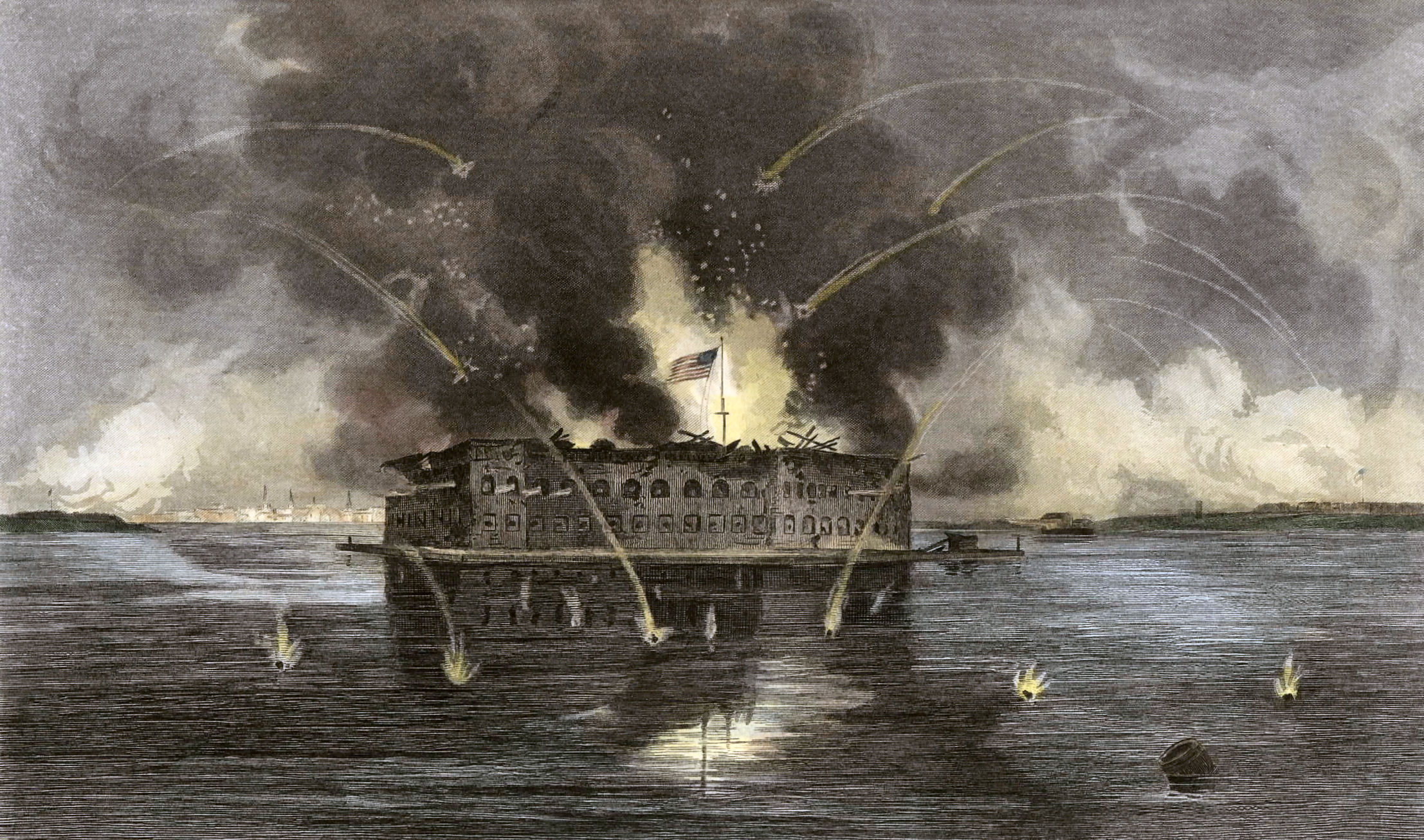
Five months and 150 years ago, in November 1860, Abraham Lincoln was elected president of the United States, and beginning in December, led by South Carolina, the Deep South seceded and seized local federal bases and depots. In the uncertain months of early 1861, South Carolina repeatedly called for the evacuation of Fort Sumter, and the first shots of the war were fired in January to drive off a steamer attempting to resupply the fort. Lincoln took office on March 4, and eventually sent ships to resupply the fort. The morning after the first ships arrived on April 11, Confederate batteries opened fire, and the Civil War began. Virginia seceded on April 17; Robert E. Lee resigned on April 20 to go south; and a week later West Virginia seceded from Virginia. In May, Arkansas and Tennessee seceded, and Kentucky declared neutrality. Not until July was the first major battle of the war fought, at Bull Run, as Washingtonians picnicked.

In the western theater, Kentucky's neutrality would hold until September, when Confederate and Union forces attempted to secure the Ohio River valley at the river's mouth. But the major battles of Kentucky and Tennessee happened in 1862, when the Union captured Fort Donelson on the Cumberland River in February, pushing the front south to the Tennessee River, and the Confederacy was turned back from the Kentucky campaign at the Battle of Perryville in October.

In November 2010, by contrast, the Republicans made significant gains in the House in the midterm elections, and the country's political attention has been focused on conflicts over government spending, federal debt, and military action in the Maghreb. Months will trickle by in the ongoing debates, as the country drifts closer to the 2012 presidential elections, already underway. It's been a similar amount of time from the 2010 elections as from Lincoln's election to Fort Sumter.

So, there are a couple of blogs launched to overview the commemoration of the Civil War as it proceeds: The Long Recall, a period blog of the Civil War, A House Divided at the Washington Post, and Disunion at the New York Times (timeline). A snippet:
Charleston Harbor, S.C., April 9, 1861
After months of anxiety and expectation, there came at last a day of terrible clarity. For months, a single question had preoccupied the men of Fort Sumter’s beleaguered Union garrison, from their commander down to the lowliest private: what would the Lincoln administration do? Would it yield to Southern coercion and evacuate the fort, sending a signal to the world that it was ready to negotiate with the secessionists, and perhaps even let the slave states go in peace? Or would it send reinforcements and supplies to Charleston Harbor — and in so doing, quite possibly touch off civil war?

...the garrison had remained in a bizarre position of both power and powerlessness. One the one hand, as [fort surgeon Samuel Wylie] Crawford realized, they could at will change the course of American history, with a single cannon shot from one. On the other hand, Fort Sumter, which had looked so commanding and impregnable on their first arrival, was beginning to feel less so. On all sides of the harbor, they could see new artillery platforms under construction, cannons being wheeled into place, and in the distance bayonets flashing like a heliographed message, as recruits marched and counter-marched on the beach. Major Robert Anderson, the Union garrison’s commander, expressed it for most in the garrison when he wrote that he felt like “a sheep tied watching the butcher sharpening a knife to cut his throat.”
The Civil War Trust has an animated map of the battle of Fort Sumter, among others. Public, professional, and amateur historians are writing many other blogs (1, 2, 3, 4, 5, 6, 7, 8 ) and lists ( 1, 2, 3, 4, 5, 6, 7 ).

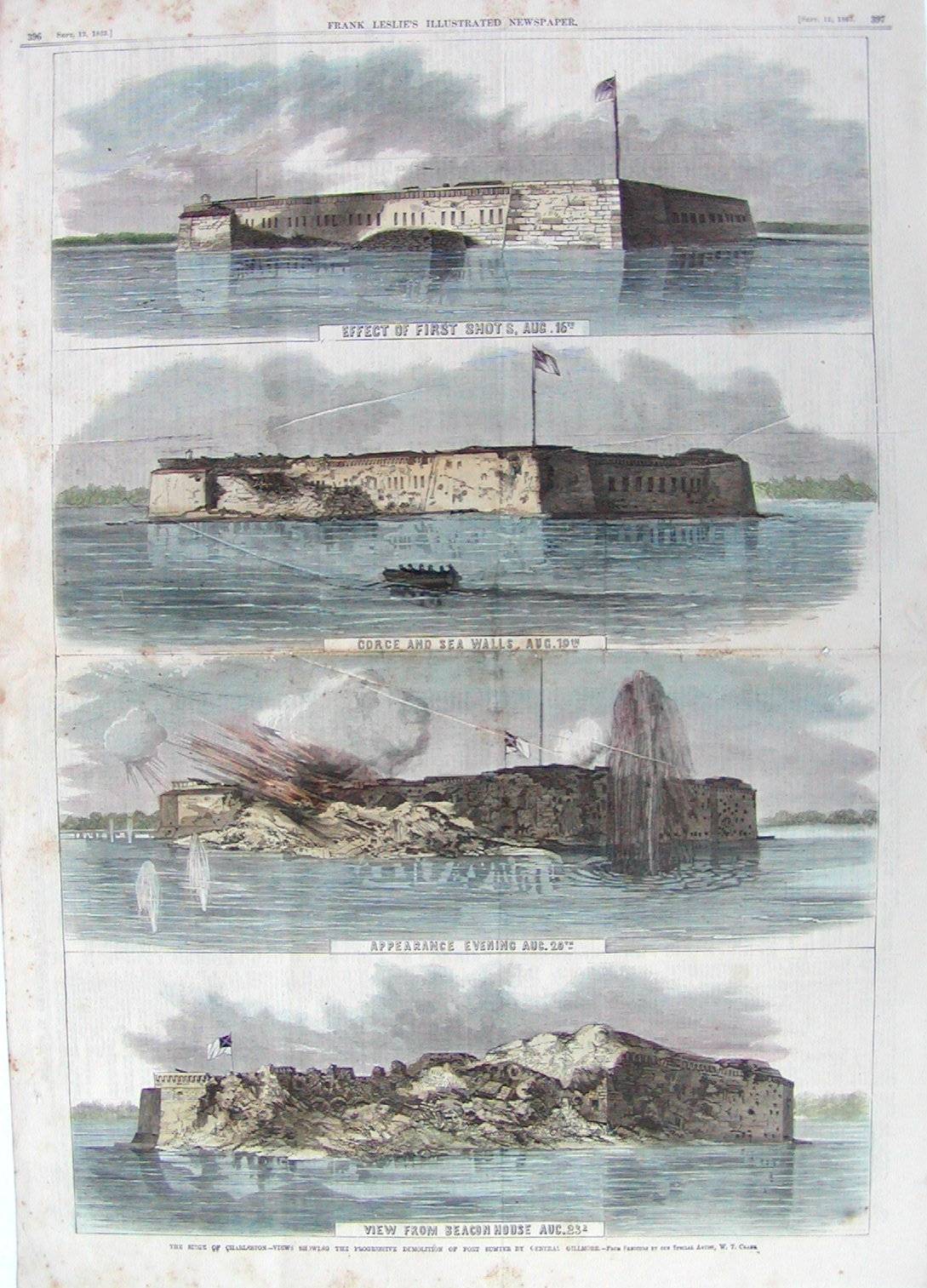
Images: National Park Service Fort Sumter Historic Images

EDIT
In Why They Fight: Civil War Re-enactors and the Battle over Historic Sites (Time), Gregg Segal has a series of photos of Civil War re-enactors in the modern locations of battles.

Baylor University has a digital version of the War of the Rebellion Atlas.