Showing posts with label Caribbean. Show all posts

Saturday, April 9, 2011

Muddy water taking back the land

Continental drift (1, 2, 3, 4, 5) isn't the only way the shape of landforms will change. Coastlines vary a great deal with sea level, as well. Climate change predicts at least a certain amount of change in sea levels. The IPCC's Fourth Assessment Report, Climate Change 2007, Working Group II, predicts less than a meter of sea level rise over the next century or so.

The most extreme speculations about rising sea levels have to do with the melting of all the ice trapped in Greenland and Antarctica, which could cause sea levels to rise 60 or 70 meters. Of course, that's nothing more than informed speculation: people just don't know enough about the the Antarctic ice sheet to predict how it will behave in the future. The current arrangement of the continents means that ocean currents are very different from the ancient worlds that had well-mixed oceans and ice-free poles, and as long as Antarctica is located over the South Pole, keeping the ice from floating off, a great deal of ice may be parked there.

But, speculation is fun! According to the USGS, even a 10-m rise would displace 25% of the US population. Sea Level Explorer shows height above sea level using Google Maps. Flood Maps uses Google Maps to show sea level rise from 7 meters to over 60 meters. At 13 meters, Shanghai and Tianjin in China are completely flooded, and much of Bangladesh and Calcutta in India are flooded. Not to mention Miami and New Orleans. At 60 meters, huge population centers in Bangladesh, China, coastal Europe, and the southern U.S. are under water. Johnston's Archive has some neat pictures of a 66-meter rise in sea level.

The 100-meter maps are the most fun. Maps for "An End to Global Warming" has maps of North America with a 100-meter rise (also here), released by Dave Pape under a CC-Attribution license.

New England is an island, stretching from the Hudson Straits to New Brunswick.Below its cataracts, the Ohio River flows through the tidewater directly into the huge Mississippi Sea.In the Greater Antilles, Cuba is a much-reduced archipelago, while Jamaica and Hispaniola mostly retain their shapes.
With Dubia, Chris Wayan speculates on an Earth after a thousand years of unrestrained carbon pollution and global warming:
That world heats up. Climate zones move north until the poles thaw. Greenland and Antarctica melt. Coastal nations are drowned. In the end, the sea rises some 110 meters. Global hothouse! It's happened before, of course, on this scale, but not in the last 50 million years or so.

...we shouldn't be surprised to find that Florida now has no governor—or voters. It's a scuba paradise rivaling Australia's Barrier Reef, but there's no dry land at all. Louisiana was doomed too, of course, but I was startled to find that the sea swallows half Alabama too—south of Tuscaloosa, only Red and Grove Islands and the small Troy Peninsula are left. Mississippi is even worse off—the Gulf chews inland to Tupelo and Mantee, leaving only the Jackson Peninsula and Brookhaven Island, and a jungly strip up at the Tennessee border. Mississippi Bay nibbles all the way up into Illinois, though it's broken up on the west side by long Crowley Island and the Spring and Pleasant Isles. Further south, in Texas, fishermen avoid the rotting, polluted Houston Reefs. But Austin survives—with a steamy coastal climate, flora, and culture resembling lost New Orleans.

Unfortunately, Dallas survives too.

...For, by definition, most readers will be from our world's high-population zones. Random changes will, on average, degrade them. And the lands that improve, that become the heartlands of Randomia's civilizations, are likely to be barren obscure lands in our world, mere names (if that) to non-Randomian readers. The great European cities are all flooded on Dubia (millions of European readers groan), while the green Sahara nurtures great civilizations (a handful of Saharan readers cheer). If you love civilization, Randomia will probably kill or cripple the ones you love, and plant its greatest civilizations in places you associate with backwardness.

So the grass always looks browner in a parallel world--because what you value most, what you KNOW to value, is generally lost. This principle makes it hard to see alternate worlds fairly.
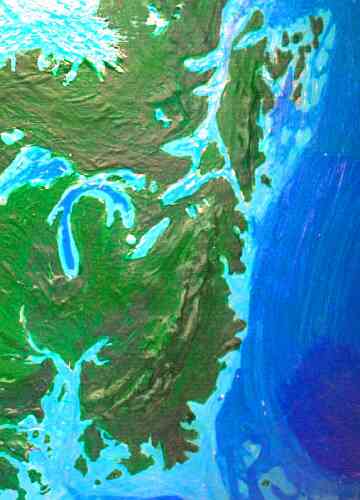
His Planetocopia has all sorts of images of speculative versions of Earth and other planets. There's also some interesting discussion at the Randi forums.

Wednesday, January 20, 2010

Haiti & the earthquake

A week ago, on January 12 at 4:53pm, a powerful earthquake struck Haiti. The images from the disaster, such as this graphic Boston Globe photo gallery, are staggering. The Guardian has a map of relief efforts.

The NYT brings together eight ways the rebuild Haiti. Felix Salmon advises not to give money to Haiti (at least, not earmarked for Haiti); AidWatch concurs and has more advice. Similar thoughts here, although aid can relieve immediate suffering. Jeffrey Sachs and David Brooks consider postdisaster reconstruction.

Econoblogger Tyler Cowen was anticipating a Haitian renaissance hours before the earthquake struck. He'd luckily avoided being there on holiday, a trip influenced by his history with Haiti. Cowen discusses other ways to help Haiti, geopolitical speculations about Haiti, and considers why is Haiti so poor. It's a topic of great interest: Why is Haiti so poor?

Some point to the timeline of U.S. involvement in Haiti. Haiti's history of terrible governance is justly infamous. Ronald Bailey argues that Haiti's lack of human, social, and institutional capital explains its lack of wealth. A news report from last summer highlights the lingering colonial debt:
The appalling state of the country is a direct result of having offended a quite different celestial authority — the French. France gained the western third of the island of Hispaniola — the territory that is now Haiti — in 1697. It planted sugar and coffee, supported by an unprecedented increase in the importation of African slaves. Economically, the result was a success, but life as a slave was intolerable. Living conditions were squalid, disease was rife, and beatings and abuses were universal. The slaves’ life expectancy was 21 years. After a dramatic slave uprising that shook the western world, and 12 years of war, Haiti finally defeated Napoleon’s forces in 1804 and declared independence. But France demanded reparations: 150m francs, in gold.

For Haiti, this debt did not signify the beginning of freedom, but the end of hope. Even after it was reduced to 60m francs in the 1830s, it was still far more than the war-ravaged country could afford. Haiti was the only country in which the ex-slaves themselves were expected to pay a foreign government for their liberty. By 1900, it was spending 80% of its national budget on repayments. In order to manage the original reparations, further loans were taken out — mostly from the United States, Germany and France. Instead of developing its potential, this deformed state produced a parade of nefarious leaders, most of whom gave up the insurmountable task of trying to fix the country and looted it instead. In 1947, Haiti finally paid off the original reparations, plus interest. Doing so left it destitute, corrupt, disastrously lacking in investment and politically volatile. Haiti was trapped in a downward spiral, from which it is still impossible to escape. It remains hopelessly in debt to this day.

The debt, 150 million gold francs, would be the equivalent of about 1.4 million troy ounces. That amount of gold today is worth nearly $1.6 billion. Haitian mud cakes (1, 2, 3, 4, 5) are an attempt to cope with the physical suffering of chronic hunger.

There's also been interest in Jared Diamond's comparative discussion of Haitian and Dominican history, environment, and development in chapter 11 of Collapse. Diamond's discussion is a broad overview, but he begins with Haitian deforestation:
To anyone interested in understanding the modern world's problems, it's a dramatic challenge to understand the 120-mile-long border between the Dominican Republic and Haiti, the two nations dividing the large Caribbean island of Hispanola that lies southeast of Florida. ...From an airplane flying high overhead, the border looks like a sharp line with bends, cut arbitrarily across the island by a knife, and abruptly dividing a darker and greener landscape east of the line (the Dominican side) from a paler and browner landscape west of the line (the Haitian side). On the ground, one can stand on the border at many places, face east, and look into pine forest, then turn around, face west, and see nothing except fields almost devoid of trees.

That contrast visible at the border exemplifies a difference between the two countries as a whole. Originally, both parts of the island were largely forested... Today, 28% of the Dominican Republic is still forested, but only 1% of Haiti. ...In Haiti and the Dominican Republic just as elsewhere in the world, the consequences of all that deforestation include loss of timber and other forest materials, soil erosion, loss of soil fertility, sediment loads in the rivers, loss of watershed protection and hence of potential hydroelectric power, and decreased rainfall. All of those problems are more severe in Haiti than in the Dominican Republic. In Haiti, more urgent than any of those just-mentioned consequences is the problem of the loss of wood for making charcoal, Haiti's main fuel for cooking.

...there were many reasons why deforestation and other environmental problems began earlier, developed over a longer time, and proceeded further in Haiti than in the Dominican Republic. The reasons involved four of the factors in this book's five-factor framework: differences in human environmental impacts, in various friendly or unfriendly policies of other countries, and in responses by the societies and their leaders. Of the case studies described in this book, the contrast between Haiti and the Dominican Republic discussed in this chapter, and the contrast between the fates of the Norse and the Inuit in Greenland...provide the clearest illustrations that a society's fate lies in its own hands and depends substantially on its own choices.

EDIT
I've been updating this post significantly in the time since I posted it, mostly to add more links. Nicholas Kristof interviewed notable aid critics, who emphasized the need for assistance to earthquake victims, and advocated garmet sweatshops. Kristof has defended the importance of sweatshops in 2000 2006, and 2009, echoed by Paul Krugman. Andy Kershaw demands a more respect for Haitians.