This morning was a once-in-centuries full lunar eclipse on the winter solstice, but even though last week's ice storms have melted off, it was too overcast here to be worth waking up.
Still thinking about solstice traditions. Since this is the first year I've had a proper Yule Tree, I'll save the trunk to kindle a fire on the solstice, and maybe grill some pork chops.
Showing posts with label astronomy. Show all posts
Showing posts with label astronomy. Show all posts
Tuesday, December 21, 2010

Wednesday, September 22, 2010
Happy Equinox
...btw; today's the autumnal equinox (and the week of Oktoberfest).
I managed to find Jupiter with my wee telescope on Monday, but I couldn't get it to focus any sharper than a blur.
I managed to find Jupiter with my wee telescope on Monday, but I couldn't get it to focus any sharper than a blur.
Tuesday, September 7, 2010
Letters to a future age
...on the Georgia Guidestones, an American Stonehenge: Monumental Instructions for the Post-Apocalypse (Wired).
It's kind of amazing how relatively easy it is to send Rosetta Stones forward into the future, although I wonder how this monument would hold up over 10,000 years. That is a truly mind-boggling distance of time, and yet but a pittance if our species is to continue to survive in geological time.
EDIT
The third directive is "unite humanity with a living new language".
It's kind of amazing how relatively easy it is to send Rosetta Stones forward into the future, although I wonder how this monument would hold up over 10,000 years. That is a truly mind-boggling distance of time, and yet but a pittance if our species is to continue to survive in geological time.
EDIT
The third directive is "unite humanity with a living new language".
Tuesday, January 5, 2010
Solar eclipses in the Ohio River Valley
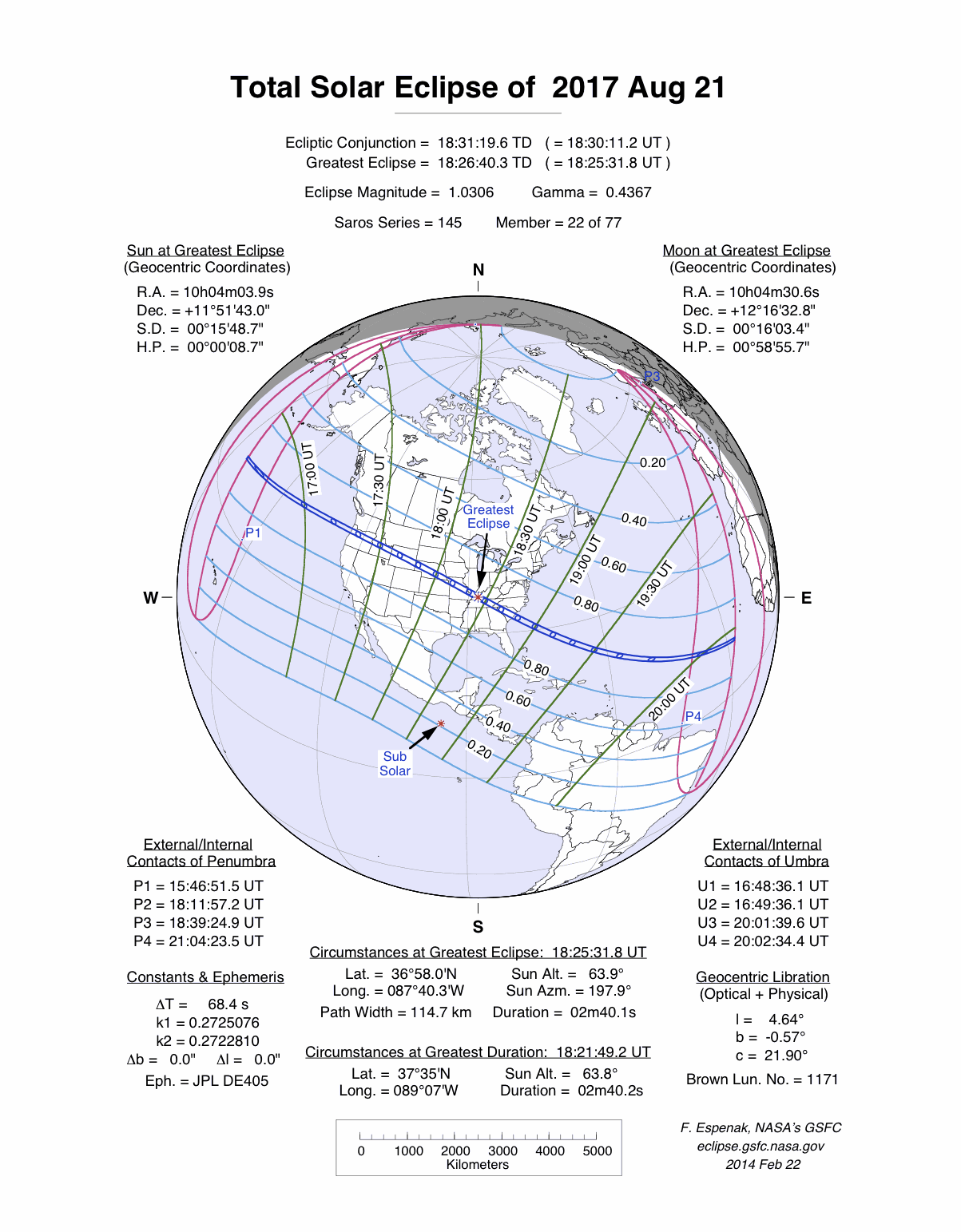
A mendicantbug post about searching WolframAlpha for eclipses alerts us to the upcoming major total solar eclipses in August 2017 (NASA) and April 2024. That'll be the last eclipse with a nearby totality until 2045.
The next lunar eclipse on the winter solstice this year and the 2012 partial solar eclipse may be visible just before sunset.
Perhaps WolframAlpha is more useful than I had thought.
The next lunar eclipse on the winter solstice this year and the 2012 partial solar eclipse may be visible just before sunset.
Perhaps WolframAlpha is more useful than I had thought.
Thursday, December 31, 2009
The 11th day of Winter
The winter solstice is, technically, not the shortest day of the year, but the brief instant at which the Earth's axial tilt is farthest away from the sun; this occurred on Dec. 21, at 17:47 UTC. More colloquially, it is the day on which this instant occurs, which is commonly known as the first day of winter. So, today is the 11th day of Winter. The solstice can occur at varying times; in 2006, it happened 22 minutes after midnight UTC, according to the USNO. The solstice being an instant rather than a day can be a source of some confusion, as when pagans celebrate the solstice on the wrong day, showing up at Stonehenge a day early (since it seems Stonehenge observes the first sunrise after the moment of the solstice).
Measuring this precise moment is difficult for non-astronomers, but ancient peoples built many structures aligned with the changing position of the rising or setting sun throughout the year. The summer solstice is easier to determine using their methods than the winter, because around the winter solstice, the "sun stands still". More modern instruments can use this phenomena, the analemma, in an analemma calendar.
This New Year's Eve will also see the second full moon in the month of December, a "blue moon" (1, 2, 3, 4). The next winter solstice, on December 21, 2010, will feature a total lunar eclipse visible in all stages throughout North America.
I reckon everyone will celebrate the end of the Aughties tonight, since 2010 begins in a few hours. Of course, the 10th year is the final year in a set of ten years; 2010 is the last year of the first decade of the 21st century, and the second decade begins in 2011. We begin counting with the number 1, not the number zero. But the common parlance will have tonight as the end of the Aughties, and (not being a fan of the decade) I'd say we should move on to a new one sooner than later.
Happy New Year!
Measuring this precise moment is difficult for non-astronomers, but ancient peoples built many structures aligned with the changing position of the rising or setting sun throughout the year. The summer solstice is easier to determine using their methods than the winter, because around the winter solstice, the "sun stands still". More modern instruments can use this phenomena, the analemma, in an analemma calendar.
This New Year's Eve will also see the second full moon in the month of December, a "blue moon" (1, 2, 3, 4). The next winter solstice, on December 21, 2010, will feature a total lunar eclipse visible in all stages throughout North America.
I reckon everyone will celebrate the end of the Aughties tonight, since 2010 begins in a few hours. Of course, the 10th year is the final year in a set of ten years; 2010 is the last year of the first decade of the 21st century, and the second decade begins in 2011. We begin counting with the number 1, not the number zero. But the common parlance will have tonight as the end of the Aughties, and (not being a fan of the decade) I'd say we should move on to a new one sooner than later.
Happy New Year!
Monday, December 14, 2009
A River of Stars in a Dark Sky
 In Japanese, the Milky Way is known as "天の川 (あまのがわ)", the River of Heaven, because it appears as a mighty river of stars flowing through the night sky. Every summer, people celebrate "Tanabata", a festival that recognizes this phenomena.
 Long ago, there was a princess named Vega, who was the daughter of the king of heaven. Every day, she went to the banks of the Milky Way River to weave clothes for her father. But since she worked so hard, she was very lonely. One day, she met a cowboy tending his herd on the other side of the river. His name was Altair, and they fell in love and soon got married. But after they were married, the princess didn't weave clothes for her father, and the cowboy let his animals wander all over the sky. This made Vega's father angry, so he banished Altair to the other side of the river to separate the couple. Each of the pair could only sit on opposite sides of the river and look wistfully at each other. But on one night every year, on the seventh night of the seventh month, the pair of stars are allowed to meet one another, since a flock of magpies agreed to form a bridge over the river with their wings.
This phenomena is hard to see, because of pervasive light pollution in the developed world, the extent of which is apparent in maps of Earth's city lights. In most cities, light pollution is so severe that only the very brightest starts are faintly visible, while in truly dark areas, the light of the Milky Way can cast a visible shadow.
The International Dark Sky Association advocates against light pollution. There are a few locations in the eastern US designated as a dark sky preserve, including Cherry Springs State Park in northern Pennsylvania. The park has annual star parties that attract hundreds of astronomers, which began in the late 1990s when individual hobbyists noticed an isolated black patch on nighttime satellite photos.
Similar maps can be seen at the World Atlas of Artificial Night Sky Brightness. One of the largest patches of dark skies in the eastern US appears to be in eastern West Virginia in the Monongahela National Forest. This area is the heart of the National Radio Astronomy Observatory, which has the world's largest fully steerable radio telescope in a radio quiet zone at Green Bank, WV.
For nearer places, the DarkSky Finder is a Java application that works in Firefox. Near Louisville, the darkest sites are southwest of Leavenworth, IN, in the southeastern portion of the Hoosier National Forest and across the river in the corresponding section of Kentucky. There is a slightly darker area immediately west of Hazard, KY, around Buckhorn Lake (an area with a high incidence of communities with interesting names). There are some maps and brochures of the Daniel Boone National Forest for this area; the Redbird Crest Trail, especially the eastern side, is in the middle of this dark spot. The topo maps could useful as well; 17 is Buckhorn Lake; 44 shows the area around Thousandsticks west of Hyden; and the Redbird Crest Trail is on 11 and 28, centered on Creekville.
Subscribe to:
Posts (Atom)

 Posts
Posts