Non-Terre-centric measurement in science fiction is surprisingly uncommon, but China Miéville's "Embassytown" does an interesting job of it. Rather than seconds or local days or years, time is measured with hours according to the metric system prefixes. The base SI unit is not the hour but the second, of course, but this is similar to using the kilogram as basic rather than the gram.
We should assume an hour is 3,600 contemporary Terre seconds.Thus, a kilohour is just more than 41 days (comparable to a month), a megahour is about 114 Julian years, and a gigahour is about 114,077 Julian years.
This is relatively human-scale, perhaps even compared to the kilosecond, but again there's the difficulty of nothing in between the kilo- and the mega- and the giga-. Here there's no basic unit in between the near-month and the near-century. I suspect that humans need to measure human-scale time with a unit that has more factors than 1, 2, 5, and 10.
Showing posts with label time and calendars. Show all posts
Showing posts with label time and calendars. Show all posts
Friday, June 7, 2013

Thursday, May 31, 2012
The HHH system of measurement
The hathmic system, also known as the hathom-hecand-hemoth
system, is a hexadecimal anthropocentric system of measurement, created
as an exercise in recreational arithmetic, as an intellectual folly,
and possibly for purposes of fiction. The names aren't serious, mostly
just bad puns on various historical units (fathom, plethron, li, league, fist, watch, behemoth, and quadrans).
Anthropocentric units are often more useful to humans than geocentric ones, but they should be based on some consistent scale rather than using different ratios between units. The metric system is inconvenient in anthropocentric terms, but is very convenient in being based consistently on a decimal system. But the decimal system is kind of boring, so this system based upon hexadecimal comes from a made-up culture that reveres squares. Different systems of measurement are good at measuring different things; this system is focused on representing human-scale walking travel times. For example, in one haach (of time), a person can walk about one hleeg (of distance).
The base unit is the hathom, which by astonishing coincidence is precisely 1.8 meters. This is six feet in metric (25-mm) inches, or about 5 feet 10 inches, roughly the average height of a human male. Sixteen hathoms are a lethron, which is 28.8 meters or about 94.5 feet. Sixteen lethrons are a hli, which is 460.8 meters or about 0.29 miles. Sixteen hlis are a hleeg, which is 7.372 kilometers, or about 4.58 miles.
Going smaller, one-sixteenth of a hathom is a lister, which is 112.5 millimeters or about 4.43 inches. A lister is further divided into sixteen units, each of which is each to about 7 millimeters or 0.28 inches.
The most practical unit of time is the day, one-sixteenth of which is a haach. This is an hour and a half long. The base unit of time, however, is the hecand, which is about 1.3 seconds. There are 65,536 hecands in a day.
There has to be a base unit of mass, to fill out the system; I'm just ripping off SI on this. The base unit of mass is the hemoth, equivalent to 5,832 kilograms. More commonly, people would use a huad, which weighs about 89 grams. Sixteen huads weigh about 1.42 kilograms.
Anthropocentric units are often more useful to humans than geocentric ones, but they should be based on some consistent scale rather than using different ratios between units. The metric system is inconvenient in anthropocentric terms, but is very convenient in being based consistently on a decimal system. But the decimal system is kind of boring, so this system based upon hexadecimal comes from a made-up culture that reveres squares. Different systems of measurement are good at measuring different things; this system is focused on representing human-scale walking travel times. For example, in one haach (of time), a person can walk about one hleeg (of distance).
The base unit is the hathom, which by astonishing coincidence is precisely 1.8 meters. This is six feet in metric (25-mm) inches, or about 5 feet 10 inches, roughly the average height of a human male. Sixteen hathoms are a lethron, which is 28.8 meters or about 94.5 feet. Sixteen lethrons are a hli, which is 460.8 meters or about 0.29 miles. Sixteen hlis are a hleeg, which is 7.372 kilometers, or about 4.58 miles.
Going smaller, one-sixteenth of a hathom is a lister, which is 112.5 millimeters or about 4.43 inches. A lister is further divided into sixteen units, each of which is each to about 7 millimeters or 0.28 inches.
The most practical unit of time is the day, one-sixteenth of which is a haach. This is an hour and a half long. The base unit of time, however, is the hecand, which is about 1.3 seconds. There are 65,536 hecands in a day.
There has to be a base unit of mass, to fill out the system; I'm just ripping off SI on this. The base unit of mass is the hemoth, equivalent to 5,832 kilograms. More commonly, people would use a huad, which weighs about 89 grams. Sixteen huads weigh about 1.42 kilograms.
Tuesday, April 12, 2011
Commemorating the Civil War
There are times, when traveling, that we must fly in to a city, spend a few days there, and depart. But when you see a place in this way, the sense you get of that place is disconnected from the space that it inhabits. You don't get a sense of how far the place is from its neighbors, from its rivals, from its mountains or rivers or coasts. I prefer a mode of travel that is itself a journey: fly into a city if necessary, but travel from there to another place, and depart. To travel overland, be it by train, by car, by ferry, on the surface of the Earth gives you a much deeper appreciation for the context of a place, and how it fits into the space of the world, in relationship to other places.
 As with space, so with time. This commemoration of the American Civil War should not be a sudden occasional glimpse of some stuff that happened an arbitrary amount of time ago, but a way to understand the context of the unfolding events of the past, and their relationships to each other, by making an analogy to the timestream that we experience every day. It's low-bandwidth approach to appreciating history: rather than observing deeply for a short period of time, observe shallowly for a long period of time.
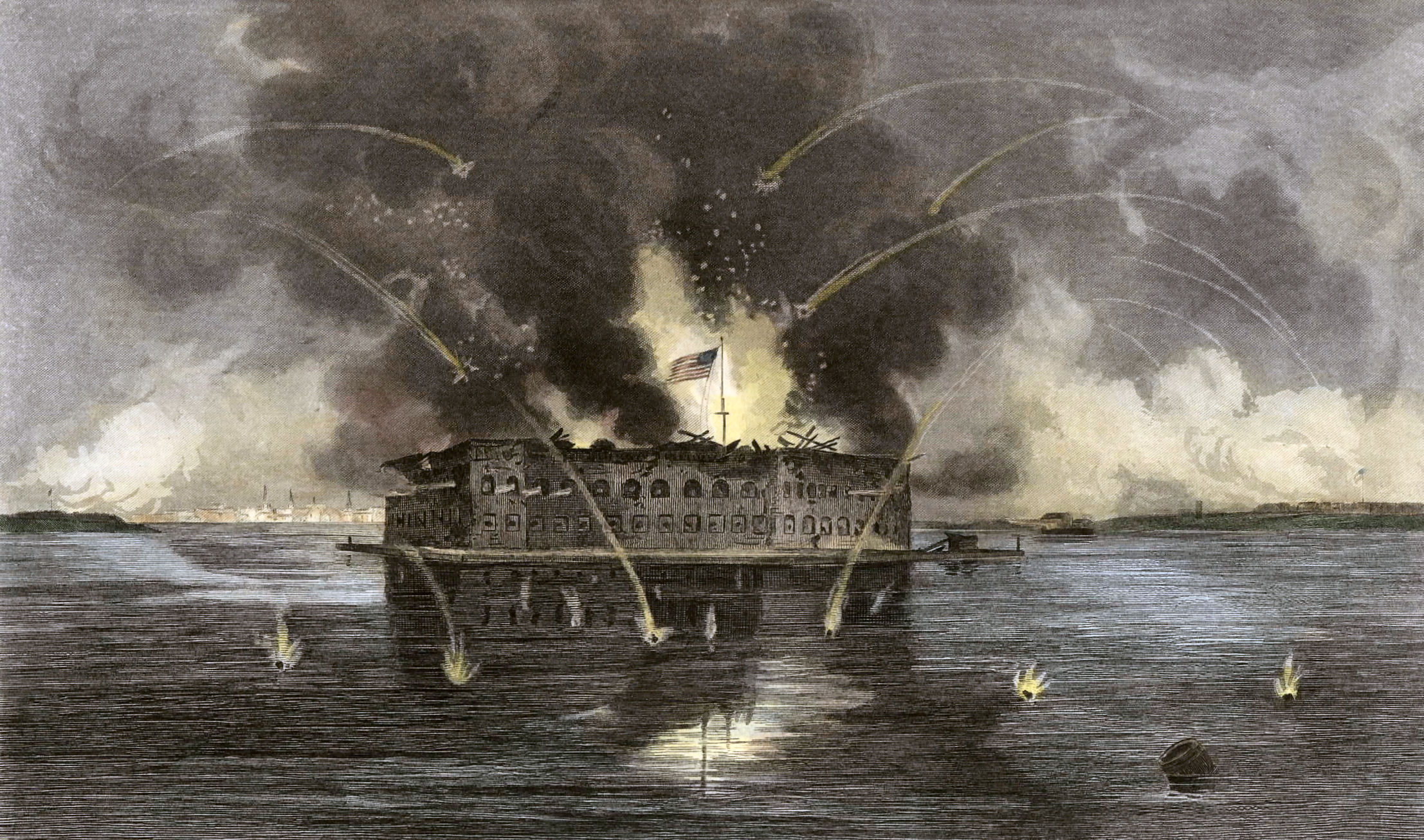
Five months and 150 years ago, in November 1860, Abraham Lincoln was elected president of the United States, and beginning in December, led by South Carolina, the Deep South seceded and seized local federal bases and depots. In the uncertain months of early 1861, South Carolina repeatedly called for the evacuation of Fort Sumter, and the first shots of the war were fired in January to drive off a steamer attempting to resupply the fort. Lincoln took office on March 4, and eventually sent ships to resupply the fort. The morning after the first ships arrived on April 11, Confederate batteries opened fire, and the Civil War began. Virginia seceded on April 17; Robert E. Lee resigned on April 20 to go south; and a week later West Virginia seceded from Virginia. In May, Arkansas and Tennessee seceded, and Kentucky declared neutrality. Not until July was the first major battle of the war fought, at Bull Run, as Washingtonians picnicked.
In the western theater, Kentucky's neutrality would hold until September, when Confederate and Union forces attempted to secure the Ohio River valley at the river's mouth. But the major battles of Kentucky and Tennessee happened in 1862, when the Union captured Fort Donelson on the Cumberland River in February, pushing the front south to the Tennessee River, and the Confederacy was turned back from the Kentucky campaign at the Battle of Perryville in October.
In November 2010, by contrast, the Republicans made significant gains in the House in the midterm elections, and the country's political attention has been focused on conflicts over government spending, federal debt, and military action in the Maghreb. Months will trickle by in the ongoing debates, as the country drifts closer to the 2012 presidential elections, already underway. It's been a similar amount of time from the 2010 elections as from Lincoln's election to Fort Sumter.
So, there are a couple of blogs launched to overview the commemoration of the Civil War as it proceeds: The Long Recall, a period blog of the Civil War, A House Divided at the Washington Post, and Disunion at the New York Times (timeline). A snippet:

Images: National Park Service Fort Sumter Historic Images
EDIT
In Why They Fight: Civil War Re-enactors and the Battle over Historic Sites (Time), Gregg Segal has a series of photos of Civil War re-enactors in the modern locations of battles.
Baylor University has a digital version of the War of the Rebellion Atlas.
 As with space, so with time. This commemoration of the American Civil War should not be a sudden occasional glimpse of some stuff that happened an arbitrary amount of time ago, but a way to understand the context of the unfolding events of the past, and their relationships to each other, by making an analogy to the timestream that we experience every day. It's low-bandwidth approach to appreciating history: rather than observing deeply for a short period of time, observe shallowly for a long period of time.
 Five months and 150 years ago, in November 1860, Abraham Lincoln was elected president of the United States, and beginning in December, led by South Carolina, the Deep South seceded and seized local federal bases and depots. In the uncertain months of early 1861, South Carolina repeatedly called for the evacuation of Fort Sumter, and the first shots of the war were fired in January to drive off a steamer attempting to resupply the fort. Lincoln took office on March 4, and eventually sent ships to resupply the fort. The morning after the first ships arrived on April 11, Confederate batteries opened fire, and the Civil War began. Virginia seceded on April 17; Robert E. Lee resigned on April 20 to go south; and a week later West Virginia seceded from Virginia. In May, Arkansas and Tennessee seceded, and Kentucky declared neutrality. Not until July was the first major battle of the war fought, at Bull Run, as Washingtonians picnicked.
In the western theater, Kentucky's neutrality would hold until September, when Confederate and Union forces attempted to secure the Ohio River valley at the river's mouth. But the major battles of Kentucky and Tennessee happened in 1862, when the Union captured Fort Donelson on the Cumberland River in February, pushing the front south to the Tennessee River, and the Confederacy was turned back from the Kentucky campaign at the Battle of Perryville in October.
In November 2010, by contrast, the Republicans made significant gains in the House in the midterm elections, and the country's political attention has been focused on conflicts over government spending, federal debt, and military action in the Maghreb. Months will trickle by in the ongoing debates, as the country drifts closer to the 2012 presidential elections, already underway. It's been a similar amount of time from the 2010 elections as from Lincoln's election to Fort Sumter.
So, there are a couple of blogs launched to overview the commemoration of the Civil War as it proceeds: The Long Recall, a period blog of the Civil War, A House Divided at the Washington Post, and Disunion at the New York Times (timeline). A snippet:
Charleston Harbor, S.C., April 9, 1861The Civil War Trust has an animated map of the battle of Fort Sumter, among others. Public, professional, and amateur historians are writing many other blogs (1, 2, 3, 4, 5, 6, 7, 8 ) and lists ( 1, 2, 3, 4, 5, 6, 7 ).
After months of anxiety and expectation, there came at last a day of terrible clarity. For months, a single question had preoccupied the men of Fort Sumter’s beleaguered Union garrison, from their commander down to the lowliest private: what would the Lincoln administration do? Would it yield to Southern coercion and evacuate the fort, sending a signal to the world that it was ready to negotiate with the secessionists, and perhaps even let the slave states go in peace? Or would it send reinforcements and supplies to Charleston Harbor — and in so doing, quite possibly touch off civil war?
...the garrison had remained in a bizarre position of both power and powerlessness. One the one hand, as [fort surgeon Samuel Wylie] Crawford realized, they could at will change the course of American history, with a single cannon shot from one. On the other hand, Fort Sumter, which had looked so commanding and impregnable on their first arrival, was beginning to feel less so. On all sides of the harbor, they could see new artillery platforms under construction, cannons being wheeled into place, and in the distance bayonets flashing like a heliographed message, as recruits marched and counter-marched on the beach. Major Robert Anderson, the Union garrison’s commander, expressed it for most in the garrison when he wrote that he felt like “a sheep tied watching the butcher sharpening a knife to cut his throat.”
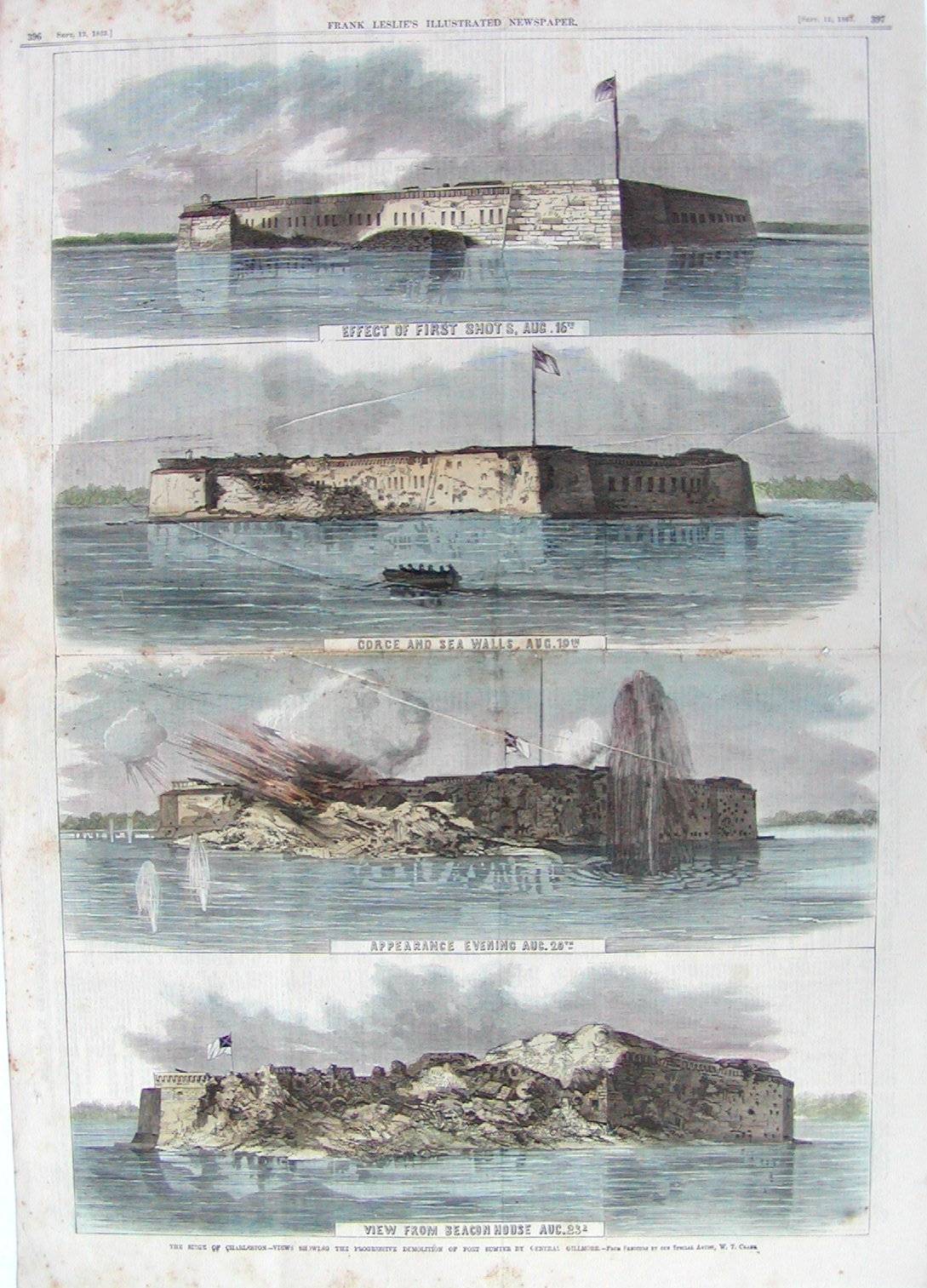
Images: National Park Service Fort Sumter Historic Images
EDIT
In Why They Fight: Civil War Re-enactors and the Battle over Historic Sites (Time), Gregg Segal has a series of photos of Civil War re-enactors in the modern locations of battles.
Baylor University has a digital version of the War of the Rebellion Atlas.
Wednesday, September 22, 2010
Happy Equinox
...btw; today's the autumnal equinox (and the week of Oktoberfest).
I managed to find Jupiter with my wee telescope on Monday, but I couldn't get it to focus any sharper than a blur.
I managed to find Jupiter with my wee telescope on Monday, but I couldn't get it to focus any sharper than a blur.
Tuesday, September 7, 2010
Letters to a future age
...on the Georgia Guidestones, an American Stonehenge: Monumental Instructions for the Post-Apocalypse (Wired).
It's kind of amazing how relatively easy it is to send Rosetta Stones forward into the future, although I wonder how this monument would hold up over 10,000 years. That is a truly mind-boggling distance of time, and yet but a pittance if our species is to continue to survive in geological time.
EDIT
The third directive is "unite humanity with a living new language".
It's kind of amazing how relatively easy it is to send Rosetta Stones forward into the future, although I wonder how this monument would hold up over 10,000 years. That is a truly mind-boggling distance of time, and yet but a pittance if our species is to continue to survive in geological time.
EDIT
The third directive is "unite humanity with a living new language".
Sunday, February 14, 2010
On Lupercalia, 2010 CE
Today is the 56th day of winter, in the 2,010th year of the common era. Today is a celebration descended from the Roman ritual of Lupercalia, celebrated in a colorful way by them, and renamed by the Christians after one of their saints, in the usual way.
Today we took possession of our snow-blanketed house. Another snowstorm is due tonight.
Weird.
Today we took possession of our snow-blanketed house. Another snowstorm is due tonight.
Weird.
Saturday, January 16, 2010
"2010" and the national epoch
The year is now 2010, which unfortunately is time for prescriptivist nonsense.
There's another good example of saying the year number fully in the US Constitution (Article VII):
The US Constitution would have 1776 as year one, the first year of independence.
I've been a little curious about the usage of the quaint "in the year of the Republic" recently. This sort of epoch is said to be common in Taiwan, based on an East Asian tradition of dating in regnal years, as in contemporary Japan. The French Republican calendar used a similar epoch from 1793, and the positivist calendar had 1789 as the first year. Other examples are a little tricky to Google up, even if it was a common enough phrase. A court document cited here describes 1837 as the second year of the Republic (of Texas). But this system seems to be a source of confusion: 1938 would be the 163rd year of independence, and the 152nd year of the Republic. It's a confusion of cardinal and ordinal numbers; July 4, 1776, marked the completion of two centuries of American independence, even if something that happened in 1976 was "in the 201st year of independence."
So in 2010, we should say "in the 235th year of independence" and "in the 224th year of the Republic".
There's another good example of saying the year number fully in the US Constitution (Article VII):
Done in Convention by the Unanimous Consent of the States present the Seventeenth Day of September in the Year of our Lord one thousand seven hundred and Eighty seven and of the Independence of the United States of America the Twelfth In witness whereof We have hereunto subscribed our Names...
The US Constitution would have 1776 as year one, the first year of independence.
I've been a little curious about the usage of the quaint "in the year of the Republic" recently. This sort of epoch is said to be common in Taiwan, based on an East Asian tradition of dating in regnal years, as in contemporary Japan. The French Republican calendar used a similar epoch from 1793, and the positivist calendar had 1789 as the first year. Other examples are a little tricky to Google up, even if it was a common enough phrase. A court document cited here describes 1837 as the second year of the Republic (of Texas). But this system seems to be a source of confusion: 1938 would be the 163rd year of independence, and the 152nd year of the Republic. It's a confusion of cardinal and ordinal numbers; July 4, 1776, marked the completion of two centuries of American independence, even if something that happened in 1976 was "in the 201st year of independence."
So in 2010, we should say "in the 235th year of independence" and "in the 224th year of the Republic".
Thursday, December 31, 2009
The 11th day of Winter
The winter solstice is, technically, not the shortest day of the year, but the brief instant at which the Earth's axial tilt is farthest away from the sun; this occurred on Dec. 21, at 17:47 UTC. More colloquially, it is the day on which this instant occurs, which is commonly known as the first day of winter. So, today is the 11th day of Winter. The solstice can occur at varying times; in 2006, it happened 22 minutes after midnight UTC, according to the USNO. The solstice being an instant rather than a day can be a source of some confusion, as when pagans celebrate the solstice on the wrong day, showing up at Stonehenge a day early (since it seems Stonehenge observes the first sunrise after the moment of the solstice).
Measuring this precise moment is difficult for non-astronomers, but ancient peoples built many structures aligned with the changing position of the rising or setting sun throughout the year. The summer solstice is easier to determine using their methods than the winter, because around the winter solstice, the "sun stands still". More modern instruments can use this phenomena, the analemma, in an analemma calendar.
This New Year's Eve will also see the second full moon in the month of December, a "blue moon" (1, 2, 3, 4). The next winter solstice, on December 21, 2010, will feature a total lunar eclipse visible in all stages throughout North America.
I reckon everyone will celebrate the end of the Aughties tonight, since 2010 begins in a few hours. Of course, the 10th year is the final year in a set of ten years; 2010 is the last year of the first decade of the 21st century, and the second decade begins in 2011. We begin counting with the number 1, not the number zero. But the common parlance will have tonight as the end of the Aughties, and (not being a fan of the decade) I'd say we should move on to a new one sooner than later.
Happy New Year!
Measuring this precise moment is difficult for non-astronomers, but ancient peoples built many structures aligned with the changing position of the rising or setting sun throughout the year. The summer solstice is easier to determine using their methods than the winter, because around the winter solstice, the "sun stands still". More modern instruments can use this phenomena, the analemma, in an analemma calendar.
This New Year's Eve will also see the second full moon in the month of December, a "blue moon" (1, 2, 3, 4). The next winter solstice, on December 21, 2010, will feature a total lunar eclipse visible in all stages throughout North America.
I reckon everyone will celebrate the end of the Aughties tonight, since 2010 begins in a few hours. Of course, the 10th year is the final year in a set of ten years; 2010 is the last year of the first decade of the 21st century, and the second decade begins in 2011. We begin counting with the number 1, not the number zero. But the common parlance will have tonight as the end of the Aughties, and (not being a fan of the decade) I'd say we should move on to a new one sooner than later.
Happy New Year!
Saturday, July 4, 2009
A Generic d20 Calendar
Some well-developed campaign worlds have a calendar. Tolkien also developed alternate calendars for Earth. These are intended to be more evocative than practical, I suspect.
The problem with timekeeping and calendar reform for Earth is that nothing matches up perfectly or in an evenly divisble way. A year is slightly less than 365.25 days, a sidereal day is about four minutes shorter than a solar day, there are 86,400 seconds in a day only on average, and we can't have a simple perpetual calendar because the Abrahamic religions have religious objections to intercalary days.
For more abstract timekeeping purposes in a game, a 364-day Generic Game Year is very similar to an Earth year, and more easily divided. The Generic Game Year has a perpetual calendar in both lunar and solar months.
The Lunar Generic Game Year is divided into 13 lunar months, each with 28 days. Each month is further subdivided into four weeks, each with seven days: Moonday, Fireday, Waterday, Treeday, Goldday, Earthday, and Sunday (as in the Japanese calendar). Moonday is the first night of the full moon, which occurs on the first Moonday, Fireday, and Waterday of the month (consequently, it's easy to tell when the lycanthropes will attack). The lunar date is given by the number of the moon. For example: "the third day of the eight moon of last year". The year begins on a Moonday, the first night of the full moon following the winter solstice.
The Solar Generic Game Year is divided into four seasons (Winter, Spring, Summer, and Fall), each of which is divided into three months: Forewinter, Highwinter, Wintersaft, Forespring, Highspring, Springsaft, Foresummer, Highsummer, Summersaft, Forefall, Highfall, and Fallsaft. Each month has 30 days, except the last month in a season, which has 31 days. This extra day is of special solar significance: Wintersaft 31 is the vernal equinox; Springaft 31 is the summer solstice; Summersaft 31 is the autumnal equinox; and Fallsaft 31 (a Sunday) is the winter solstice and the end of the year. Alternatively, you could view the solar calendar as having twelve 30-day months and four intercalary days, one between each season.
This system, of course, is agnostic about the epoch for counting years, leap days, and eclipses and other astronomical events. It doesn't account for a more unusual planetary system with a double sun, extra moons, &c, but rather represents a regular Earthlike system in a simplified, abstract way.
EDIT
Note also Paizo's Time on Golarion. Who wouldn't like a 360-day calendar, at least if you could pronounce the names of the months? ;)
The problem with timekeeping and calendar reform for Earth is that nothing matches up perfectly or in an evenly divisble way. A year is slightly less than 365.25 days, a sidereal day is about four minutes shorter than a solar day, there are 86,400 seconds in a day only on average, and we can't have a simple perpetual calendar because the Abrahamic religions have religious objections to intercalary days.
For more abstract timekeeping purposes in a game, a 364-day Generic Game Year is very similar to an Earth year, and more easily divided. The Generic Game Year has a perpetual calendar in both lunar and solar months.
The Lunar Generic Game Year is divided into 13 lunar months, each with 28 days. Each month is further subdivided into four weeks, each with seven days: Moonday, Fireday, Waterday, Treeday, Goldday, Earthday, and Sunday (as in the Japanese calendar). Moonday is the first night of the full moon, which occurs on the first Moonday, Fireday, and Waterday of the month (consequently, it's easy to tell when the lycanthropes will attack). The lunar date is given by the number of the moon. For example: "the third day of the eight moon of last year". The year begins on a Moonday, the first night of the full moon following the winter solstice.
The Solar Generic Game Year is divided into four seasons (Winter, Spring, Summer, and Fall), each of which is divided into three months: Forewinter, Highwinter, Wintersaft, Forespring, Highspring, Springsaft, Foresummer, Highsummer, Summersaft, Forefall, Highfall, and Fallsaft. Each month has 30 days, except the last month in a season, which has 31 days. This extra day is of special solar significance: Wintersaft 31 is the vernal equinox; Springaft 31 is the summer solstice; Summersaft 31 is the autumnal equinox; and Fallsaft 31 (a Sunday) is the winter solstice and the end of the year. Alternatively, you could view the solar calendar as having twelve 30-day months and four intercalary days, one between each season.
This system, of course, is agnostic about the epoch for counting years, leap days, and eclipses and other astronomical events. It doesn't account for a more unusual planetary system with a double sun, extra moons, &c, but rather represents a regular Earthlike system in a simplified, abstract way.
EDIT
Note also Paizo's Time on Golarion. Who wouldn't like a 360-day calendar, at least if you could pronounce the names of the months? ;)
Timekeeping in d20
The d20 game has for a long time had a unique system of timekeeping, based on the need to count relatively short but human-scale units of time. This system meshes interestingly with the traditional Chinese system of twelve two-hour watches.
The smallest unit of time is a second. There are 6 seconds in a round, 10 rounds in a minute, 10 minutes in a turn, 12 turns in a watch, and 12 watches in a day. The terminology may vary according to the edition of the game.
In southern temperate latitudes (say, between Boston and Miami), sunrise and sunset varies over the course of the year, by about an hour and a half in the south and about three hours farther north. In Atlanta, Georgia, it's very close to two hours. For gameplay purposes, it'd be a simple abstraction to rule that the sun rises in the fourth watch and sets on the tenth watch. This would be very nearly true in Atlanta if the first watch started at 11:30pm rather than midnight. The timezones make some things simpler, but not necessarily the accurate assessment of true solar noon and solar midnight.
A pendulum with a period of two rounds (which would count one round per swing) would be about 36 meters long; a pendulum with a period of one round (which would count a half-round every swing) would be about 9 meters long.
The smallest unit of time is a second. There are 6 seconds in a round, 10 rounds in a minute, 10 minutes in a turn, 12 turns in a watch, and 12 watches in a day. The terminology may vary according to the edition of the game.
In southern temperate latitudes (say, between Boston and Miami), sunrise and sunset varies over the course of the year, by about an hour and a half in the south and about three hours farther north. In Atlanta, Georgia, it's very close to two hours. For gameplay purposes, it'd be a simple abstraction to rule that the sun rises in the fourth watch and sets on the tenth watch. This would be very nearly true in Atlanta if the first watch started at 11:30pm rather than midnight. The timezones make some things simpler, but not necessarily the accurate assessment of true solar noon and solar midnight.
A pendulum with a period of two rounds (which would count one round per swing) would be about 36 meters long; a pendulum with a period of one round (which would count a half-round every swing) would be about 9 meters long.
Sunday, June 21, 2009
The Mesoamerican Calendar & Vigesimal
Many people know that the Maya calendar "predicted" a "catastrophe" in 2012. But the Maya calendar was strange and interesting. Rather than solar years, the Maya Long Count calendar counted the number of days from the beginning of their mythological epoch thousands of years earlier.
Counting the number of days in 4,000 years is somewhat unwieldy in our numeral system—it nearly a million and a half days. Rather than our decimal (base-10) system, the Mayans used a vigesimal (base-20) system of numbers. In vigesimal, each position in the numeral is worth more: rather than 1s, 10s, 100s, and 1000s, each position denotes 1s, 20s, 400s, and 8000s. Rather than count a million and a half days in the seven digits it would take in decimal numbers, they counted it in just five digits. The Long Count calendar was not a pure vigesimal count; the Mayans modified it so the first two digits would count a period of 360 days rather than 400 days, which was close enough to a solar year to be convenient for their purposes.
Imagine we used a system of counting days, and we only used five digits to do so. The day 13,765 would be the 250th day of the 37th Julian year. The day 99,999 would be the 285th day of the 273rd year. On the next day, the count would reset to zero, because we aren't using a sixth digit for the hundred thousandth day. In a decimal count, this would happen about every 273 years. In the Maya's modified vigesimal count, it would have happened every 2,880,039 days, or roughly every 7,885 years.
If, using our decimal system, we began counting the number of days since April 27, 1821, then December 20, 2012, would be the 69,999th day. The next day (December 21) would be the 70,000th day. Something analogous happens on that day in the Mayan calendar. Obviously, it's a great chance for someone to get rich selling stuff to New Agers.
A couple of months ago, I was working on a fictional puzzle that would use a vigesimal day-count calendar, which is an unfamiliar and confusing concept for most people, and was monkeying around with base-20 math and how to represent it graphically. One of the problems with thinking about numbers in other bases is that they're very difficult to conceptualize for a number of reasons. One is that we don't have many words to describe these numbers. Another is that we don't have adequate glyphs to represent them: there are only ten Arabic numerals.
Most of us have been trained for years in base-10 math, and find it very intuitive, easy to talk about, and easy to think in. The English language has remnants of alternative systems: base-12 or dozenal (dozens, grosses, and great grosses), and base-20 or vigesimal ("Four score and seven years ago..."). These systems are pretty common in the world's cutures, because they are easier to divide. While ten is evenly divisible only by two and five, twenty is divisible by 2, 4, 5, and 10, and twelve is divisible by 2, 3, 4, and 6. The base-60 or sexagesimal system of the Sumerians and Babylonians consisted of six base-10 units, and survives in measurements of time and geometry.
Computer scientists have been using octal and hexadecimal, base-8 and base-16, for decades because they are convenient ways to handle binary, base-2, numbers. But computer scientists don't have numerals to represent them, instead borrowing the letters of the alphabet to stand in for the missing digits. It can be a somewhat confusing system.
In 1968, Bruce A. Martin proposed a new series of numerals that drew out the 15 numerals according to their bit position. I tried some similar ideas, drawing out the numbers in a way somewhat similar to the Maya numerals. There is a design problem with this, though: the numerals are difficult to distinguish and sometimes rely on counting out every digit. In Martin's system, for example, the glyph for three is hard to quickly and clearly distinguish from the glyph for five. Good font design, or using an angle bracket instead of a straight line for the back, could help, but it's an inherent problem.
 Working with invented alphabets and scripts, it's clear that a quick and easy way to generate glyphs for sounds is to flip or rotate existing characters. In the Latin alphabet, M, W, q, p, b, and d, are all flipped or rotated. So, I tried something similar for the Arabic numerals, and borrowed the character for 10 from kanji. It's certainly not a perfect system: 1 and 8 rotated look like other symbols, and need to be somewhat modified. Ten looks very like a plus symbol, and they would need to be clearly distinguished in a font. OTOH, for those of us accustomed to the decimal system, it's easy to remember which glyph represents seventeen.
Another reason that it's easy to think in decimals and hard in other bases is that the decimal positions all have names. Ten tens is a hundred, ten hundreds is a thousand, a thousand thousands is a million, a thousand million is a billion, a million million is a trillion. English has some words in dozenal: a dozen dozen is a gross, a dozen gross is a great gross. But what is a score score? I borrowed and twisted around some old Scottish and English words to have some vocabulary to play with.
A score scores is a dubbock; a score dubbocks is a skelling, and a score skellings is a skell. In decimal, a score is 20, a dubbock is 400, a skelling is 8,000, and a skell is 160,000. Thus, two skelling, twelve dubbock, nine score and sixteen is equivalent to (in decimal) twenty thousand, nine hundred, and ninety-six. Somewhere after a skell is a villion, the vigesimal million.
Counting the number of days in 4,000 years is somewhat unwieldy in our numeral system—it nearly a million and a half days. Rather than our decimal (base-10) system, the Mayans used a vigesimal (base-20) system of numbers. In vigesimal, each position in the numeral is worth more: rather than 1s, 10s, 100s, and 1000s, each position denotes 1s, 20s, 400s, and 8000s. Rather than count a million and a half days in the seven digits it would take in decimal numbers, they counted it in just five digits. The Long Count calendar was not a pure vigesimal count; the Mayans modified it so the first two digits would count a period of 360 days rather than 400 days, which was close enough to a solar year to be convenient for their purposes.
Imagine we used a system of counting days, and we only used five digits to do so. The day 13,765 would be the 250th day of the 37th Julian year. The day 99,999 would be the 285th day of the 273rd year. On the next day, the count would reset to zero, because we aren't using a sixth digit for the hundred thousandth day. In a decimal count, this would happen about every 273 years. In the Maya's modified vigesimal count, it would have happened every 2,880,039 days, or roughly every 7,885 years.
If, using our decimal system, we began counting the number of days since April 27, 1821, then December 20, 2012, would be the 69,999th day. The next day (December 21) would be the 70,000th day. Something analogous happens on that day in the Mayan calendar. Obviously, it's a great chance for someone to get rich selling stuff to New Agers.
A couple of months ago, I was working on a fictional puzzle that would use a vigesimal day-count calendar, which is an unfamiliar and confusing concept for most people, and was monkeying around with base-20 math and how to represent it graphically. One of the problems with thinking about numbers in other bases is that they're very difficult to conceptualize for a number of reasons. One is that we don't have many words to describe these numbers. Another is that we don't have adequate glyphs to represent them: there are only ten Arabic numerals.
Most of us have been trained for years in base-10 math, and find it very intuitive, easy to talk about, and easy to think in. The English language has remnants of alternative systems: base-12 or dozenal (dozens, grosses, and great grosses), and base-20 or vigesimal ("Four score and seven years ago..."). These systems are pretty common in the world's cutures, because they are easier to divide. While ten is evenly divisible only by two and five, twenty is divisible by 2, 4, 5, and 10, and twelve is divisible by 2, 3, 4, and 6. The base-60 or sexagesimal system of the Sumerians and Babylonians consisted of six base-10 units, and survives in measurements of time and geometry.
Computer scientists have been using octal and hexadecimal, base-8 and base-16, for decades because they are convenient ways to handle binary, base-2, numbers. But computer scientists don't have numerals to represent them, instead borrowing the letters of the alphabet to stand in for the missing digits. It can be a somewhat confusing system.
In 1968, Bruce A. Martin proposed a new series of numerals that drew out the 15 numerals according to their bit position. I tried some similar ideas, drawing out the numbers in a way somewhat similar to the Maya numerals. There is a design problem with this, though: the numerals are difficult to distinguish and sometimes rely on counting out every digit. In Martin's system, for example, the glyph for three is hard to quickly and clearly distinguish from the glyph for five. Good font design, or using an angle bracket instead of a straight line for the back, could help, but it's an inherent problem.
 Working with invented alphabets and scripts, it's clear that a quick and easy way to generate glyphs for sounds is to flip or rotate existing characters. In the Latin alphabet, M, W, q, p, b, and d, are all flipped or rotated. So, I tried something similar for the Arabic numerals, and borrowed the character for 10 from kanji. It's certainly not a perfect system: 1 and 8 rotated look like other symbols, and need to be somewhat modified. Ten looks very like a plus symbol, and they would need to be clearly distinguished in a font. OTOH, for those of us accustomed to the decimal system, it's easy to remember which glyph represents seventeen.
 Another reason that it's easy to think in decimals and hard in other bases is that the decimal positions all have names. Ten tens is a hundred, ten hundreds is a thousand, a thousand thousands is a million, a thousand million is a billion, a million million is a trillion. English has some words in dozenal: a dozen dozen is a gross, a dozen gross is a great gross. But what is a score score? I borrowed and twisted around some old Scottish and English words to have some vocabulary to play with.
A score scores is a dubbock; a score dubbocks is a skelling, and a score skellings is a skell. In decimal, a score is 20, a dubbock is 400, a skelling is 8,000, and a skell is 160,000. Thus, two skelling, twelve dubbock, nine score and sixteen is equivalent to (in decimal) twenty thousand, nine hundred, and ninety-six. Somewhere after a skell is a villion, the vigesimal million.
Thursday, June 18, 2009
Kiloseconds & Brevels
The second is the unit of time we all know and love. It is the duration of 9,192,631,770 periods of the radiation corresponding to the transition between the two hyperfine levels of the ground state of the cesium 133 atom at rest at absolute zero, corrected for gravitational time dilation.
A hectosecond is about a minute and a half.
A kilosecond is between 16 and 17 minutes. There are 3.6 kiloseconds in an hour.
A megasecond is about 11 and a half days.
A gigasecond is 31.7 years.
A terasecond is more than 31,000 years.
SI uses the second-minute-hour system because these standard prefixes are completely impractical. It's probably possible for people to think in a system that has 86.4 kiloseconds per day, and an 11-day week. But the system of metric prefixes doesn't allow for a unit of time between 11.5 days and 31.7 years. Some of the obsolete or nonstandard metric units might be helpful. A myriameter would be about 2.7 hours. A hectokilosecond would be 1.2 days.
Adapting an ordinary dial clock to indicate the time in kiloseconds would be a hassle, since the kilosecond doesn't divide easily into minutes or hours. But that doesn't mean we must ignore the humorous or unusual units of measurement. They can live on, as the moment does.
Impractical as it may be, I'm not ready to give up on the kilosecond. Fifteen minutes is a useful, common block of time, and a kilosecond is very similar. One one-hundreth of a day is 14.4 minutes, also very close. This is a unit of time that only needs a name: I dub it the brevel.
The brevel is a vague and indeterminate amount of time: not quite 15 minutes, but close; not quite a thousand seconds, but close; and there are nearly, but not quite, a hundred brevels in a day.
EDIT
Effectively, this is similar to the ancient Chinese ke (刻).
A hectosecond is about a minute and a half.
A kilosecond is between 16 and 17 minutes. There are 3.6 kiloseconds in an hour.
A megasecond is about 11 and a half days.
A gigasecond is 31.7 years.
A terasecond is more than 31,000 years.
SI uses the second-minute-hour system because these standard prefixes are completely impractical. It's probably possible for people to think in a system that has 86.4 kiloseconds per day, and an 11-day week. But the system of metric prefixes doesn't allow for a unit of time between 11.5 days and 31.7 years. Some of the obsolete or nonstandard metric units might be helpful. A myriameter would be about 2.7 hours. A hectokilosecond would be 1.2 days.
Adapting an ordinary dial clock to indicate the time in kiloseconds would be a hassle, since the kilosecond doesn't divide easily into minutes or hours. But that doesn't mean we must ignore the humorous or unusual units of measurement. They can live on, as the moment does.
Impractical as it may be, I'm not ready to give up on the kilosecond. Fifteen minutes is a useful, common block of time, and a kilosecond is very similar. One one-hundreth of a day is 14.4 minutes, also very close. This is a unit of time that only needs a name: I dub it the brevel.
The brevel is a vague and indeterminate amount of time: not quite 15 minutes, but close; not quite a thousand seconds, but close; and there are nearly, but not quite, a hundred brevels in a day.
EDIT
Effectively, this is similar to the ancient Chinese ke (刻).
Subscribe to:
Posts (Atom)

 Posts
Posts


