I earlier noted that
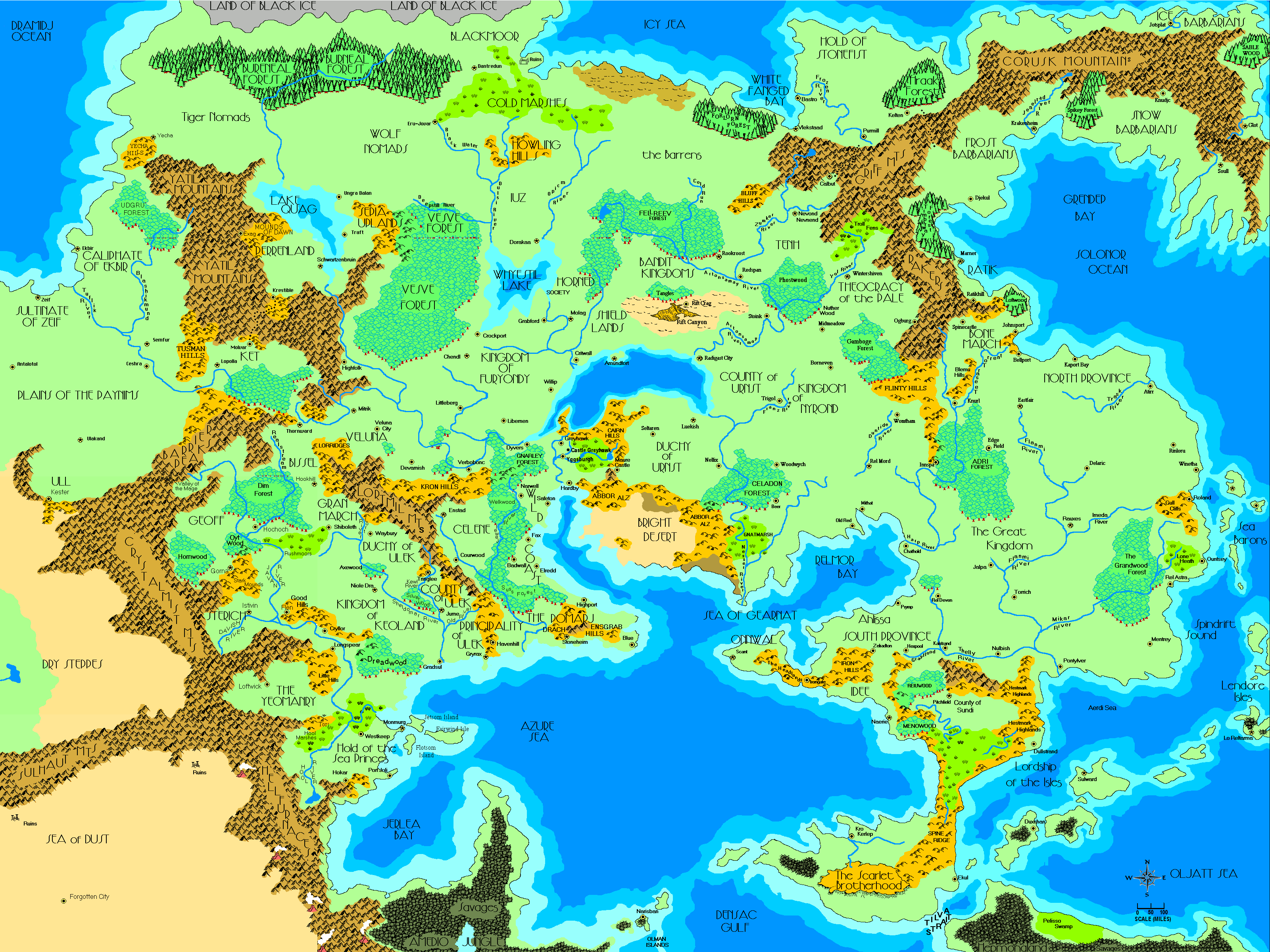
many of the classic D&D modules were located in and around the Sheldomar Valley. The Temple of Elemental Evil, for one, is located just over the Lortmil Mountains near Verbobonc. Others could be relocated nearby with some slight modifications: for example, a large swamp in the western Seahold could contain modules S1 and S2, while the Lendore Isles (and UK1, L1, and L2) could be moved offshore of the Seahold. So I've been putting together this pocket guide to the Sheldomar Valley based of various wikis and the
Living Greyhawk Gazetteer; there is plenty of official information about the Greyhawk campaign setting, but it can be easy to get lost in it all. Here's a
map. I'm more interested in the situation circa 579 CY, when adventurers begin arriving at Hommlet.
The Flanaess is inhabited by three main types of humans: the pale, blond Suloise, the olive-skinned Oerdians, and the aboriginal bronze-skinned Flan, for whom the region is named. Their ancient languages (Ancient Suloise, Old Oerdian, and Flan, respectively) are the ancestors of most contemporary human tongues. Across the mountains to the west live the Baklunish, and the Olman inhabit the jungle islands of the Densac Gulf, but relatively few of these peoples dwell in the Sheldomar Valley.
The
Common Tongue is descended from a dialect of Old Oerdian developed by Baklunish scribes, with some Suloise influence, that developed into a language of trade and administration. Modern spoken descendents of Old Oerdian include Keoish and Velondi.
Keoish is the dominant human language of the Sheldomar Valley, while
Velondi is spoken by the peasants of Furyondy and Veluna.
Suloise is essentially dead, but of interest to sages and scholars. It has a few modern descendants:
Amedi is spoken by the barbarians of the Amedio Jungles,
Lendorian is spoken in the Lendore Isles, and languages of the tundra barbarians of the north are descended from Suloise.
The Kingdom of
Keoland is one of the oldest states in the Flanaess. It is a feudal monarchy, governed largely by Suel aristocracy; the king is chosen by the Noble Council of Nicole Dra, the capital. Although founded centuries ago, it reached its peak during "imperial" expansion in the 350s; several of its daughter states govern northern parts of the Sheldomar Valley. Most people are of mixed Suel and Oerdian descent and speak Keoish and Common, and few Flan remain.
Gran March is a heavily militarized state north of Keoland; the elected Commandant governs from Hookhill. Although Gran March owes fealty to Keoland, it is self-governing and dominated by the Knights of the Watch; all adult males are required to provide military service. Most people speak Keoish and Common.
The Grand Duchy of
Geoff is a feudal monarchy owing fealty to Keoland; the Grand Duke governs from Gorna. It is further divided into six cantrevs, each ruled by a Llwyr (a baron). Flan culture and people are more prominent in Geoff than the rest of the Sheldomar Valley; most people speak Flan and Common, as well as Keoish to a lesser extent.
Sterich is a feudal monarchy that is formally a vassal to Keoland, but self-governing in practice; the earl governs from Istivin. Sterich was established by settlers from Geoff, and has long been a mining colony where peasants do well since labor is in short supply.
The
Seahold, formerly a province of Keoland, is a sovereign state ruled by Prince Jeon II, who has taken up a campaigns against slavery and slave-raiding from the Amedio Jungle and Olman Islands. Most people speak Keoish and Common, a few speak Amedi, Olman, or other languages. (There are dark whispers that the Scarlet Brotherhood has some future designs upon the Hold of the Sea Princes ca. 589).
The
Yeomanry League is a democratic republic to the southwest of Keoland; the Spokesman governs from Loftwick. It was allied with Keoland until the 360s, when it objected to Keoland's conquests. Most people in the Yeomanry are freeholders of mixed Suel and Flan descent who speak mostly Keoish and Common.
Bissel is a border state at the northern end of the region, at the crossroads of the Sheldomar Valley, the Baklunish states, and the rest of the Flanaess. Bissel was conquered by Keoland in the 350s, governed as the Littlemark, then later conquered by the kingdom of Furyondy. Furyondy's influence gradually waned, until the Margrave established Bissel's independence in a battle in 477 CY. Most people are of mixed Baklunish, Suel, and Oerdian descent, and speak Common or Baklunish dialects.
The
Ulek States are a trio of three sovereign kingdoms east of Keoland. The northernmost is an elven kingdom, the southernmost is a dwarven kingdom, and a druidic human kingdom lies between.
The
Valley of the Mage is an isolated and xenophobic elven kingdom hidden in the Barrier Peaks. It is ruled by a powerful arcane spellcaster known as the Black One. The valley elves are scorned by all other elves (possibly due to an ancient bargain for extraplanar lore) and reject the elven pantheon, preferring Ehlonna and the druidic Old Faith. A plurality of the Valley's residents are various humans under the rule of a human earl, a vassal of the elven king, and many gnomes live there as well, but the valley is thinly populated and has very little traffic with the outside world, even preferring raiding to trade.
The most popular and widespread gods in the Sheldomar Valley include such important deities like
Heironeous,
Fharlanghn,
Ehlonna, and
St. Cuthbert, as well as
Phaulkon,
Zilchus, and
Norebo. Sea gods like
Osprem and
Procan are popular along the coast, while Flan gods like
Pelor,
Allitur, and
Obad-Hai are popular in the western half of the region.
Istus and
Rao are worshipped in Bissel, while
Kelanen has a headquarters in Istivin and adherents in the Seahold.


 Posts