So, contra the argument that voting is meaningless, it's pretty easy to tell that an individual vote is worth something. And that's because corrupt candidates are willing to pay for them: electoral fraud is very rare these days, but vote buying is one of the most common kinds. The market price of a vote is something like $10-20 ( WaPo). "Everything is worth what its purchaser will pay for it". Twenty bucks is like a typical individual campaign donation, or a couple hours of work. It's not the influence of Sheldon Adelson, but it's not nothing.
For comparison, just over 125 million Americans voted in 2008, which at $20/vote would be $2.5 billion, which sounds about right to me. There was about $2.6 billion spent on political advertising in 2008 all told (NYT)—near on half a billion dollars directly by the Obama and McCain campaigns.
TL/DR: if individual votes didn't matter, nobody would ever pay cash money to get them.
Tuesday, November 6, 2012

Friday, August 3, 2012
My new project to learn the kanji
So, I've been using SRS with Anki to study languages since late 2009, almost three years. Mostly with Japanese, but French and other languages as well. It's been interesting.
I got suckered into the sentence-mining AJATT championed then, but apparently that site has abandoned that method in favor of something called "MCDs" or whatever. Sentence mining is interesting, but it's fairly labor-intensive to make new cards, which tends to lead to wide variation in study times. I think it's helped some with my particle use, but it's too hard for the reward I get.
I suspect that the best way to use Anki is to focus exclusively on reading comprehension, whether it's comprehension of the kanji or vocab more generally. Furthermore, I think it's best to use Anki to build on existing body of knowledge, rather than begin by introducing a whole new body of knowledge. And to introduce things slowly, rather than blasting through dozens of new flashcards a day.
So August 1, I started a new project to simply recognize individual kanji with basic definitions and meanings (in Japanese, not Heisig's method). I'll work up a deck and simply introduce 3 new kanji every day, including the 300-400 I already know. If I do three a day for a year, I'd be able to recognize 1000 or so by the end of next summer.
Rather than using the order of the kyōiku kanji, in which Japanese children learn them, or by levels on the JLPT, I'm crafting a more idiosyncratic order: first, all kanji by stroke count, up to six strokes; then, the rest of the kanji used as radicals (which can have up to 13 strokes). After that, it's either more kanji by stroke count or instead kanji by frequency of use. The Japanese Wikipedia Kanji Frequency List, discussed further in this thread, is a fascinating resource: 173 kanji make up 50% all kanji in Wikipedia, 454 kanji cover 75% of all kanji, and 874 kanji cover 90%. Here's a list of the 2,500 most common kanji in Japanese newspapers, used by jisho.org.
I've wanted to put together a learner's semantic dictionary of kanji compounds, which gives examples of kanji compound words in each entry that contain only kanji prviously introduced. But that's a huge amount of work, a years-long project, and I'd never get started if I waited to do that. =/
Thursday, July 19, 2012
Typesetting Klingon in blackletter
Klingon has a famously terrible-looking Romanization. The language has sounds that are very difficult to represent in the Latin script, developed at a time before Unicode became ubiquitous. It uses the
 Latin alphabet idiosyncratically, using capital letters to help remind readers that the sound the letter represents is probably not what they expect from the conventional English reading. So we get this, here set in Arial Unicode MS.
I'm also very suspicious of the pIqad scripts, which look like something created by a graphic designer who never had to actually write the language down. The graphemes for <q> and <Q> in particular look awfully similar.
However, the banner for Qo'noS QonoS, looks really good in a blackletter face. Perhaps Klingon
 just has a font problem: isn't this better, in Unifraktur Cook?
It may be as affected as the heavy-metal umlaut, but I think there's more to it. Klingon uses both capital and lower-case H, although the latter is only used in the digraphs and . In many blackletter typefaces, the lower-case and capital H have the same basic shape, so the capital letter is less aberrant and jarring at the end or middle of a word. Blackletter faces often have a high x-height relative to the cap height, so the odd capital letters stand out a little less. Lastly, this typeface makes a very clear distinction between lower-case L and capital I, making more legible the last phrase, lIghoH "He disputes y'all". It can be a subtle distinction in many sans-serif or even serif faces. Besides, it certainly seems like Klingons would make free use of heavy-metal umlauts.
Libre blackletter fonts are not in great supply; Dieter Steffman made some gratis ones, but for Web typography the likeliest choice is the Unifraktur faces, available in Google Web Fonts.


I'm also very suspicious of the pIqad scripts, which look like something created by a graphic designer who never had to actually write the language down. The graphemes for <q> and <Q> in particular look awfully similar.
However, the banner for Qo'noS QonoS, looks really good in a blackletter face. Perhaps Klingon

It may be as affected as the heavy-metal umlaut, but I think there's more to it. Klingon uses both capital and lower-case H, although the latter is only used in the digraphs
Libre blackletter fonts are not in great supply; Dieter Steffman made some gratis ones, but for Web typography the likeliest choice is the Unifraktur faces, available in Google Web Fonts.

Thursday, July 12, 2012
How hard is learning Klingon?
...by which I mean not "how hard it is to pronounce" (challenging) or "how hard/complex the grammar is" (varies, for a conlang), but something more on the order of "how much language there is to learn"?
So I did a quick analysis of The Klingon Dictionary. The heart of the Klingon language is in the morphology, the system of affixes that derive and inflect the root words of the language. As for the affixes, there are 21 noun suffixes that fit into five slots, 32-35 pronominal verb prefixes, and 31 verb suffixes that fit into nine slots. Almost half of the total suffixes mark person in some way. Additionally, the grammatical sketch introduces seven dozen or so roots, almost a dozen stand-alone pronouns, a dozen or so numbers (as well as two suffixes for numbers), almost a dozen conjunctions, a half-dozen question words, and three dozen or so adverbials and exclamations. So you could probably fit a very solid working knowledge of Klingon onto about 230 flash cards. That's large but manageable.
As for the dictionary, I estimate that there are about 1,460 words in the Klingon-English section. With the morphology, that's a lot of expressive power, although the vocabulary intentionally doesn't cover a lot of semantic space.
Tuesday, June 19, 2012
Retrospective: Dungeon #64 (Sept/Oct 1997)
Spoiler alert! Of course, 15 years is well past the spoiler statute of limitations.
These were some pretty memorable adventures; after all these years I remembered a little about all of them, although perhaps more about the scene at Lathtarl's Lantern than the actual adventure it's in.
"Grotto of the Queen", by Paul and Shari Culotta (AD&D Forgotten Realms, Levels 6-9): The ambush of a rival adventuring party offers the PCs an opening to raid the submerged temple of the evil sea goddess Umberlee. The hook into this adventure is fairly contrived, requiring a fair amount of DM engineering: the adventurers are approached by a Lantanese emissary, to recover a magical boat taken by the cult of Umberlee. The party's nemesis (a 14th-level wizard with nothing better to do than follow the party and engineer some scrapes for them) warns the cult of their attack, and the cult prepares an ambush, which is instead triggered by a rival adventuring party. Alternatively, the author suggests that the cult of Umberlee has an effective spy network, which seems like a much simpler backstory.
Either way, the adventurers travel in an advanced Lantanese ship to a pirate enclave of Lathtarl's Lantern, on the Sword Coast between Baldur's Gate and Waterdeep. This is a neat little evil pirate town: it has a huge tavern full of dozens of pirates and outlaws, along with a couple of gnolls, ogres, and half-orcs, all drinking and carousing. There's a high likelihood that adventurers will get into a barroom brawl, ending in a boxing match before a shouting, leering crowd. Most of the residents are followers of Umberlee, so the adventurers should use some sublety in town. The grotto itself is a well-conceived dungeon, built by terrestrial worshippers of an evil sea goddess. The moderately-sized complex opens with some traps, some of which have been triggered, and can catch the temple unawares. Which is good: the final encounter should be very challenging, with a sea priestess who uses the environment of the confined, flooded temple to good advantage.
I don't like the plot of this adventure, but the actual setting and dungeon are pretty great. With some modest re-skinning, it would be an excellent addition to a campaign involving grim pirates who follow evil sea gods or demons.
"Bzallin's Blacksphere", by Christopher Perkins (AD&D, Levels 12-15): In the town of Horizon, a sphere of annihilation is growing and threatening to destroy the community. The town's wizard-protector Amazzer (Wiz17) believes that his predecessor Bzallin is responsible for this. So the adventurers travel to Bzallin's ruined keep and destroy its guardians (a hibernating necromancer and some powerful undead), then travel from there to the lich Bzallin's lair: a pocket demiplane suspended within the quasielemental plane of Vacuum. It's not a tesseract, but the geometry of Bzallin's Cube is interesting enough to temporarily confound mappers. This demiplane is full of Bzallin's apprentices (themselves fairly powerful wizards), his demonic and daemonic servitors, and a number of magical traps and wards. There's many of the delicious trimmings you would expect of a high-level lich's lair, making use of a wide range of evocative higher-level spells. This is a high-level, high-magic romp, and the author is probably right in suggesting that the DM refer extensively to all volumes of the Encyclopedia Magica. There's probably about two to three dozen encounters, ranging from Bzallin's apprentices (who are mostly around 10th-level wizards) to the lich himself, a near-epic-level enounter.
One thing that's apparent about the suggested level of these adventures, generally speaking, is that an average-sized party needs to be near the high end of the level spread, not the low end. A 6th-level party in "Grotto of the Queen" will probably get killed, while a 12th-level party in "Bzallin's Blacksphere" is very badly outclassed by the big bad. Anyway, I love wizards and liches, and "Bzallin's Blacksphere" is definitely my favorite from this issue.
 "Last Dance", by Jeff Crook (AD&D Ravenloft, Levels 4-6): In the city of Pont-à-Museau in the domain of Richemulot, the adventurers are hired by Madame Araby Tuvache, a psychopath, to clear out her basement of rats. In fact, she plans to trap them inside and kill them with her clockwork house of marionette horrors. The plot is simple and the dungeon doesn't seem all that dangerous, but this adventure is certainly gruesome. The PCs are not really expected to defeat the villain—if they kill her, the Dark Powers of Ravenloft transform her into an even worse creature, a Greater Animator running a haunted house—but merely to explore the environment and make it out alive. I'm not sure why the heroes don't just burn the place down from the get-go. This may be short enough to finish in a single session.
"The Mad Chefs of Lac Anchois", by Jennifer Tittle Stack (AD&D, Levels 6-9): So, Pol and Prue Dhomme, a pair of Francophone cloud giant restauranteurs have captured some grippli young (instead of giant frogs) to butcher and serve for some giantish food critics that will visit their establishment, Chez Grands Frères, in three days. The grippli tribe mother asks some adventurers to intervene and rescue the children, and why not? How PCs approach this problem is fairly open-ended: they can try stealth, role-playing, deceit, negotiation, or even a direct frontal assault. The restaurant has several kobold waitresses (Francine, Chapponage, and Amortisseuse) to serve human-sized customers, although getting past the half-ogre mage wine steward Brummel and into the kitchen will be a challenge. If the adventurers attack the chefs, they may battle a dough golem or suffer the effects of their dreaded spoon of transmuting flesh to roquefort. The cloud giants are not actually evil evil, they just don't realize that the grippli young are sentient creatures.
This could be an interesting variant on a rescue-the-princess scenario, but the adventure plays it for laughs, and humor in D&D can be quite difficult to pull off. I don't think that the author quite succeeds; it seems pretty goofy. Of course, there is a time and a place for all things. Perhaps this adventure could be lighter interlude and welcome relief from a gruelling hack-and-slash campaign against giantish foes, such as G1-3: Against the Giants, where there is little or no opportunities for role-playing with the giants. "The Mad Chefs of Lac Anchois" certainly has more opportunity for role-playing, although I think the cloud giant brothers and their minions could be portrayed in a more sinister light; the comedy of this adventure will come through in any case. It's short enough to play through in a single session, I reckon.
Humor is used in a lot of my favorite adventures later on: the kobold Meepo in Bruce Cordell's The Sunless Citadel, the kobolds in Richard Pett's "The Devil Box" in Dungeon #109, or some of the goblins in Pathfinder #1—Rise of the Runelords: Burnt Offerings, by James Jacobs. "The Devil Box" is in fact one of my favorite Dungeon adventures, and it is hilarious. The key difference, I think, is that those adventures play for laughs creatures known to be small, weak, and relatively nonthreatening when encountered individually, so that humor adds some interest to overplayed monsters. Kobolds and goblins are supposed to be reckless, troublesome, and mischievous; the contrast between their evil ambitions and their individual weakness can be naturally funny. But the real villains in those adventures are not only sinister and threatening, but also powerful and deadly. In "The Mad Chefs of Lac Anchois", however, it is powerful monsters like giants and ogre magi that are played for laughs, and this corrodes the premise of the game: heroes are needed to combat the sinister threats of a dangerous world. Turning the dangerous monsters into jokes weakens the suspension of disbelief, rather than bolstering it.
Tuesday, June 12, 2012
Retrospective: Dungeon #63 (July-August 1997)
I started buying issues of Dungeon magazines from about 1997, subscribing (with a few intermittent gaps) until the end of the print run in 2007. I sorted them the other day, and found that I have 75 issues all together: half of the magazines published, amounting to some hundreds of adventures. It's been between five and fifteen years since I read these, but there were some great adventurers with vivid scenes memorable even after years. However, I rarely use them, because it's hard to usefully find good adventures. Although Dungeon #150 has an index that lists only the system, title, author, and issue of each adventure, and there are a few public indices online that add a short blurb, it's usually still not easy enough to find an appropriate adventure for a certain style, setting, or situation. So I'm going to start a regular feature, reading through and reviewing some my old Dungeon magazines, starting with the first one I ever bought in a store, #63. What do I remember from this issue, before re-reading it? The goblin-o-war, invisible stalker, and "Blood & Fire".
 "Hunt for a Hierophant", by Chris Doyle (AD&D, Levels 6-8): The evil wizard Zerrick has rallied a horde of bullywugs from the Cragmoor swamp to invade the communities beyond the Drakewood Forest, so adventurers are needed to rouse the slumbering hierophant druid Leander. They get some clues from an assortment of fey, treants, and giants, then negotiate the druid's dungeon resting place. The dungeon combines some combat tests with puzzles and riddles, most of which look relatively simple enough for an average group to handle easily.
"Gnome Droppings", by Christopher Perkins (Spelljammer, Levels 2-4): Tinker gnomes drop their autognome cargo from a spelljamming ship, then come back and recover it. The adventurers hear a strange noise in the forest, and if they're curious, they might investigate, slaughter some evil-if-innocent bystanders (grimlocks and spriggans), and interact with a harmless-but-malfunctioning robot. There's a hook into Spelljammer (especially the goofier parts, like giant hamsters), but nobody gets hurt if the adventurers just snooze. The right group would have fun, but is this actually an adventure?
"Huzza's Goblin-O-War", by Paul F. Culotta (AD&D Forgotten Realms, Levels 4-6): A monstrous pirate ship, crewed by goblins, margoyles, and a wizard, attack the PCs' ship at sea. When I first read it, the idea of a hill giant pirate captain struck me as a little too high-fantasy for my tastes. It may seem a little gonzo, but it sure does look like an entertaining encounter, even if Huzza is probably not bright enough to be a corsair. It's set in the Sea of Fallen Stars in the Forgotten Realms, but could be worked into any sea area with monstrous pirates.
"Invisible Stalker", by Johnathan M. Richards (AD&D SideTrek, Levels 1-2): It's exactly what you'd guess from the pun: a creepy sleazeball of a villain with the power to not be seen, here accomplished via a level-inappropriate magic item. The villain's plan would be an interesting encounter, if you want to see how 1st-level characters plan to use a powerful magic ring later on. If so, it can be set in any city environment.
"Blood & Fire", by John Baichtal (Al-Qadim, Levels 5-7): The adventurers travel from Qaybar, an emirate somewhere in Zakhara, to find its missing heir (the McGuffin). They travel across the desert to the oasis of Khaldun where they discover he's been taken by the Brotherhood of the True Flame, a powerful cabal of sinister flame mages, and taken to their Ivory Tower in the Valley of Mist. The plot of this adventure is fairly straightforward, and the final dungeon is not complex; there's about a half-dozen wilderness encounters and ten or so at the Tower. But there's a great deal of attention to detail in creating an evocative Arabian-themed desert setting. There's some excellent images and encounters: leucrottas haunting the dunes at night, an enchanted young couple mystically frozen in amber, a wizard mummy who doesn't realize he's dead in his cairn, the Apparatus of Kwalish clattering in a poisonous fog. Tony DiTerlizzi did some great illustrations here; I love the portrait of the coiling dragonne Zu'l Janah. This looks like a great adventure, my favorite in this issue.
"Beauty Corrupt", by Kent Ertman (AD&D 2E, Levels 4-5): After "The Phantom Menace", I'll never blindly trust a plot that revolves around the disruption of trade negotiations (here, between the coastal towns of Orchid Bay and WyrWatch). The hook is a simple request to heal the key negotiator, who has a mystical afflication. But this adventure has a fairly creative McGuffin: a sirene's song, captured by a covey of hags as a spell component. They dwell in a fairly simple lair typical of a sea hag, guarded by scrags and merrow, with a few false entrances; the encounters look very tough, but the goal is to disrupt a spell, not kill everything in sight. There's the opportunity to adventure underwater, since a plant called quipper kelp allows characters to breathe water.
Saturday, June 9, 2012
A brief tour of the Sheldomar Valley
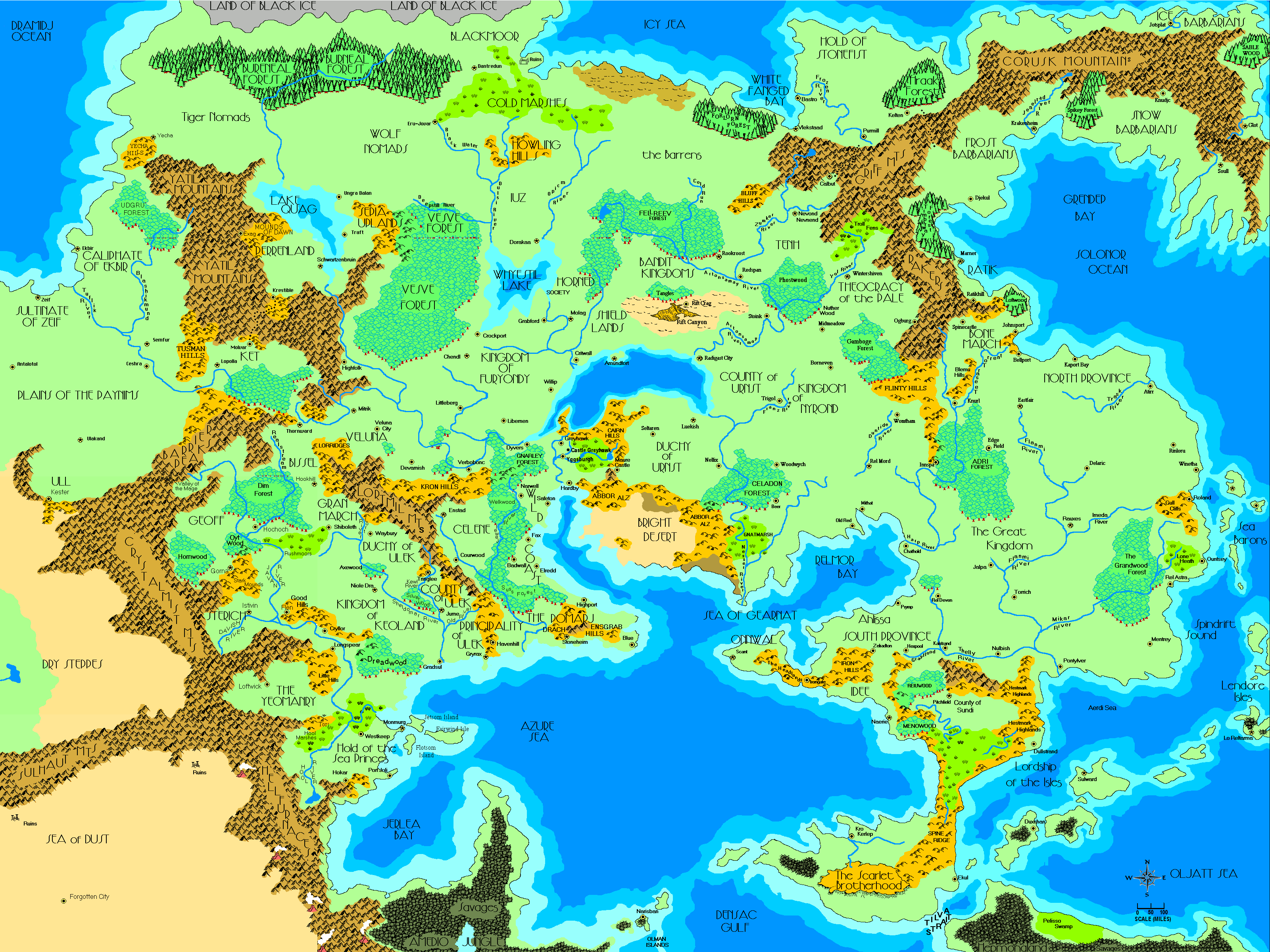
I earlier noted that many of the classic D&D modules were located in and around the Sheldomar Valley. The Temple of Elemental Evil, for one, is located just over the Lortmil Mountains near Verbobonc. Others could be relocated nearby with some slight modifications: for example, a large swamp in the western Seahold could contain modules S1 and S2, while the Lendore Isles (and UK1, L1, and L2) could be moved offshore of the Seahold. So I've been putting together this pocket guide to the Sheldomar Valley based of various wikis and the Living Greyhawk Gazetteer; there is plenty of official information about the Greyhawk campaign setting, but it can be easy to get lost in it all. Here's a map. I'm more interested in the situation circa 579 CY, when adventurers begin arriving at Hommlet.
The Flanaess is inhabited by three main types of humans: the pale, blond Suloise, the olive-skinned Oerdians, and the aboriginal bronze-skinned Flan, for whom the region is named. Their ancient languages (Ancient Suloise, Old Oerdian, and Flan, respectively) are the ancestors of most contemporary human tongues. Across the mountains to the west live the Baklunish, and the Olman inhabit the jungle islands of the Densac Gulf, but relatively few of these peoples dwell in the Sheldomar Valley.
The Common Tongue is descended from a dialect of Old Oerdian developed by Baklunish scribes, with some Suloise influence, that developed into a language of trade and administration. Modern spoken descendents of Old Oerdian include Keoish and Velondi. Keoish is the dominant human language of the Sheldomar Valley, while Velondi is spoken by the peasants of Furyondy and Veluna. Suloise is essentially dead, but of interest to sages and scholars. It has a few modern descendants: Amedi is spoken by the barbarians of the Amedio Jungles, Lendorian is spoken in the Lendore Isles, and languages of the tundra barbarians of the north are descended from Suloise.
The Kingdom of Keoland is one of the oldest states in the Flanaess. It is a feudal monarchy, governed largely by Suel aristocracy; the king is chosen by the Noble Council of Nicole Dra, the capital. Although founded centuries ago, it reached its peak during "imperial" expansion in the 350s; several of its daughter states govern northern parts of the Sheldomar Valley. Most people are of mixed Suel and Oerdian descent and speak Keoish and Common, and few Flan remain.
Gran March is a heavily militarized state north of Keoland; the elected Commandant governs from Hookhill. Although Gran March owes fealty to Keoland, it is self-governing and dominated by the Knights of the Watch; all adult males are required to provide military service. Most people speak Keoish and Common.
The Grand Duchy of Geoff is a feudal monarchy owing fealty to Keoland; the Grand Duke governs from Gorna. It is further divided into six cantrevs, each ruled by a Llwyr (a baron). Flan culture and people are more prominent in Geoff than the rest of the Sheldomar Valley; most people speak Flan and Common, as well as Keoish to a lesser extent.
Sterich is a feudal monarchy that is formally a vassal to Keoland, but self-governing in practice; the earl governs from Istivin. Sterich was established by settlers from Geoff, and has long been a mining colony where peasants do well since labor is in short supply.
The Seahold, formerly a province of Keoland, is a sovereign state ruled by Prince Jeon II, who has taken up a campaigns against slavery and slave-raiding from the Amedio Jungle and Olman Islands. Most people speak Keoish and Common, a few speak Amedi, Olman, or other languages. (There are dark whispers that the Scarlet Brotherhood has some future designs upon the Hold of the Sea Princes ca. 589).
The Yeomanry League is a democratic republic to the southwest of Keoland; the Spokesman governs from Loftwick. It was allied with Keoland until the 360s, when it objected to Keoland's conquests. Most people in the Yeomanry are freeholders of mixed Suel and Flan descent who speak mostly Keoish and Common.
Bissel is a border state at the northern end of the region, at the crossroads of the Sheldomar Valley, the Baklunish states, and the rest of the Flanaess. Bissel was conquered by Keoland in the 350s, governed as the Littlemark, then later conquered by the kingdom of Furyondy. Furyondy's influence gradually waned, until the Margrave established Bissel's independence in a battle in 477 CY. Most people are of mixed Baklunish, Suel, and Oerdian descent, and speak Common or Baklunish dialects.
The Ulek States are a trio of three sovereign kingdoms east of Keoland. The northernmost is an elven kingdom, the southernmost is a dwarven kingdom, and a druidic human kingdom lies between.
The Valley of the Mage is an isolated and xenophobic elven kingdom hidden in the Barrier Peaks. It is ruled by a powerful arcane spellcaster known as the Black One. The valley elves are scorned by all other elves (possibly due to an ancient bargain for extraplanar lore) and reject the elven pantheon, preferring Ehlonna and the druidic Old Faith. A plurality of the Valley's residents are various humans under the rule of a human earl, a vassal of the elven king, and many gnomes live there as well, but the valley is thinly populated and has very little traffic with the outside world, even preferring raiding to trade.
The most popular and widespread gods in the Sheldomar Valley include such important deities like Heironeous, Fharlanghn, Ehlonna, and St. Cuthbert, as well as Phaulkon, Zilchus, and Norebo. Sea gods like Osprem and Procan are popular along the coast, while Flan gods like Pelor, Allitur, and Obad-Hai are popular in the western half of the region. Istus and Rao are worshipped in Bissel, while Kelanen has a headquarters in Istivin and adherents in the Seahold.
Subscribe to:
Posts (Atom)

 Posts