It may be that Fritz Leiber's stories about Fafhrd and the Gray Mouser were the origin of the thieves' guild trope. In any case, the Thieves' Guild of Lankhmar is a great adversary to these characters. A close reading of the stories can suggest some details about their headquarters, though perhaps fewer than a building from a movie such as the "Night of the Living Dead" farmhouse.
"Thieves' House" is chronologically later but the first published of the stories, from 1943. Thieves' House lies on Cheap Street, an empty alleyway. Its door is always open, its entry is lit by torches, but such false hospitality only heightens the foreboding of the place. The thieves on watch signal warnings with ominous whistles. Immediately inside the entrance, a shaft stretches up so thieves can attack intruders from the ceiling, and trapdoors in the floor allow thieves to surprise foes from below. Accessible from the entry corridor is a winding stairway leading up. On the second level of the building, the stairway opens onto a chamber lined with curtained alcoves. One of these alcoves has a secret stone door leading to a safehouse outside the building.
This alcove-lined room is the main setting for much of the story's action, since it is here that the Master of Thieves first examines the great treasure. From here, Fafhrd and the Mouser speed through mazy corridors, up and down several stairways, to egress through the roof or to deep cellars accessible only through ancient, forgotten stairs and passages lined with spring-blade traps.
"Ill Met in Lankhmar", published in 1970 and winning the Nebula and Hugo awards, revisits Thieves' House and its ever-open portal on Cheap Street. Fafhrd and the Mouser disguise themselves as beggars to infiltrate the building, since the Beggarmasters of the Beggars' Guild report to the Thieves' Guild. The front doorway is very low, since a niche is hidden above it on the inside from which two hidden guards may attack intruders. The front door opens into a corridor lined with four doors: three open into training rooms for thiefly skills such as lockpicking, pickpocketing, and dodging artfully, while a fourth opens into a dining hall. At the end of the corridor, a stairway winds up with curving balustrade.
On second story stretches a corridor identical to that of the first floor, except for its luxurious appointment, lined with seven doors. The first room contains costumes, wigs, and equipment for disguises. The next four doors are shut. The sixth door opens into a map room with a round meeting table and seven chairs, as well as numerous models of Lankhmart buildings. The seventh room contains the eldritch equipment and workspace of a felonious sorcerer and his imp.
Past the second floor, the winding stair continues up two more stories past two more empty corridors. On the fourth floor, a portable ladder leads up to a hatch in the ceiling leading onto the slate roof. A guard is posted below the hatch, and a thief on the roof passes signals to distant buildings with the light from a lantern.
These descriptions do contradict somewhat; in one, the characters go up the stairs to find a corridor, and in the other, they find a room. However, "Thieves' House" makes it clear that the building is rife with secret doors, traps, and secret passages unknown even to its residents. Perhaps such a secret door sometimes conceals the second-floor corridor or room.
Wednesday, January 26, 2011

Games to Try
Last August, during my GenCon recap, I expressed some nostalgia for the old hex-and-counter conflict simulation wargames from Avalon Hill, SPI, and other companies that I remember seeing, but never getting a chance to play before they largely faded away. I've spent a couple days trolling through Board Game Geek and elsewhere exploring this subject, and have happened on a couple of games that I'd really like to try.
"Hammer of the Scots" (2002, Columbia Games)(img) is a block wargame that explores the Wars of Scottish Independence, which simulates a fog of war in a manner reminiscent of "Stratego". It seems to be well-regarded, covers an interesting topic, and hopefully looks enough like a Euro-style game that I may be able to rope some family into playing. Unfortunately, it's a two-player game; I suspect that part of the reason so many interesting games get played so rarely is that they're very particular about the number of people who may participate in what is an inherently social activity.
"Age of Napoleon" (2003, Mayfair Games)(video) is a grand strategy game overviewing the Napoleonic wars from 1805 to 1815, with a counters and a card-driven system to represent combat events and shifting diplomacy. It seems like a game I'd enjoy at the same level I enjoyed "Axis & Allies" back in the day, with a history theme I have a nascent and developing interest in, an interesting representation of the vagaries of diplomacy, and grand-strategy-level play light enough to play in an afternoon or evening. Sadly, it is also only a two-player game.
Battle Cry (2000, 2010, AH/WotC) spawned the Commands and Colors system that drives several popular history- and fantasy-themed strategy games. These games, like Command and Colors: Ancients (2006, GMT Games) seem to be very popular and fun, but more game-y than simulationist. I'm a little burned out on WWII and fantasy battle games, and would like a more hardcore take on ancient and American Civil War combat, but this is probably a good game to get, anyway: there's a sesquicentennial coming on, and my interest in the Civil War will likely be high for some time. A game-y system is more likely to attract players, and the 150th anniversary edition includes a lot of battles from the western front important to the Ohio River Valley (Fort Donelson, Perryville) that receive scant attention from wargames.
Entdecker: Exploring New Horizons (2001, Mayfair) is a prequel to "Settlers of Cataan" by the same designer, which uses tile placement to represent the exploration of an archipelago and create territory to be claimed by the players. My family enjoys playing Cataan and Carcassone a lot, so this game may garner some similar interest while being a nice change of pace from those games. It's also the first multiplayer game on this list. =/ There's also a bunch of children's games, like "LEGO Minotaurus", "Max", and "Blokus", that may be a worthy step up from "Candyland".
But I started all this by looking into what historical wargames people are playing these days. Going through all these games, I've started to turn against some of the games like C&C:A that make compromises with historical accuracy for better gameplay; Who wants to play a historical wargame if it doesn't accurately represent the personalities of individual Roman commanders or the interaction of rampaging elephants with pre-Marian legions at Cannae? Terribly unbalanced scenarios, stacks of chits, and endless consultation of combat results tables are a small price to pay for the historic verisimilitude only an old-school hex-and-counter game are supposed to provide!
So perhaps for ancient-era wargames something like SPQR Deluxe (1992, 2008, GMT Games)(img) might be the way to go. It covers most of the Punic Wars and several battles through the Roman Republic era. And ancient tactics are kind of interesting; the way units are laid out in lines and blocks is kind of "chess-y".
A better idea to dip toes in this water might be to try one of the old free or introductory low-complexity wargames, like "Battle for Moscow" (1986, GDW; 2009, VPG)(img) or "Napoleon at Waterloo", an introductory game put out in 1971 by SGI before it was acquired by TSR, and now freely available.. The NAW system was the basis for "Blue & Gray" (1975, SPI; DG), a relatively lightweight Civil War wargame, as well as Napoleonic games. "Battle of Honey Springs" (2007, LPD) is another free introductory print-and-play wargame that cover most important ACW battles in Indian Territory, now Oklahoma. And if ~that~ is any fun, then try to something newer like "Three Battles of Manassas", Perryville, or other series (1, 2, 3) before considering a monster game like "Three Days at Gettysburg".
Tuesday, December 21, 2010
Happy Solstice
This morning was a once-in-centuries full lunar eclipse on the winter solstice, but even though last week's ice storms have melted off, it was too overcast here to be worth waking up.
Still thinking about solstice traditions. Since this is the first year I've had a proper Yule Tree, I'll save the trunk to kindle a fire on the solstice, and maybe grill some pork chops.
Still thinking about solstice traditions. Since this is the first year I've had a proper Yule Tree, I'll save the trunk to kindle a fire on the solstice, and maybe grill some pork chops.
Thursday, November 11, 2010
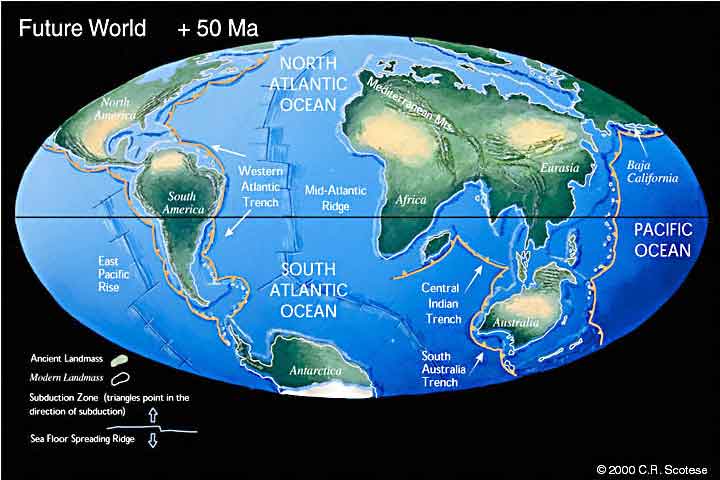
Even more continental drift
Somehow my earlier posts about speculative future continental drift neglected the great Oct. 20, 2007, article at NewScientist.com, "Pangea, the comeback".

Most of these projections assume that, over 300 million years or so, Australia (and possibly Antarctica) will fly across the Pacific Ocean and collide with western North America. Then, the Americas will mash together and collide with the eastern edge of Afro-Eurasia. The exception is Christopher Scotese's Pangaea Proxima, which has the Atlantic Ocean stop widening and begin to shrink away.
These are all just speculation, of course, and apt fodder for fantasy. Grognard James Maliszewski, considering setting his old-school RPG in a hypothetical future Pangea, pointed out that the map of the Mystara campaign setting was based on the continents of the Jurassic. Commenter Malcadon points out the similarity between Robert E. Howard's Hyborian age and the Afro-Eurasia of 50 million years from now.
Dougal Dixon, an author of "The Future is Wild", has another similar work: After Man: A Zoology of the Future.
EDIT
Offensive redirected link removed for the Hyborian Age. Try Wikipedia here or here.
Tuesday, November 2, 2010
Election results 2010
Ken Herndon concedes in the Metro Council race:
Paul beats Conway for the Senate seat, Yarmuth wins re-election, Fischer wins for mayor, and it looks like Ben Chandler won a very narrow re-election in KY-6.
Polls are closing in California, since it's about 10pm now: time to see what happens with Prop. 19.
EDIT (2010-11-11)
Write-in votes for Herndon counted; James win affirmed (C-J):
With all but two precincts reporting, James had 58 percent of the vote, while Republican Candace Jaworski had 13 percent, and incumbent Independent Deonte Hollowell had just 8 percent; the rest were write-ins.Background here and here. Full results later.
Democrat Ken Herndon had tried a write-in campaign, but there were far fewer write-in votes cast than James received. County election officials will begin counting write-in votes Monday.
According to the election board, there are 14,013 registered votes in the district, which is centered in Old Louisville.
Herndon said around 8 p.m. Tuesday that he had called James to congratulate him on winning. “There was just too much straight party voting. It was too difficult to overcome,” Herndon said.
Paul beats Conway for the Senate seat, Yarmuth wins re-election, Fischer wins for mayor, and it looks like Ben Chandler won a very narrow re-election in KY-6.
Polls are closing in California, since it's about 10pm now: time to see what happens with Prop. 19.
EDIT (2010-11-11)
Write-in votes for Herndon counted; James win affirmed (C-J):
Democrat Ken Herndon, who ran a write-in campaign after the party’s executive committee selected David James as its candidate for the office, received 900 write-in votes, said Sue Toole, chief operations officer for County Clerk Bobbie Holsclaw.
Based on recorded machine votes, James, a former Louisville police officer and Fraternal Order of Police president, had 3,070 votes, while Republican Candace Jaworski had 657 votes and independent incumbent council member Deonte Hollowell had 398 votes. Herndon had conceded the race to James election night.
Sarah Palin in 2012
It seems like it'd be worthwhile to put down something I've thought for some time.
Since Barack Obama won the 2008 presidential elections, there has been a group on the blue side of the aisle that has been secretly hoping Sarah Palin would run in 2012 and become the Republican candidate. This is because she's considered easy for Obama to beat. Lots of voters strongly dislike her, and if she ran, it might set up a 1964- or 1984-style blowout election. See here or here. Even David Plouffe thinks so. But this kind of sentiment is wrong: this is a much more dangerous scenario than people recognize.
It became pretty clear after the 2008 elections, in early 2009 or so, that the economy was going to still be bad by the time of the 2010 elections, which was going to play to the benefit of the Republicans. The scale and impact of the 2007-2009 recession was badly underestimated by many, from John McCain's famous "the fundamentals of the economy are strong" gaffe at a time when many Republicans denied that there was a recession underway at all, to the Obama administration's underestimates of the rise in unemployment absent stimulus and subsequent decision to lowball the stimulus.
Although the media loves the tactical fallacy and dramatic narratives, structural factors like war deaths and economic conditions drive election results. Real disposable personal income predicts elections and presidential approval often tracks unemployment. The rest is window dressing. The 2007-2009 recession was another jobless recovery. Economic weakness can persist for years following the collapse of a major housing or asset price bubble: look at Japan. And so the Republicans are to have a big year this cycle.
It's pretty normal for the coattail effect to cause a hangover in the next midterm election. Since the Civil War, the president's party loses House seats in the midterm elections, averaging losses of about 32 seats. Here's a picture:

In that 100-plus years of midterm elections, there have been three exceptions. The Republicans need to win 39 seats to reclaim the House, so if they win 40-50 seats or so, their victory will be somewhat above average that will leave them with a very narrow majority. But hardly the blowout "apocalypse" that Republicans have been exulting about this season. Republicans are likely to overinterpret the results of this election, and the media will be complicit in propagating a narrative of a surging GOP winning a "referendum" on the president.
The opposition party campaigns on the deficit, which is driven by the cyclical fall in tax revenues despite flat government spending. The Republicans are probably deluded as usual about their desire to enact spending cuts to popular government programs, or will focus on inconsequential but high-profile gimmicks over the budget. Or they might be serious for once and try an ill-conceived austerity plan at a time of economic weakness. The "growth through austerity" argument is wrong in the short term; the IMF surveyed growth-through-austerity attempts and found "...that the typical such episode is clearly contractionary: a fiscal consolidation equivalent to 1% of GDP leads on average to a 0.5% decline in GDP after two years, and to an increase of 0.3 percentage points in the unemployment rate." Perhaps monetary policy and QE could counterbalance this. But in any case, divided government is unlikelier to respond accommodatingly if the economy receives another financial shock similar to the Lehman failure that neccesitated TARP. Problems with the euro may spark such a crisis, given Greece's problems. Who knows. In any case, given the scale of the output gap, likelihood of a continuingly jobless recovery, and serious downside potential to a weak political response to a new economic shock, there's a significant chance that the economy will be weak in 2012.
If the economy is too stagnant, weak, or recessionary in 2012, the Republican will probably win, regardless of who the candidate is. And although people wrote off her chances following the 2008 elections, the odds that Sarah Palin would be the Republican candidate for president in 2012 have been growing since then. Much of the excitement, media coverage, and money she has generated over the last two years has been driven by the speculation that she would run for president: that fades away if she runs and fails, and it fades away if she fails to run. Many of the current primary competitiors are boring technocrats, people who failed to ignite the base before, or elites or phonies like Mitt Romney that too many would have to hold their nose for to support (like they hated doing with John McCain). Palin encapsulates everything the base loved about President George W. Bush, and nothing they hated about him. Two years out, South Carolina Senator Jim DeMint looks to be Palin's only real competitor for Tea Party energy, and possibly the conservative elites could rally around him. But Palin thrives on the scorn of the media and Republican elites: the more they dismiss or belittle her, the more the base gathers around her. So there is a significant chance that she could win the Republican primary in 2012.
So, here it is: There is a nontrivial chance that Sarah Palin could win the primary, and a nontrivial chance that any Republican candidate could win the presidency in 2012. This is what has come to be known as a fat tail or a black swan. People think there's small chance of it happening, but the consequences would be large and very negative.
Sarah Palin would be a terrible president, a dreadful president. And that's reason enough to hope she never gets anywhere near the office.
Elections 2010
Today is Election Day. I'll be watching the results tonight on the PBS Newshour on KET, as well as WHAS11 and Fox41. The CNN Election Center has good information, and in addition to the Louisville Courier-Journal and the New York Times, there's the usual political blogs. Check out Marc Ambinder's hour-by-hour guide, or try Nate Silver's.
Other useful sites for elections and election watching include:
The most interesting elections this cycle? Prop. 19 in California is the most important vote on cannabis legalization in years, and could have a huge impact on American drug policy. The Louisville mayoral and Metro Council races will be interesting, too, although all the write-in votes will require a hand count.
Other useful sites for elections and election watching include:
- Google Maps: Vote (and others)
- Kentucky Voter Information Center (ky.gov)
- Jefferson County Clerk Elections Center (jeffersoncoutyclerk.org)
- Vote Kentucky (ky.gov)
- Kentucky Board of Elections (ky.gov)
- Kentucky Unofficial Results (ky.gov)
- Jefferson County Unofficial Results (ky.gov)
The most interesting elections this cycle? Prop. 19 in California is the most important vote on cannabis legalization in years, and could have a huge impact on American drug policy. The Louisville mayoral and Metro Council races will be interesting, too, although all the write-in votes will require a hand count.
Subscribe to:
Posts (Atom)

 Posts